
NASA’s Psyche Spacecraft Captures Earth and Moon from Deep Space
Calibration Images Reveal Our Planet and Satellite as Sparkling Dots Amid the Stars


in July 2025, NASA’s Psyche spacecraft turned its cameras back toward Earth and captured something breathtaking a picture of our planet and the Moon from 180 million miles away. From this incredible distance, Earth and its companion appear only as two tiny specks of light, sparkling against the stars. While this may look simple, it’s a remarkable achievement that serves both as a scientific test and a humbling reminder of our place in the universe. This moment instantly recalls the famous “Pale Blue Dot” image taken by Voyager 1 decades ago, showing Earth as a fragile dot in the vastness of space.

The Psyche Mission
Launched on October 13, 2023, from NASA’s Kennedy Space Center in Florida, Psyche is on a long journey to explore asteroid 16 Psyche, a rare, metal-rich world. Scientists believe this asteroid may be the exposed core of a protoplanet a building block of planets like Earth. By studying it, researchers hope to understand how rocky planets formed and why they have metallic cores.

The mission is managed by NASA’s Jet Propulsion Laboratory (JPL) in California, with scientists at Arizona State University (ASU) leading the research. Psyche will use Mars for a gravity assist in May 2026, slingshotting itself toward its target in the asteroid belt. If all goes as planned, it will arrive at 16 Psyche in 2029 and spend over two years orbiting and studying this unique world.
Why the Camera Test Matters
The recent images of Earth and the Moon weren’t just for beauty they were part of an important calibration test for Psyche’s multispectral imager. This camera system, built with help from Malin Space Science Systems, has two identical cameras with filters and telescopic lenses. They can capture light from visible to near-infrared wavelengths, helping scientists determine the asteroid’s composition, such as metal or silicate content. For this test, Psyche’s cameras took long-exposure photographs, some with shutter times up to 10 seconds, to gather enough light. From such a huge distance about twice as far as Earth is from the Sun our planet and Moon appear as tiny pinpricks, nearly blending together.
Collecting “Solar System Trading Cards”
This isn’t Psyche’s first calibration. Earlier in 2025, the spacecraft tested its imagers on Jupiter and Mars, even capturing some of Jupiter’s largest moons. Jim Bell, the instrument lead at ASU, described this strategy as collecting “solar system trading cards.” Each observation ensures the cameras are accurate, so by the time Psyche reaches its asteroid, the data will be trustworthy and comparable to telescopes on Earth. Future calibration might include Saturn or even Vesta, another asteroid. This careful approach guarantees that Psyche’s discoveries will be scientifically solid.
Bigger Goals of the Mission
Asteroid Psyche itself is about 140 miles (226 kilometers) wide and thought to be made largely of iron and nickel. If true, it could hold secrets about how Earth and other rocky planets formed their cores billions of years ago. The spacecraft also carries advanced technology, like the Deep Space Optical Communications (DSOC) system. In 2024, it successfully sent a high-definition video using lasers across millions of miles, proving a new way to transmit data faster in future missions.
Other instruments, including a magnetometer and gamma-ray/neutron spectrometer, have also passed their recent checkouts, showing that Psyche is healthy and ready for its mission.
A Humbling Perspective
From Psyche’s vantage point, Earth looks like a faint blue dot, barely separate from the Moon. It’s a striking reminder that our world, so vast to us, is just a tiny spark in the endless universe. These images make us reflect on both our fragility and our connectedness. As the spacecraft speeds onward, scientists and the public alike are filled with excitement. By 2029, when Psyche reaches its namesake asteroid, it could reveal answers to fundamental questions about planetary formation and even our own origins. Until then, these distant portraits remind us of something simple yet profound: no matter how far we travel, Earth will always shine as home.
About the Creator
Muzamil khan
🔬✨ I simplify science & tech, turning complex ideas into engaging reads. 📚 Sometimes, I weave short stories that spark curiosity & imagination. 🚀💡 Facts meet creativity here!
Keep reading
More stories from Muzamil khan and writers in Futurism and other communities.
A Dinosaur with Sail Discovered on Isle of wight
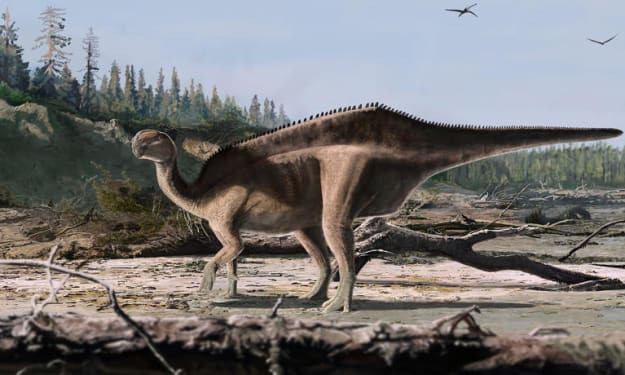
A Striking New Find Imagine walking along the Isle of Wight’s beaches in southern England and stumbling upon fossils from a creature that lived 125 million years ago. That’s exactly what happened with the discovery of Istiorachis macarthurae, a new species of dinosaur. What makes this herbivore special is a sail-like structure running along its back and tail a feature that has sparked excitement and debate among paleontologists. This dinosaur belongs to the iguanodontians, a group of plant-eating dinosaurs closely related to the well-known Iguanodon. Unlike most of its relatives, however, Istiorachis stands out with its exaggerated neural spines that formed the “sail.”
By Muzamil khan7 months ago in Futurism
Digital Signage in Education & Universities Market to Reach USD 5.48 Billion by 2034
The global digital signage in education and universities market is experiencing steady growth as educational institutions adopt advanced communication technologies across campuses. The market is projected to grow from USD 2.15 billion in 2024 to approximately USD 5.48 billion by 2034, reflecting a 9.8% CAGR during the forecast period. Digital signage systems are increasingly used in schools, colleges, and universities to display announcements, schedules, emergency alerts, and academic information.
By Roberto Crum3 days ago in Futurism
Education Cyber Security Market to Reach USD 365.10 Billion by 2034
The global education cyber security market is witnessing substantial growth as educational institutions increasingly rely on digital platforms, cloud infrastructure, and connected devices for teaching and administration. The market is projected to expand from USD 66.87 billion in 2024 to nearly USD 365.10 billion by 2034, reflecting a strong 18.5% CAGR during the forecast period. The rapid adoption of digital learning tools, remote education systems, and online student databases has increased the need for robust cyber security frameworks in the education sector.
By Roberto Crum3 days ago in Futurism
The BAFTA Awards
By now, in a stunning departure from recent years, most of the world is aware of what happened at the BAFTA film awards. Social Media Headlines will tell you the bare bones: that John Davidson, a Tourette's Syndrome advocate, shouted a racial slur at two Actors of Colour, Michael B Jordan and Delroy Lindo.
By Natasja Rose4 days ago in Psyche


Comments
There are no comments for this story
Be the first to respond and start the conversation.