
Mars Isn’t Plan B: Why Earth Stays More Livable — No Matter What
From breathable air to self-repairing ecosystems, Earth’s advantages dwarf even the most ambitious visions of Mars colonization

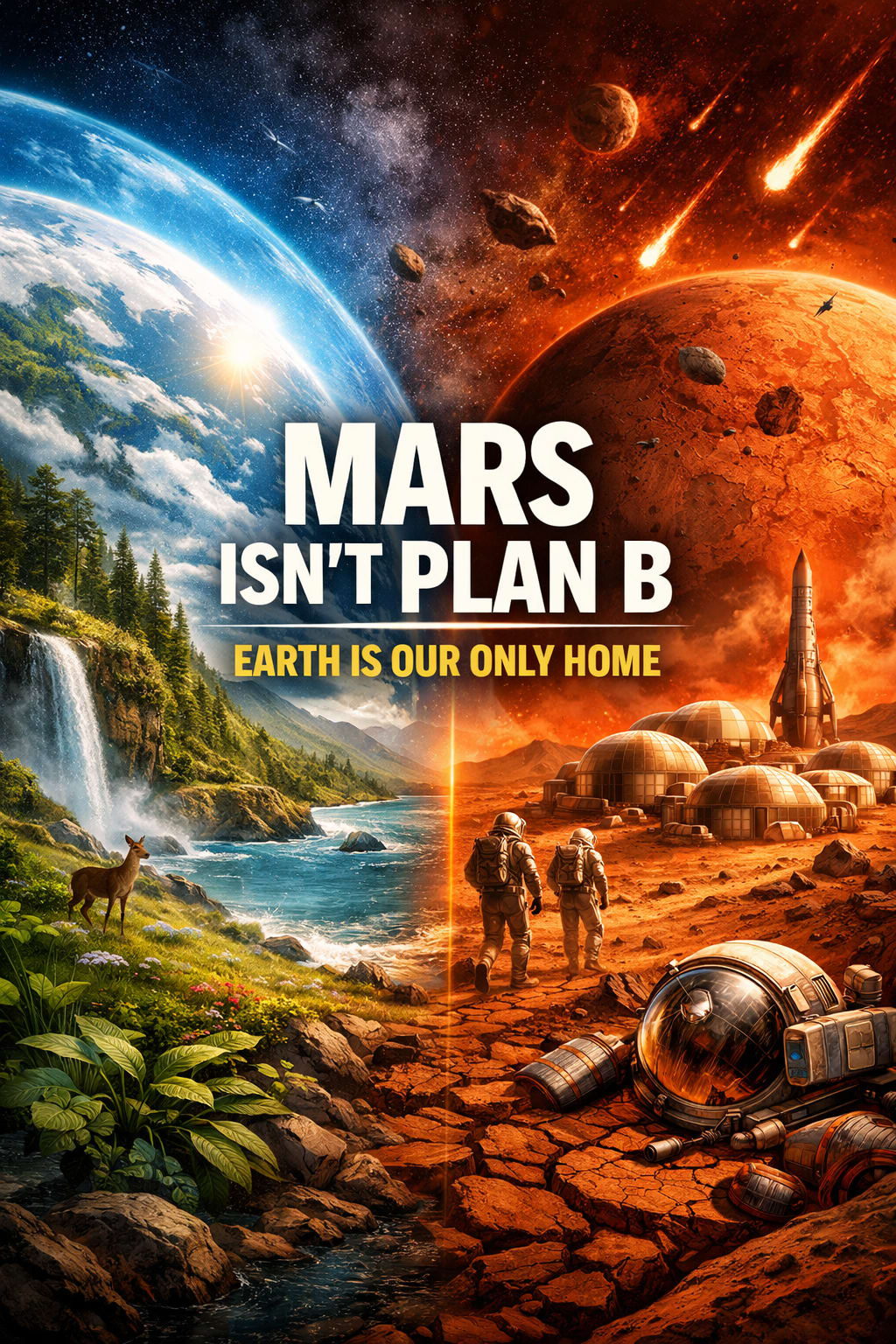
For decades, we’ve been sold a sleek, silver-lined dream: if things go south on Earth, we’ll simply pack our bags and move to the Red Planet. From billionaire-funded rocket launches to Hollywood blockbusters, the narrative is clear—Mars is humanity’s "Plan B." It’s our cosmic lifeboat in the event of climate collapse, nuclear war, or resource depletion.
But if you strip away the high-octane marketing and the science-fiction hype, a cold, hard reality remains: Mars is a death trap.
No matter how advanced our technology becomes, Earth is not just our home; it is a self-sustaining biological miracle that no amount of engineering can replicate. Mars isn't a backup plan—it's a scientific curiosity. Here is why Earth remains overwhelmingly more livable than any other world, and why we need to stop looking for an exit strategy.
1. Earth’s Natural Advantage: The Free Life-Support System
The most fundamental reason Earth is irreplaceable is that it provides for us "for free." We don't have to think about the air we breathe or the protection we receive from the stars.
- Breathable Atmosphere: Earth’s atmosphere has the perfect mix of nitrogen and oxygen. On Mars, the air is 95% carbon dioxide and 100 times thinner. Stepping outside on Mars without a suit wouldn't just be difficult; your blood would literally boil due to the lack of pressure.
- The Magnetic Shield: Earth has a molten iron core that generates a massive magnetic field. This shield deflects deadly solar radiation. Mars lost its magnetic field billions of years ago, leaving its surface bombarded by cosmic rays that shred human DNA and increase cancer risks to lethal levels.
- Gravity: We evolved in $1g$. Mars has only $38\%$ of Earth’s gravity. Long-term exposure to low gravity causes bone density loss, muscle atrophy, and cardiovascular issues. We don't yet know if a human fetus can even develop properly in Martian gravity.
2. The Terraforming Myth: Fantasy vs. Physics
Proponents of Mars colonization often point to "terraforming"—the process of transforming Mars into an Earth-like world by thickening its atmosphere and warming its surface. While it sounds great in a screenplay, the physics tell a different story.
Recent studies, including those backed by NASA, suggest that Mars simply doesn't have enough CO2 trapped in its rocks to create a significant greenhouse effect. Even if we could
nuking the ice caps (as some have suggested), the planet’s weak gravity means it would struggle to hold onto any new atmosphere we created.
On Earth, we have a stable climate system maintained by complex feedback loops involving oceans, forests, and plate tectonics. We are currently struggling to manage a $1.5°C$ change on a planet designed for life; the idea that we could successfully engineer a $-60°C$ frozen desert into a garden is, frankly, hubris.
3. Ecosystems: Our Hidden Superpower
Perhaps Earth’s greatest strength is its resilience. Our planet is a web of interconnected ecosystems.
• Forests regulate our air.
• Oceans act as a massive heat sink.
• Microorganisms in the soil recycle nutrients.
These systems are self-repairing. When a forest burns, it eventually regrows. When a reef is damaged, it can recover. On Mars, there are no ecosystems—only life-support machines.
In a Martian colony, every breath of air and drop of water would be the result of a mechanical process. If a pump fails, everyone dies. If a seal leaks, everyone dies. Living on Mars is like living in a submarine that you can never leave. There is no "nature" to fall back on; there is only the machine.
4. The Economics of Survival
The cost of keeping a single human alive on Mars is staggering. Transporting equipment, food, and specialized shielding across tens of millions of kilometers means that every kilogram of cargo costs more than its weight in gold.
If we invested even 10% of the resources required for a Mars colony into Earth’s "Plan A," we could:
1. Achieve global carbon neutrality.
2. Desalinate enough water to end droughts.
3. Restore the Amazon rainforest.
4. Transition the entire planet to 100% renewable energy.
Preventing environmental collapse on Earth is not just more practical; it is infinitely cheaper and more humane than trying to build a dome-city on a frozen rock.
5. The Psychological Toll of the Red Void
We often forget that humans are biological creatures tied to Earth’s rhythms. Our circadian rhythms are tuned to a 24-hour day. Our mental health is tied to the sight of green trees, the sound of rain, and the vastness of an open blue sky.
Life on Mars would be a life of extreme confinement. You would live in windowless, radiation-shielded bunkers. You would eat lab-grown protein and recycled waste. You would be millions of miles away from every sunset, every ocean wave, and every person you’ve ever known. The "Plan B" dream often ignores the reality of the human soul, which was not built for the sterile, claustrophobic silence of space.
Why Mars Still Matters (As a Frontier, Not a Lifeboat)
None of this is to say we shouldn't go to Mars. Exploration is vital. Studying Mars helps us understand:
• The history of our solar system.
• How climates can fail (a cautionary tale for Earth).
• The fundamental question: "Are we alone?"
But we must distinguish between exploration and evacuation. Mars is a laboratory, a magnificent desert where we can push the boundaries of science. It is not, and will never be, a replacement for the lush, breathing world we already have.
The Real Plan A
The danger of the "Plan B" narrative is that it encourages complacency. If we believe there is a backup planet waiting for us, we might be less inclined to fight for the one we have.
There is no "Planet B." There is no silver rocket that will save us from the consequences of our choices here. Earth’s atmosphere, gravity, and ecosystems are a gift four billion years in the making. The future of humanity doesn't lie in escaping Earth—it lies in finally learning how to live on it.
About the Creator
Adil Ali Khan
I’m a passionate writer who loves exploring trending news topics, sharing insights, and keeping readers updated on what’s happening around the world.
Keep reading
More stories from Adil Ali Khan and writers in Futurism and other communities.
Scientists May Have Found an Exoplanet Colder Than Mars — Here’s What That Means
Astronomers may have identified one of the coldest planets ever detected beyond our solar system. Early observations suggest a possible new exoplanet with surface temperatures even lower than those on Mars, the famously frozen Red Planet. While the discovery is still awaiting confirmation, scientists believe this distant world could expand our understanding of how planets form, evolve, and survive in extreme environments.
By Adil Ali Khan5 days ago in Futurism
Inhalation Anesthesia Market Analysis: Hospital Demand & Revenue Forecast
According to IMARC Group's latest research publication, the global inhalation anesthesia market size reached USD 1.68 Billion in 2024. Looking forward, IMARC Group expects the market to reach USD 2.20 Billion by 2033, exhibiting a growth rate (CAGR) of 2.75% during 2025-2033.
By sujeet. imarcgroup7 days ago in Futurism
Fundus Camera Market Size & Forecast 2026–2034
Introduction The global healthcare landscape is witnessing a profound transformation driven by digital technologies, preventive care models, and an increasing focus on early diagnosis. Among the many diagnostic tools shaping modern ophthalmology, the fundus camera has emerged as one of the most critical instruments for detecting, monitoring, and managing retinal diseases. From diabetic retinopathy and glaucoma to macular degeneration and hypertensive retinopathy, fundus cameras play a central role in safeguarding vision and preventing avoidable blindness.
By Sakshi Sharma7 days ago in Futurism


Comments
There are no comments for this story
Be the first to respond and start the conversation.