
How Religions Explained the Cosmos Before Telescopes: Myths, Dogmas, and Celestial Mysteries
Space

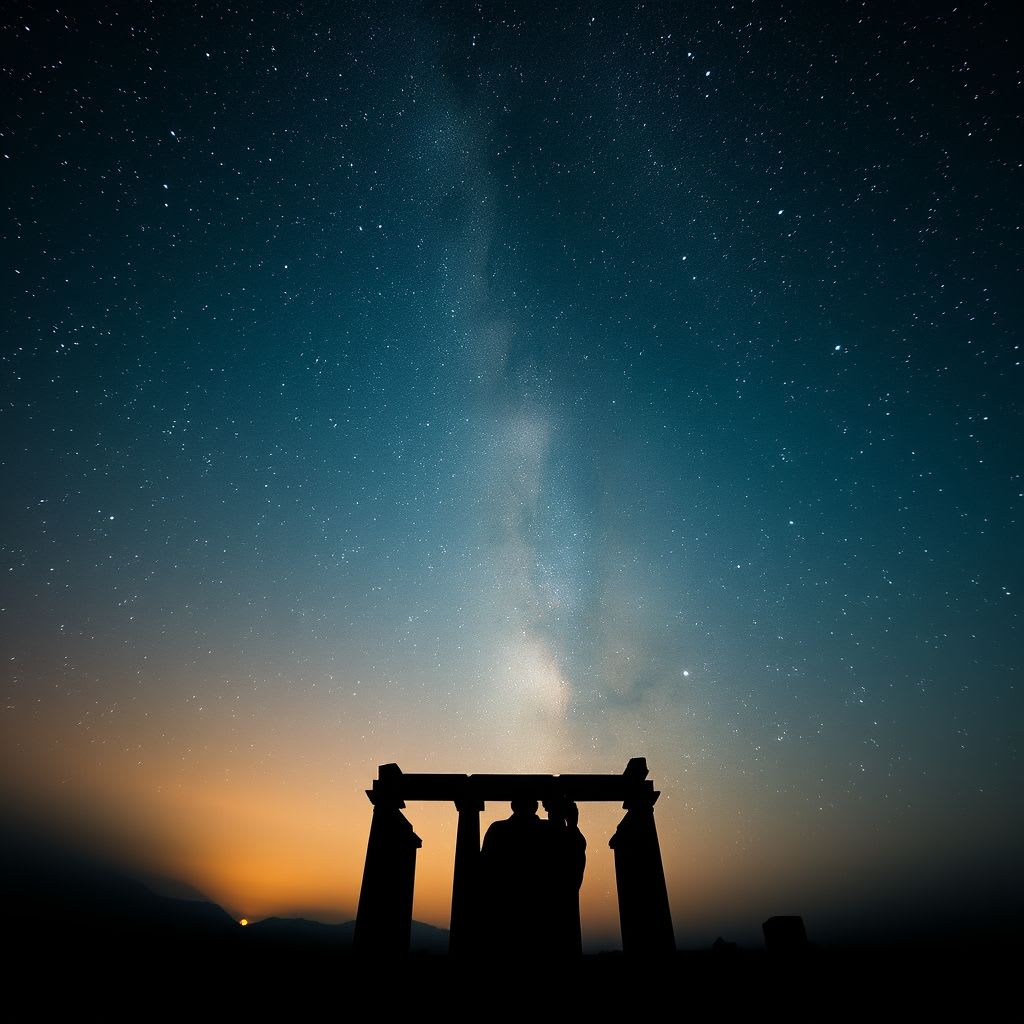
Long before telescopes, satellites, and astrophysics offered us a glimpse into the true nature of the universe, humanity gazed at the night sky with a mixture of awe and fear. Stars, planets, comets, and the Moon weren’t just distant objects they were divine symbols, messages from the heavens, and pieces of a grand spiritual puzzle. In nearly every culture, the cosmos was explained through the lens of religion and mythology. So how exactly did people understand the universe before science took its first real look through a lens?
A Divine Design: The Universe as God’s Creation
For thousands of years, the night sky was interpreted as the work of gods or a single omnipotent deity. Without tools to measure distance or understand planetary motion, ancient people turned to faith for answers.
In monotheistic religions like Christianity and Islam, the universe was believed to be crafted by God with a clear purpose. Every celestial event a meteor shower, a lunar eclipse, or the slow dance of the planets was thought to carry divine meaning. These occurrences were not just natural phenomena; they were signs, warnings, or messages from the Creator.
Earth at the Center: Geocentrism as Religious Truth
In most ancient belief systems, Earth was seen as the unmoving center of the universe. The concept of geocentrism that everything in the cosmos revolved around our planet was widely accepted and deeply tied to religious teachings.
In medieval Christian Europe, this idea was strongly supported by interpretations of the Bible and the ancient works of Ptolemy. According to this view, Earth sat still while the Sun, Moon, and stars orbited it in perfect, divine harmony. This wasn't just science it was sacred doctrine. Any suggestion otherwise was considered heresy, famously leading to conflicts with early astronomers like Galileo.
Similarly, in early Islamic thought, the geocentric model dominated. However, Islamic scholars like Al-Biruni and Ibn Sina (Avicenna) began to question this view centuries before the invention of the telescope, laying the groundwork for a more scientific approach.
The Heavens as a Realm of Gods
In ancient Greece, the sky was believed to be the domain of the Olympian gods. Each constellation was tied to a myth Hercules, Andromeda, Perseus giving the stars a narrative function. The heavens weren’t just a backdrop; they were an active stage where gods lived, fought, and loved.
Hinduism presents an even more intricate cosmic model. The universe is a vast cycle of creation and destruction, governed by gods like Brahma, Vishnu, and Shiva. The Vedas describe multiple layers of reality lokas stacked upon each other like levels of a cosmic cake. These realms include divine worlds, human planes, and even underworlds, all part of a vast spiritual system.
In ancient Egypt, the goddess Nut was believed to stretch across the sky, her body forming the vault of heaven. Each night she swallowed the Sun, only to give birth to it again at dawn. Time itself was seen as a divine rhythm, with cosmic bodies moving to the beat of sacred cycles.
Comets and Eclipses: Omens of Doom
Without an understanding of physics or astronomy, unexpected celestial events were deeply unsettling. Comets, eclipses, and meteors were often viewed as ominous signs from the gods.
In ancient China, comets were considered “heavenly brooms,” sweeping away the old order and heralding great change often disaster. Court astrologers recorded them meticulously, believing they foretold the fate of emperors and empires.
In Christian Europe, solar eclipses were frequently interpreted as expressions of divine anger or the foreshadowing of calamity. For the Aztecs, eclipses were terrifying reminders that the Sun whom they believed needed human blood to survive might disappear forever unless properly appeased.
Astrology: Where Faith and Observation Merged
Before astronomy became a science, astrology was a sacred discipline. In ancient Mesopotamia, priests observed the stars not for curiosity, but for guidance. The movement of planets and constellations was believed to mirror the will of the gods and provide insight into human affairs from harvests to warfare.
Astrology wasn’t just mysticism; it was political and spiritual strategy. Emperors, pharaohs, and kings made decisions based on the stars. This celestial interpretation of divine will blurred the line between science and faith for centuries.
Conclusion: Myths as the First Maps of the Stars
Before telescopes, religion and myth gave people a way to make sense of the vast unknown above them. These explanations weren’t just about the heavens they helped define humanity’s place in the universe. They brought order, meaning, and a sense of belonging in a cosmos that could otherwise feel overwhelming.
Today, we know that stars are massive spheres of burning gas, that Earth orbits the Sun, and that the universe is unimaginably vast. Yet the ancient desire to understand the skies lives on. The myths and beliefs of our ancestors may not hold scientific truth, but they were our first steps toward understanding a cosmos that still inspires wonder.
About the Creator
Keep reading
More stories from Holianyk Ihor and writers in Futurism and other communities.
What Would You See If You Could Travel Faster Than Light?
An Imaginative Journey Beyond the Boundaries of Physics The speed of light isn’t just fast it’s the cosmic speed limit. According to Albert Einstein’s theory of special relativity, nothing with mass can reach or exceed the speed of light in a vacuum (about 299,792 km/s). But what if we suspend the rules for a moment? What if faster-than-light (FTL) travel were possible? What would we see as we crossed that ultimate frontier?
By Holianyk Ihor6 months ago in Futurism
About Binding Prometheus
I want to start actively advocating on behalf of my own work, and the most valuable part of my canon is, without a doubt, Binding Prometheus, the play I have been working on since 2019 and only finished in 2023 as part of my MA. The play itself is an amalgamation of a million different inspirations. On one end, it evokes the Ancient Greek myth-play, deriving its own title from the earliest extant work of Western drama we have, Aeschylus’s Prometheus Bound. On the other end, it borrows significantly from the sci-fi bulwarks from over the years, namely Mary Shelley’s Frankenstein and Karel Capek’s Rossum’s Universal Robots. The play could be an episode of Black Mirror, I fear. I don’t know. I’ve only ever seen one episode of Black Mirror.
By Steven Christopher McKnight17 days ago in Futurism


Comments
There are no comments for this story
Be the first to respond and start the conversation.