
What Would You See If You Could Travel Faster Than Light?
Space

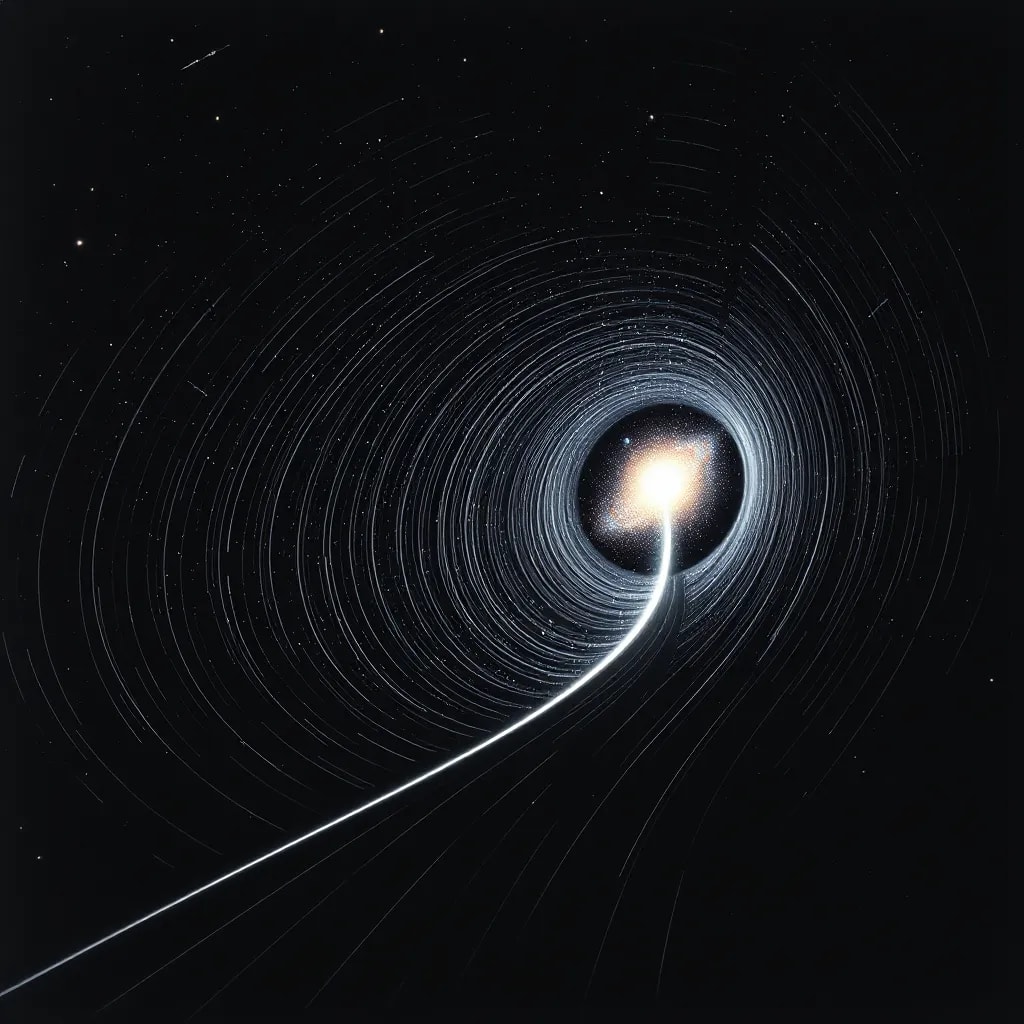
An Imaginative Journey Beyond the Boundaries of Physics
The speed of light isn’t just fast it’s the cosmic speed limit. According to Albert Einstein’s theory of special relativity, nothing with mass can reach or exceed the speed of light in a vacuum (about 299,792 km/s). But what if we suspend the rules for a moment? What if faster-than-light (FTL) travel were possible? What would we see as we crossed that ultimate frontier?
Let’s dive into a thought experiment where science brushes up against the wild world of imagination.
Time Reversed: Watching the Universe Rewind
One of the strangest theoretical consequences of breaking the light-speed barrier is the reversal of time. As an object approaches the speed of light, time slows down from the perspective of an outside observer. But if you somehow go beyond that speed into the forbidden realm of FTL some interpretations of physics suggest that time could start moving backward.
Imagine flying through space and seeing the universe rewind. Stars that exploded long ago would “unexplode,” shrinking back into brilliant orbs. Gaseous nebulae would collapse into dense points, forming stars in reverse. Supernovae would contract into dying stars, then into their youthful prime all unfolding like a cosmic film reel running in reverse.
The Blazing Light Trail of the Cosmos
At light speed, photons the particles of light travel alongside you. But if you surpass light speed, you leave them behind. The light from stars ahead of you becomes invisible because you’ve outrun it. That means, paradoxically, you might see nothing at all in front of you.
However, behind you, the opposite happens: all the light you’ve passed piles up. It forms a radiant, perhaps overwhelming, trail of photons the cumulative light from galaxies, stars, and ancient cosmic events you’ve left behind. It’s like surfing the breaking wave of history one that glows with the brilliance of a million suns compressed into a blinding wall of light.
A Star’s Lifetime in One Glance
In our everyday experience, we see distant stars as they were in the past, because their light takes time to reach us. But if you're moving faster than light, your perspective warps in ways we can hardly imagine.
You might see different epochs of a single star simultaneously. To your left, a star is just being born. Turn slightly, and it appears as a mature sun. Glance behind you, and you witness its violent death in a supernova explosion all in the same moment.
This temporal layering would be like flipping through a star’s biography with a single blink, watching its full life play out depending on your angle and position.
A Tunnel Through Distorted Space
FTL travel wouldn’t just distort time it would bend space as well. The fabric of the universe might compress in front of you and stretch behind, creating a visual effect that’s difficult to describe.
Stars and galaxies ahead might appear squashed, twisted into bizarre streaks or arcs, while those behind you seem to fade into stretched-out spirals of light. The cosmos could take on the shape of a tunnel compressed at the center and infinitely elongated at the edges like flying through a kaleidoscope of warped geometry.
A Glimpse Into the Beginning of Time?
Some physicists and sci-fi theorists suggest that if you could travel fast enough, you might actually outrun the expansion of the universe and peer into the early moments of the cosmos perhaps even witness echoes of the Big Bang.
The idea is purely hypothetical, of course, but thrilling to consider: watching matter form, seeing the primordial soup of particles coalesce, witnessing the birth of time and space themselves. In theory, FTL travel could offer a time machine in reverse a ride back to the first flicker of existence.
What About You, the Traveler?
If someone were to move faster than light, what would they look like to the rest of us?
From an outside perspective, they might vanish or appear in multiple places at once, like a quantum echo. Signals, messages, and even light couldn’t catch up with them, so communication would become impossible. They might exist outside the realm of cause and effect, lost in a space where even time can't follow.
And from their perspective? They could find themselves entirely alone, surrounded by nothing but darkness in one direction, and the glowing past of the universe chasing them from behind.
Final Thoughts: The Beauty of the Impossible
Right now, faster-than-light travel violates the known laws of physics. But imagining it playing with the "what ifs" invites us to think differently about time, reality, and our place in the universe.
Maybe one day, humanity will discover workarounds: warping space (as in wormholes), folding dimensions, or harnessing quantum weirdness to travel without actually moving. Until then, our dreams remain unbound.
So, the next time you gaze up at the stars, remember you’re already looking into the past. And if we ever find a way to travel faster than light, we might not just reach other stars… we might unlock the deepest secrets of time itself.
About the Creator
Keep reading
More stories from Holianyk Ihor and writers in Futurism and other communities.
Why Do Astronauts Take Spoons but Not Knives into Space?
Strange but true facts about everyday life in orbit When we imagine an astronaut floating through the International Space Station (ISS), we might picture futuristic gadgets, floating food packets, and tools for eating in microgravity. But here’s a curious fact: astronauts always have spoons but hardly ever bring knives. Why? The answer reveals a lot about how different life in space really is.
By Holianyk Ihor6 months ago in Futurism
About Binding Prometheus
I want to start actively advocating on behalf of my own work, and the most valuable part of my canon is, without a doubt, Binding Prometheus, the play I have been working on since 2019 and only finished in 2023 as part of my MA. The play itself is an amalgamation of a million different inspirations. On one end, it evokes the Ancient Greek myth-play, deriving its own title from the earliest extant work of Western drama we have, Aeschylus’s Prometheus Bound. On the other end, it borrows significantly from the sci-fi bulwarks from over the years, namely Mary Shelley’s Frankenstein and Karel Capek’s Rossum’s Universal Robots. The play could be an episode of Black Mirror, I fear. I don’t know. I’ve only ever seen one episode of Black Mirror.
By Steven Christopher McKnight19 days ago in Futurism
Home Shopping Market: Convenience-Led Retail & Growth Outlook
According to IMARC Group's latest research publication, The global home shopping market size was valued at USD 4,598.70 Billion in 2024. Looking forward, IMARC Group estimates the market to reach USD 12,791.25 Billion by 2033, exhibiting a CAGR of 11.44% during 2025-2033.
By James Whitman5 days ago in Futurism
How, Too
Many people wonder how, too. You are not alone, and I am an expert. I will teach you how, too! First, you need to remit a small application fee and fill out an application describing the nature of your financial situation and how often payments will be made, as this will have great bearing on how well I teach you how, too.
By Harper Lewis3 days ago in Fiction




Comments
There are no comments for this story
Be the first to respond and start the conversation.