
France Toys Market Size and Forecast 2025–2033: How Innovation, Sustainability, and Digital Play Are Reshaping Childhood
From Wooden Blocks to Smart Toys, France’s Toy Industry Enters a New Era of Growth

France Toys Market Overview
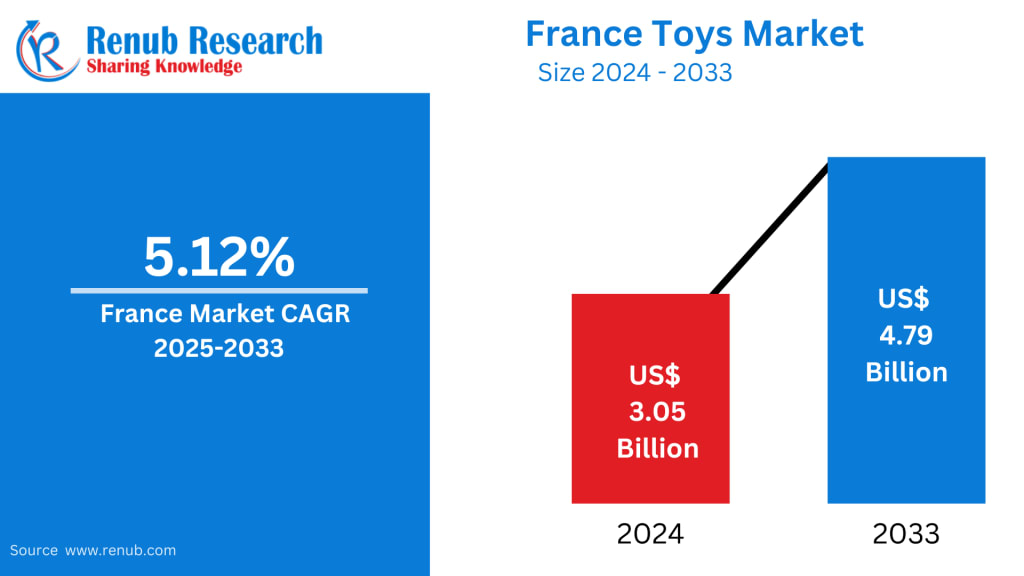
The toys market in France is undergoing a dynamic transformation, blending tradition with innovation as evolving consumer preferences reshape how children play and learn. According to Renub Research, the France Toys Market is expected to grow from US$ 3.05 billion in 2024 to US$ 4.79 billion by 2033, registering a CAGR of 5.12% during the forecast period (2025–2033). This steady expansion reflects a combination of rising disposable incomes, increasing demand for educational and interactive toys, growing online sales, and a strong national focus on sustainability and eco-friendly products.
France has long been one of Europe’s most influential toy markets, with a rich legacy of craftsmanship, creativity, and storytelling. Today, the market is more diversified than ever. It spans traditional toys like dolls, board games, and puzzles, alongside high-tech interactive toys, STEM-based learning products, and app-connected play systems. As French parents increasingly view toys as tools for development rather than simple entertainment, the industry is evolving to meet new expectations.
Another powerful force driving market growth is the rise of digital commerce. Online shopping platforms have expanded consumer choice, improved price transparency, and made niche or educational toys more accessible. Seasonal peaks such as Christmas, Easter, and back-to-school periods continue to account for a large share of annual toy sales, but e-commerce has turned toy purchasing into a year-round activity rather than a purely festive one.
With more than 723,000 births recorded in 2022 and children aged 0–14 accounting for 17.2% of France’s population, demographic fundamentals remain strong. Combined with rising awareness around child development, sustainability, and learning, these factors position the French toy market for long-term growth.
France Toys Market Size and Forecast (2025–2033)
Renub Research forecasts a robust expansion of the French toy industry over the next decade:
Market size 2024: US$ 3.05 billion
Projected market size 2033: US$ 4.79 billion
CAGR (2025–2033): 5.12%
This growth trajectory is supported by multiple structural changes in consumer behavior. French families are spending more on premium, high-quality toys that offer educational value, longevity, and ethical production. At the same time, the industry is benefiting from innovation in materials, digital integration, and licensing partnerships with global entertainment franchises.
Key Growth Drivers of the France Toys Market
1. Rising Demand for Educational and STEM Toys
One of the most powerful drivers of market expansion is the growing preference for educational toys. French parents are increasingly seeking toys that combine fun with learning, especially during early childhood. Toys designed to enhance cognitive, emotional, social, and motor skills are in high demand, reflecting broader trends in early education and skill development.
STEM toys—focused on science, technology, engineering, and mathematics—have seen particularly strong growth. These products encourage problem-solving, creativity, logical reasoning, and curiosity, helping children build foundational skills for future academic success. Robotics kits, construction models, coding toys, and science experiment sets are no longer niche products; they are becoming mainstream in French households.
This shift is redefining the toy market from a leisure-focused industry to one closely linked with education and development, opening new opportunities for manufacturers and retailers.
2. Growing Popularity of Eco-Friendly and Sustainable Toys
Sustainability has become a defining trend in France’s consumer markets, and toys are no exception. Parents are increasingly choosing products that align with their environmental values, especially for young children. This has fueled demand for wooden toys, organic textiles, recycled plastics, and biodegradable materials.
French consumers are also paying closer attention to ethical manufacturing practices, product safety, and durability. Toys that last longer, can be reused, or passed on to siblings are seen as more responsible purchases. As a result, manufacturers are investing in greener production processes, sustainable packaging, and transparent sourcing.
This eco-conscious shift is not just a trend but a long-term transformation that is reshaping product design and branding strategies across the toy industry.
3. Seasonal and Event-Based Demand Boosts Sales
The French toy market continues to benefit from strong seasonal demand. Christmas remains the single largest sales period, followed by Easter and the back-to-school season. During these times, retailers roll out aggressive promotions, discounts, and bundled offers, encouraging higher consumer spending.
Seasonal peaks are also crucial for launching new toys and testing market response to innovative products. Many manufacturers plan their entire annual strategies around these high-demand windows, making them central to overall market growth.
4. Expansion of E-commerce and Online Toy Sales
Online sales channels have become a major growth engine for the French toy industry. Parents increasingly prefer the convenience of online shopping, where they can compare prices, read reviews, and access a wider variety of products than in physical stores.
E-commerce platforms also allow smaller or specialized toy brands to reach national and international audiences without heavy investment in physical retail. This has led to greater product diversity and stronger competition, benefiting consumers while accelerating market expansion.
Challenges in the France Toys Market
1. Increasing Competition and Price Pressure
The French toy market is highly competitive, with both domestic and international brands vying for consumer attention. Global giants like Mattel, Hasbro, and LEGO compete with European specialists and emerging eco-friendly brands, creating intense pressure on pricing and margins.
Retailers often rely on discounts to attract customers, especially during seasonal peaks, which can squeeze profitability. Smaller companies may struggle to compete with well-established brands that have stronger marketing budgets and distribution networks.
2. Shifting Consumer Preferences Toward Digital Entertainment
Traditional toys face growing competition from digital entertainment such as mobile games, apps, streaming platforms, and interactive screens. Older children, in particular, are spending more time on digital devices, reducing the time spent with physical toys.
To adapt, toy manufacturers are integrating technology into their products—developing app-connected toys, augmented reality (AR) experiences, and hybrid digital-physical play systems. While this creates new opportunities, it also raises development costs and complexity.
France Toys Market Segmentation
By Toy Type
The French toy market is segmented into eight major categories:
Action Figures: Driven by licensed characters from movies, TV series, and gaming franchises
Board Games: A strong category in France, supported by family-oriented play culture
Card Games: Popular among both children and adults for social play
Construction Sets & Models: Includes building blocks, STEM kits, and creative modeling toys
Dolls & Stuffed Toys: A timeless segment with consistent demand
Plastic & Other Toys: Covers a wide range of everyday play items
Puzzles: Growing in popularity due to cognitive development benefits
Toys for Toddlers & Kids: Focused on early learning and motor skills
Educational and construction-based toys are among the fastest-growing segments, reflecting the market’s shift toward learning-driven play.
By Sales Channel
The market is distributed across five major sales channels:
Hypermarkets
Supermarkets
Toy Specialists
Multi-Specialists
Others (including online platforms and independent retailers)
While physical retail remains important for gift purchases and seasonal sales, online channels are the fastest-growing, driven by convenience and wider product availability.
Company Landscape and Competitive Analysis
France’s toy market is home to a mix of global leaders and European specialists. Key companies covered in the market include:
Mattel Inc.
Hasbro, Inc.
LEGO
Ravensburger
Spin Master Corp.
VTech
Clementoni
Thames & Kosmos
Simba Dickie Group
HABA Sales GmbH & Co. KG
These companies compete across four key dimensions: product innovation, brand recognition, distribution strength, and sustainability efforts. Many are investing heavily in educational content, digital integration, and eco-friendly materials to stay ahead in an increasingly discerning market.
Licensing remains a major growth strategy, with toys based on popular entertainment franchises continuing to drive strong sales among children and collectors alike.
Future Outlook: What Lies Ahead for the France Toys Market
Looking ahead, the French toy industry is poised for steady and sustainable growth. The market’s future will be shaped by three dominant forces: education, sustainability, and digital integration. Toys that successfully combine these elements will be best positioned to capture consumer attention and market share.
Manufacturers that focus on ethical production, innovation, and child development will gain long-term trust from French families. At the same time, e-commerce and digital marketing will continue to reshape how toys are discovered and purchased.
As children’s play habits evolve and parents become more selective, the France toys market is transforming from a traditional consumer sector into a knowledge-driven, values-oriented industry.
Final Thoughts
The France Toys Market is entering a golden phase of evolution. With market value projected to reach US$ 4.79 billion by 2033, the industry is being redefined by innovation, learning, and sustainability. Educational toys are becoming essential tools for childhood development, while eco-friendly products are reshaping production and purchasing decisions.
Despite challenges from digital entertainment and intense competition, the sector’s adaptability ensures long-term resilience. For manufacturers, retailers, and investors alike, France’s toy market offers a compelling blend of stability and opportunity—one where creativity, responsibility, and technology converge to shape the future of play.
About the Creator
jaiklin Fanandish
Jaiklin Fanandish, a passionate storyteller with 10 years of experience, crafts engaging narratives that blend creativity, emotion, and imagination to inspire and connect with readers worldwide.
Keep reading
More stories from jaiklin Fanandish and writers in Futurism and other communities.
Formulation Development Outsourcing Market Size and Forecast 2025–2033
Introduction: A Structural Shift in Drug Development The global pharmaceutical industry is undergoing a profound transformation. As drug formulations become more complex and regulatory scrutiny intensifies, pharmaceutical and biotechnology companies are increasingly turning to external specialists to manage critical formulation development activities. This shift has positioned outsourcing not just as a cost-saving measure, but as a strategic necessity for accelerating innovation and improving drug quality.
By jaiklin Fanandish3 days ago in Futurism
About Binding Prometheus
I want to start actively advocating on behalf of my own work, and the most valuable part of my canon is, without a doubt, Binding Prometheus, the play I have been working on since 2019 and only finished in 2023 as part of my MA. The play itself is an amalgamation of a million different inspirations. On one end, it evokes the Ancient Greek myth-play, deriving its own title from the earliest extant work of Western drama we have, Aeschylus’s Prometheus Bound. On the other end, it borrows significantly from the sci-fi bulwarks from over the years, namely Mary Shelley’s Frankenstein and Karel Capek’s Rossum’s Universal Robots. The play could be an episode of Black Mirror, I fear. I don’t know. I’ve only ever seen one episode of Black Mirror.
By Steven Christopher McKnight23 days ago in Futurism
Another New Hope, Nope
Abstract In the Star Wars saga the Old Republic maintained peace without strong centralised rule for thousands of years, yet ultimately collapsed not because of a lack of ideals but because of corruption, inflation and financial capture. Over the long arc of galactic history, whoever controls money controls the galaxy. A New Jedi Order that ignores the power of the Banking Clan is structurally doomed, regardless of its moral aspirations. This article argues that Rey’s project, as imagined in the 2026 narrative horizon, cannot survive as a purely compassionate, decentralised pedagogical movement. If the new Jedi are to build a durable peace, they will be forced into alliances that lead them towards the ‘grey’ side of the Force. Rey’s realistic options narrow to two archaic yet resilient traditions: the Mandalorian creed, embodied by Grogu, and the matriarchal religion of the Witches of Dathomir. In a parallel to the Bene Gesserit in Dune, the text explores the provocative thesis that Rey’s only viable solution is not the restoration of monastic celibacy, but the creation of a hereditary aristocracy of Force users. Blood, not intentions, has always structured power in the galaxy. Luke was the son of a queen; Rey is the heir of Palpatine. ‘New Hope’ thus ceases to mean moral rebirth and comes to signify newborns, bloodlines and dynasties. The ultimate irony is that the House of Palpatine–Skywalker may be the only institution capable of surviving a millennium. Palpatine may have lost the war, but his principle – that blood outlives ideals – may yet rule for eternity.
By Peter Ayolov7 days ago in Futurism
How, Too
Many people wonder how, too. You are not alone, and I am an expert. I will teach you how, too! First, you need to remit a small application fee and fill out an application describing the nature of your financial situation and how often payments will be made, as this will have great bearing on how well I teach you how, too.
By Harper Lewis7 days ago in Fiction



Comments
There are no comments for this story
Be the first to respond and start the conversation.