
Another New Hope, Nope
Bloodlines, Banks, and the End of Jedi Innocence

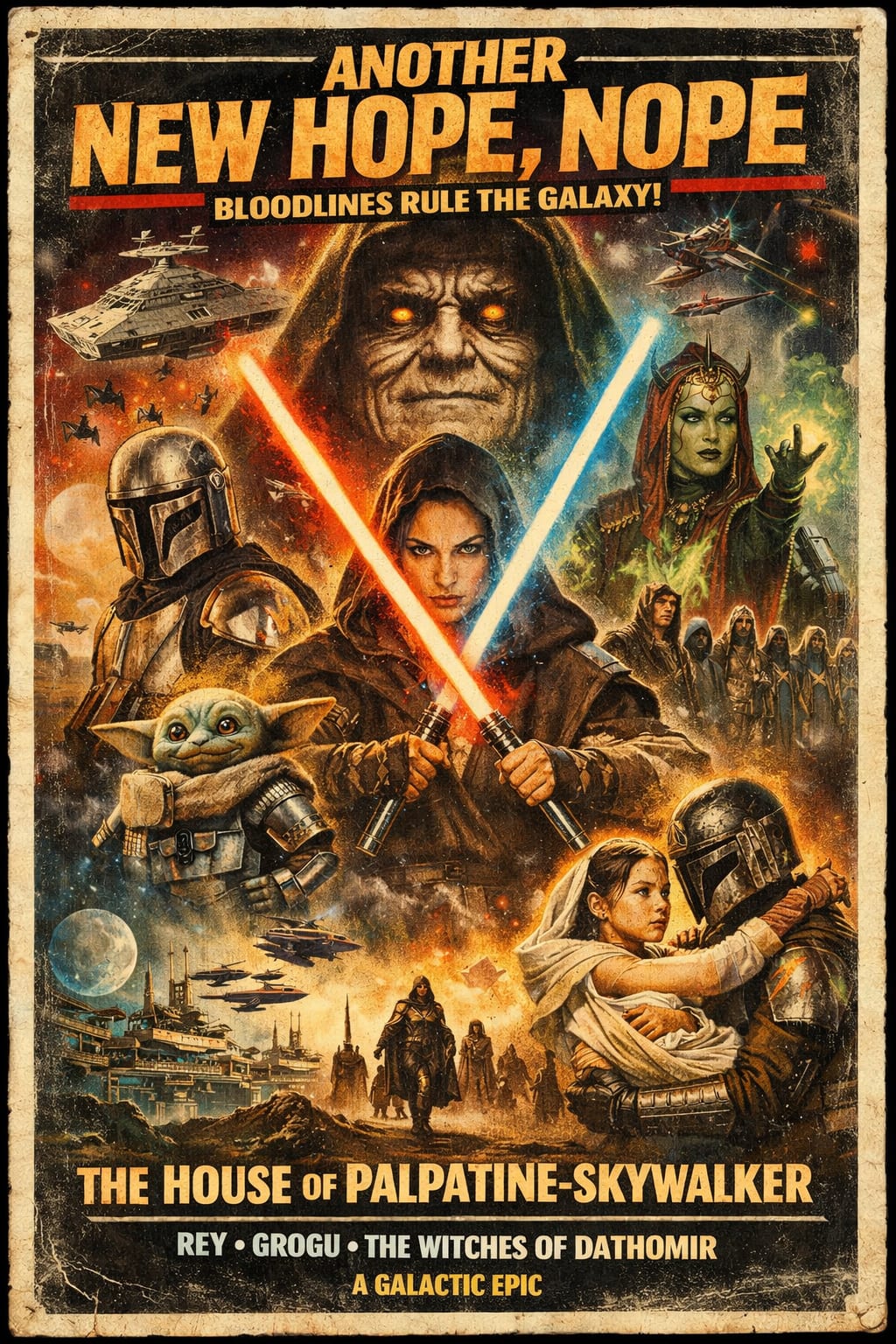
Abstract
In the Star Wars saga the Old Republic maintained peace without strong centralised rule for thousands of years, yet ultimately collapsed not because of a lack of ideals but because of corruption, inflation and financial capture. Over the long arc of galactic history, whoever controls money controls the galaxy. A New Jedi Order that ignores the power of the Banking Clan is structurally doomed, regardless of its moral aspirations. This article argues that Rey’s project, as imagined in the 2026 narrative horizon, cannot survive as a purely compassionate, decentralised pedagogical movement. If the new Jedi are to build a durable peace, they will be forced into alliances that lead them towards the ‘grey’ side of the Force. Rey’s realistic options narrow to two archaic yet resilient traditions: the Mandalorian creed, embodied by Grogu, and the matriarchal religion of the Witches of Dathomir. In a parallel to the Bene Gesserit in Dune, the text explores the provocative thesis that Rey’s only viable solution is not the restoration of monastic celibacy, but the creation of a hereditary aristocracy of Force users. Blood, not intentions, has always structured power in the galaxy. Luke was the son of a queen; Rey is the heir of Palpatine. ‘New Hope’ thus ceases to mean moral rebirth and comes to signify newborns, bloodlines and dynasties. The ultimate irony is that the House of Palpatine–Skywalker may be the only institution capable of surviving a millennium. Palpatine may have lost the war, but his principle – that blood outlives ideals – may yet rule for eternity.
Key words
Rey, New Jedi Order, bloodlines, InterGalactic Banking Clan, Mandalorians, Grogu, Witches of Dathomir, aristocracy, corruption, Palpatine legacy, power and money.
Introduction
In the Star Wars timeline as it stands in 2026, Rey’s stated goal in the forthcoming New Jedi Order film is to build a renewed Jedi movement that learns from the failures of the Old Republic rather than merely reproducing its institutional template. Set fifteen years after The Rise of Skywalker, her mission is framed as an attempt to heal the galaxy rather than to police it, to mentor rather than to govern.
This new philosophy is designed as a break with the Old Republic’s council culture. Having studied the ancient Jedi texts and absorbed Luke Skywalker’s disillusionment, Rey is meant to avoid the hubris, political entanglement and emotional detachment that allowed the Sith to infiltrate the Republic from within. The training of figures such as Finn is reported to focus on personal purpose rather than military utility, while the new Order is rumoured to adopt a more holistic understanding of balance in the Force, abandoning the rigid dispassion that destroyed Anakin and Ben Solo. Most importantly, Rey’s Jedi are supposed to remain independent from galactic politics, refusing the role of Senate enforcers that once made the Order so easily manipulated by Palpatine.
The core conflict of the upcoming film, directed by Sharmeen Obaid-Chinoy, is thus framed as the struggle of a Master attempting to rebuild amid disarray, threatened by rising powers and haunted by a legacy of institutional failure. Rey seeks to honour her promise to Luke that the Jedi will not end, but she must create a new dawn capable of surviving in a galaxy that no longer trusts saviours.
Bloodlines and Good Intentions
In the 2026 understanding of the saga, the philosophical tension surrounding Rey centres on the relationship between blood and choice. Canon insists that her success repudiates Palpatine’s vision: she carries his blood but rejects his ideology. By choosing the name Skywalker, she symbolically replaces genetic destiny with ethical inheritance. If she builds a stable galaxy, it appears at first glance to be the final defeat of the Sith.
Yet this victory is paradoxical. If her bloodline endures and stabilises galactic order, then Palpatine’s project of dynastic continuity has in fact succeeded biologically, even if it has failed spiritually. The rhetoric of choice masks the deeper continuity of aristocracy. Rey is framed as a teacher, not a ruler, but peace built through her lineage may still validate the logic of hereditary power.
The film is already rumoured to introduce a formidable and enigmatic threat, perhaps the Voidsworn, that tests the limits of compassion. Rey does not seek absolute rule; she provides tools for others to defend themselves. Yet her grandfather wanted his blood to survive as a vessel for his own will. Rey’s freedom thus becomes his ultimate failure, even as her existence preserves his genetic triumph.
The Survival of Corruption
The 2026 landscape foregrounds a brutal truth: corruption does not die with regimes. The InterGalactic Banking Clan has resurfaced at economic summits on worlds such as Lenupa, following imperial nationalisation and post-war fragmentation. Regardless of ideology, the galaxy still requires credit, liquidity and financial infrastructure. The New Jedi Order must therefore operate in an environment where corrupt financial entities may be funding the very rising powers that oppose Rey’s reconstruction.
Alongside this institutional resilience stands Grogu, a living refutation of Jedi orthodoxy. Now Din Grogu, adopted son of Din Djarin, he has explicitly rejected Luke’s celibate path in favour of Mandalorian attachment. His Force sensitivity remains, but it is now expressed through armour, loyalty and combat rather than meditation. At approximately ninety years old in Rey’s era, Grogu represents a Force heir who values family and warriorship above monastic peace. Rumours suggest his future encounter with Rey will crystallise a new paradigm: Force users as tribal protectors rather than galactic saviours.
Rey’s vision is thus challenged by internal disarray, political cynicism and a resurgent darkness. Lucasfilm markets her openness to attachment as wisdom learned from Luke’s failures, but the narrative tension is clear: idealism alone cannot dissolve banking cartels or criminal syndicates.
The Obsolescence of Jedi
By January 2026, a central debate has emerged within the fandom: are the Jedi an obsolete institution, an accidental tool of Sith manipulation? Grogu is the first figure to bridge Jedi mysticism and Mandalorian creed, combining Yoda’s longevity with a warrior-priest ethos. His attachment to tribe rather than Republic makes him resistant to state capture. A Force-sensitive Mandalorian does not wait for senatorial authorisation. He acts according to a code.
This stands in stark contrast to Rey’s potential hubris. One person attempting to reshape the galaxy risks reproducing the elitism of the old Council. Luke’s failure was rooted in imitation of a flawed template; Rey must avoid becoming a solitary architect of salvation. Many theorists now suggest that the time of the Jedi, as an institutional brand, is over. Alternative traditions such as the Witches of Dathomir or Mandalorian clans offer decentralised, embodied approaches to the Force untainted by bureaucratic decay.
New Jedi as Old Jedi
The franchise increasingly interrogates whether the Jedi’s pursuit of galactic stability was itself a precondition for fascism. Anakin fell while trying to impose order on death. Palpatine justified empire as a cure for republican chaos. The Jedi became extrajudicial police, blind to the corruption that consumed the Senate.
The narrative shift of 2026 moves towards local goodness rather than galactic populism. Compassion is reframed as care for the person directly before you, not for abstract systems. Mandalorians protect foundlings; Grogu chose family over duty. Big governments have failed, and peace now appears as a network of small loyalties rather than imperial stability.
The Power of the Mothers
The most radical path emerging in 2026 speculation is Rey’s possible alliance with the Witches of Dathomir. The Great Mothers represent a matriarchal aristocracy in which power is inherited and ritualised. Their return to the primary galaxy in recent lore creates a startling parallel with the Bene Gesserit: a sisterhood shaping history through bloodlines rather than ballots.
If Rey embraces this model, she would cease to hide her Palpatine heritage and instead claim it as legitimacy. By merging Jedi technique with Dathomiri sorcery, she could create a global female order that governs through genetic curation. This would solve the Jedi paradox of celibacy, which effectively bred the Order into extinction and made it dependent on state recruitment. The Skywalkers, Palpatines and Amidala lineage demonstrate that Force power has always clustered around dynasties. A New Hope would then mean new births, not new councils.
The Banks Will Rule Them All
The Old Republic’s twenty-five-millennia longevity was not the product of moral purity but of financial architecture. It functioned as a decentralised trading bloc, granting access to hyperspace routes, the Holonet and protected markets. Its stability derived from bloodlines in banking families and clans, not from Jedi sermons. A family can survive a thousand years; an ideology cannot.
Decentralisation made the Republic attractive but also allowed corporate power to metastasise in the Outer Rim. The Great Peace concealed internal rot, and by the time Palpatine seized control the system was hollow. The Empire, rigid and terror-driven, collapsed the moment its dictator fell. The Republic endured because it was flexible, yet that very flexibility nurtured the corruption that destroyed it.
Conclusion
As of 2026 the Star Wars galaxy stands at a philosophical crossroads. Rey can pursue the naive path of compassionate pedagogy and risk being overwhelmed by banks, warlords and syndicates, or she can accept the aristocratic logic of history and forge a matriarchal dynasty allied with ancient powers. In doing so she would confirm that the age of celibate Jedi puppets is over, replaced by a Sith-blooded nobility capable of enforcing order through lineage rather than law. In this reading Palpatine does not need to return. His principle has already won.
About the Creator
Peter Ayolov
Peter Ayolov’s key contribution to media theory is the development of the "Propaganda 2.0" or the "manufacture of dissent" model, which he details in his 2024 book, The Economic Policy of Online Media: Manufacture of Dissent.
Keep reading
More stories from Peter Ayolov and writers in Futurism and other communities.
From Babel to Code
Abstract This article argues that the central intellectual provocation in Neal Stephenson’s *Snow Crash* is neither the Metaverse as a virtual geography nor the novel’s satirical political economy, but the idea of language as a virus: a transmissible code capable of poisoning cognition, reshaping bodily behaviour, and reorganising social order. Stephenson links this viral model to the Tower of Babel as a myth of linguistic fracture and control, then projects it into a modern world where computer languages become the operational substrate of intelligent machines. The contemporary paradox is that large language models, built on formal code and computational syntax, increasingly mediate everyday human expression. Rather than machines corrupting a pure natural language, the argument developed here proposes the reverse: natural human language is itself unstable, illogical, and socially dangerous, and humans increasingly require technological filters to write, speak, and reason coherently. In an emergent environment where utterances are recorded, searchable, and algorithmically judged, language becomes less disposable and more accountable. The article concludes by interpreting this ‘global library’ condition as a new stage of linguistic civilisation, in which the risk of viral speech persists, yet the possibility of responsible language use expands through machine-assisted memory, verification, and form.
By Peter Ayolovabout 15 hours ago in BookClub
About Binding Prometheus
I want to start actively advocating on behalf of my own work, and the most valuable part of my canon is, without a doubt, Binding Prometheus, the play I have been working on since 2019 and only finished in 2023 as part of my MA. The play itself is an amalgamation of a million different inspirations. On one end, it evokes the Ancient Greek myth-play, deriving its own title from the earliest extant work of Western drama we have, Aeschylus’s Prometheus Bound. On the other end, it borrows significantly from the sci-fi bulwarks from over the years, namely Mary Shelley’s Frankenstein and Karel Capek’s Rossum’s Universal Robots. The play could be an episode of Black Mirror, I fear. I don’t know. I’ve only ever seen one episode of Black Mirror.
By Steven Christopher McKnight17 days ago in Futurism
North America Generative AI Market Size and Forecast 2025–2033
The North America Generative AI Market is on the brink of a historic expansion. According to Renub Research, the market is expected to surge from US$ 6.19 billion in 2024 to US$ 84.27 billion by 2033, registering an exceptional CAGR of 33.67% from 2025 to 2033. This rapid acceleration reflects not only technological advancement but also the region’s deep-rooted digital infrastructure, concentration of skilled talent, and strong appetite for innovation across enterprises.
By Aaina Oberoi6 days ago in Futurism



Comments
There are no comments for this story
Be the first to respond and start the conversation.