
Eternal Dawn: A Vision of 2050
How Humanity Thrived in an Era of Transformation
Eternal Dawn: A Vision of 2050
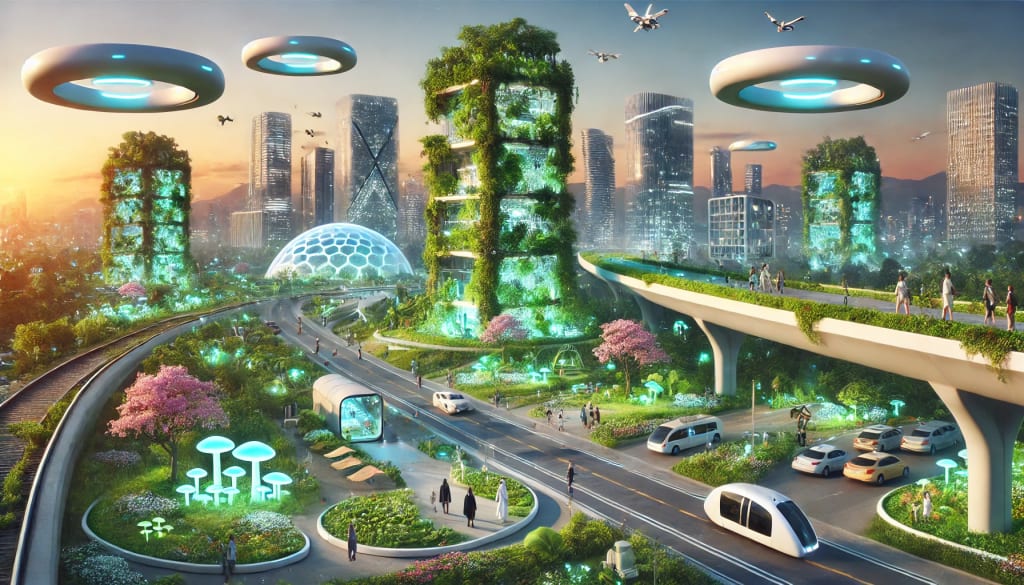
The year was 2050, and the world had become a place both familiar and extraordinary. Cities shimmered with bioluminescent light, powered not by fossil fuels or even traditional solar panels but by genetically engineered algae embedded into every surface. Roads were relics of a bygone era, replaced by networks of autonomous drones and maglev transporters weaving silently through the skies. It was a world on the brink—not of collapse, but of unprecedented transformation.
Yet, amidst this technological renaissance, a story of human ingenuity and resilience was quietly unfolding in the rolling deserts of New Sahara.
Chapter 1: The Desert's Secret
Amira Patel adjusted her visor, shielding her eyes from the glare of the sun as she stepped out of the sleek solar crawler. Around her stretched an endless expanse of sand dunes, their undulating forms interrupted only by the occasional shimmer of a solar array. But it wasn’t the panels she had come to see. Beneath the sands lay an innovation that could redefine humanity’s relationship with its planet.
She tapped her communicator. "Khalid, I’m at Node-23. Opening hatch now."
A soft hum followed as a section of sand retracted, revealing a circular entrance. Amira descended into the cool depths, her boots echoing on the metal stairs. Below lay the "Eternal Reservoir"—an underground biome meticulously engineered to transform arid wastelands into lush, self-sustaining ecosystems.
Khalid’s voice crackled in her ear. “How does it look down there?”
“Thriving,” Amira replied, her voice tinged with awe. She ran her hand along a vine-covered wall where water trickled down in tiny rivulets. The air smelled of earth and greenery. “The coral fungi colonies are spreading faster than expected. The bio-soil matrix is holding steady. If this works…”
Khalid chuckled. “It’ll work. Humanity’s stubbornness is matched only by its creativity.”
Amira smiled. They were part of Project Gaia, a coalition of scientists, engineers, and dreamers dedicated to reversing centuries of environmental damage. Their goal: terraform the uninhabitable.
Chapter 2: The Unexpected Catalyst
Two months later, Amira stood in the observation deck of New Sahara’s central research hub. The biome data scrolled across holographic screens. Everything was on track—until it wasn’t.
“Amira, we’ve got an anomaly,” Khalid called from across the room.
“What kind of anomaly?” she asked, hurrying to his station.
He pointed to a data feed showing rapid growth in a previously dormant biome. The AI flagged it as a genetic mutation in the coral fungi. “This strain wasn’t in the original blueprint.”
Amira frowned. “Could it be contamination?”
“Unlikely. The environment is sealed.”
Together, they watched as the mutated fungi began interacting with nearby plant life. Instead of competing for resources, it seemed to enhance their growth. By the end of the week, the biome’s productivity had doubled. By the month’s end, it had tripled.
Chapter 3: The Awakening
Word spread quickly. Delegations from across the globe arrived to witness the miracle. Among them was Dr. Elena Zhao, a biologist who had spent decades studying symbiosis in extreme ecosystems.
“It’s a quantum leap,” she said, examining samples under a hyper-scope. “The mutation allows the fungi to form neural-like networks with plants, accelerating nutrient exchange and resilience. It’s almost… intelligent.”
The media dubbed it "The Living Code". Within a year, it was deployed in other deserts, then in areas devastated by rising seas. Coastal cities reclaimed underwater districts, their structures entwined with the living networks.
But the Living Code didn’t stop there. It began to spread naturally, adapting to new climates and challenges. Forests regrew in scarred landscapes. Polluted rivers became crystalline. Even urban centers, once thought inhospitable to nature, saw green tendrils creeping through their concrete jungles.
One such transformation occurred in the ruins of Old Mumbai, a city long abandoned to rising sea levels. The Living Code formed sprawling mangroves in its submerged districts, providing shelter for wildlife and clean water for nearby settlements. Humanity wasn’t merely reclaiming lost ground—it was discovering new ways to live alongside nature.
Chapter 4: A New Paradigm
By 2055, humanity had entered a golden age of coexistence. The Living Code wasn’t just repairing the planet—it was reshaping how people lived. Buildings became living organisms, providing shade, clean air, and fresh water. Food production shifted from industrial farms to local biomes integrated into every community.
However, with change came new questions. Was the Living Code truly under control? Could humanity trust a force it barely understood?
Amira, now the director of Project Gaia, pondered these questions daily. She often visited the original biome, now a sprawling oasis teeming with life. One evening, she sat by a glowing pool, lost in thought, when Khalid joined her.
“You’re worried,” he said.
“I am,” she admitted. “We’ve unleashed something… extraordinary. But what if it outgrows us? What if we’re no longer the planet’s stewards?”
Khalid nodded, his gaze thoughtful. “Perhaps that’s the point. We’ve always sought to dominate nature. Maybe it’s time we learn to be part of it.”
Chapter 5: The Eternal Dawn
In the years that followed, humanity and the Living Code found a delicate balance. The fungi’s intelligence evolved, but rather than competing with humanity, it collaborated. People learned to communicate with the biomes, using biofeedback devices to harmonize their needs with the ecosystems around them.
By 2070, Earth was a patchwork of human and natural symbiosis. Cities and wilderness intertwined seamlessly, each supporting the other. Spacefaring missions carried the Living Code to Mars and beyond, terraforming barren worlds into thriving biospheres.
Amira, now an elder stateswoman of the movement, looked out from her home—a bioluminescent dome nestled in the heart of the New Sahara forest. The planet was no longer just surviving; it was flourishing. And for the first time in centuries, humanity’s future felt boundless.
As the sun set, painting the sky with hues of gold and crimson, Amira whispered to herself, “We did it. Not by conquering the Earth, but by learning to listen.”
And so, the world of 2050 became a testament to hope, innovation, and the unexpected beauty of a future reimagined.
About the Creator
Adhesion Promoter Market Trends: Sustainable Coatings, High-Performance Materials & Industry Forecast to 2034
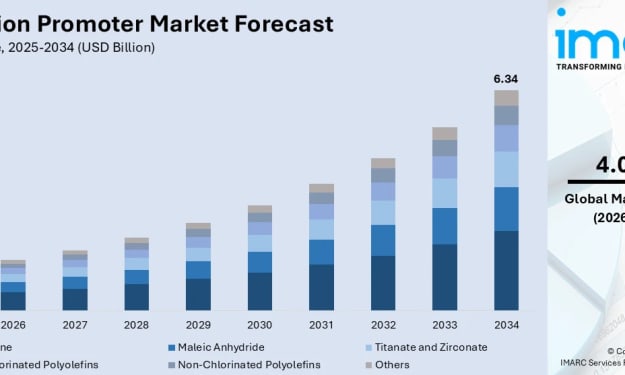
Optimizing bond strength and surface durability is becoming a central focus for industrial manufacturers as they transition toward advanced composites and high-performance coatings. According to IMARC Group’s latest data, the global adhesion promoter market size was valued at USD 4.44 Billion in 2025. Looking forward, IMARC Group estimates the market to reach USD 6.34 Billion by 2034, exhibiting a CAGR of 4.03% from 2026-2034. Asia Pacific currently dominates the market, holding a significant market share of over 45.3% in 2025.
By Andrew Sullivan2 days ago in Futurism
Writing To Succeed
If you want to find something that will help readers find your writing, possibly expand your audience, and maybe even get you noticed for other things, then you’re not alone. But how can you get it done in a world full of want-to-be writers? Look less at what you’re writing now, and more at what other writers have used to boost their views and reads.
By Jason Ray Morton 5 days ago in Writers


Comments
There are no comments for this story
Be the first to respond and start the conversation.