
China’s Coin-Sized Nuclear Battery: Lasting 50 Years Without Charging – A Breakthrough in Energy Technology
Discover how Betavolt’s innovative BV100 nuclear battery, the size of a coin, could revolutionize industries from aerospace to medical devices with 50 years of power and no need for recharging.

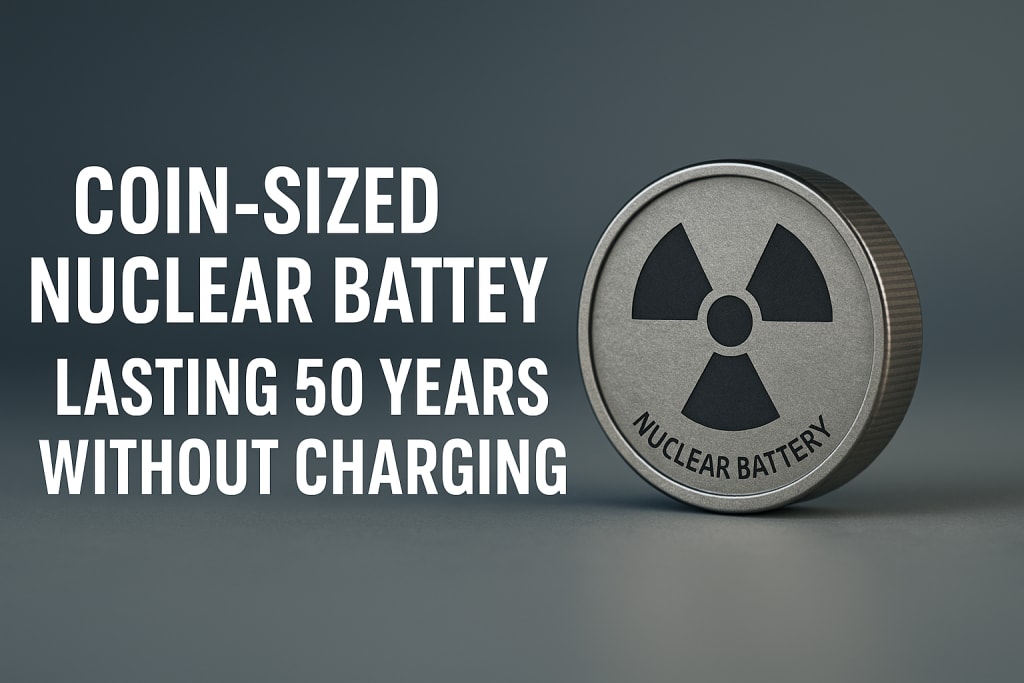
Betavolt’s BV100 nuclear battery is a game-changer, offering 50 years of reliable power without recharging. Learn how this coin-sized innovation could transform industries like healthcare, aerospace, and consumer electronics.
A groundbreaking innovation from China has taken the world of energy technology by storm. Betavolt, a Chinese company, has developed a new type of nuclear battery, the BV100, that is the size of a coin and can last up to 50 years without requiring a recharge. This significant advancement in battery technology could change the future of energy storage, particularly in industries where long-term power is crucial.
In a world where device charging is an everyday task, a battery that doesn't need recharging for half a century offers exciting possibilities. But this isn’t just any battery – it’s a nuclear battery utilizing radioactive decay to generate energy.
Let’s dive deeper into this innovation and explore its potential, applications, and implications for the future of energy.
What is the BV100 Nuclear Battery?
The BV100 nuclear battery from Betavolt is an ultra-compact energy source that is only 15mm x 15mm x 5mm in size. Despite its small size, the BV100 can produce 100 microwatts of power at 3 volts, thanks to a betavoltaic process. This process harnesses the radioactive decay of nickel-63, an isotope of nickel, to generate energy.
Betavolt’s nuclear battery represents a major breakthrough in energy efficiency. Traditional batteries require charging or periodic replacements, which can be time-consuming and environmentally taxing. But with the BV100, we’re looking at a device that can power applications for up to 50 years, making it a game-changer for sectors that rely on long-lasting energy sources.
How Does a Nuclear Battery Work?
Unlike conventional batteries that rely on chemical reactions to generate power, a nuclear battery generates energy through radioactive decay. In the case of the BV100, the nickel-63 isotope undergoes beta decay, releasing beta particles (electrons). These particles are captured by an ultra-thin diamond semiconductor, which converts the energy into electricity.
The betavoltaic technology used in the BV100 is similar to how solar panels convert sunlight into energy but instead uses radioactive decay instead of sunlight. This process allows the BV100 to maintain its power output over a significantly extended period, without requiring recharging or replacement.
Safety First: No Radiation, No Risk
When you hear “nuclear,” safety might be a concern. However, Betavolt has taken significant steps to ensure the BV100 is safe for use. The battery is designed with safety features to prevent radiation leakage. Betavolt asserts that the BV100 emits no external radiation, meaning it is safe for use in environments like medical implants and aerospace applications, where safety is paramount.
Additionally, the battery is capable of withstanding extreme temperatures, ranging from -60°C to 120°C. This makes the BV100 not only safe but also extremely durable, capable of operating in harsh environments without the risk of fire or explosion.
The Potential Applications of the BV100 Nuclear Battery
The BV100 has far-reaching potential, and its impact could be felt across several industries. Let’s look at some key areas where this tiny nuclear battery could revolutionize energy use:
1. Medical Devices
One of the most promising applications for the BV100 nuclear battery is in the medical field. Devices like pacemakers, which are implanted in the human body to regulate heart rhythms, typically require battery replacements every few years. With the BV100, these devices could be powered for decades without needing to replace or recharge the battery, reducing the risk and burden of frequent surgeries.
2. Aerospace and Satellites
Another area where the BV100 could be a game-changer is in aerospace. Satellites and space probes often require reliable, long-lasting power sources. Traditional solar panels and batteries may not be practical in the harsh conditions of space, where sunlight is scarce and battery degradation happens rapidly. A nuclear battery like the BV100 could provide an ideal solution, powering satellites and probes for decades without requiring recharging or maintenance.
3. Consumer Electronics
Although the current power output of the BV100 is modest at 100 microwatts, future iterations of the technology could enable new possibilities in consumer electronics. Imagine smartphones, laptops, or wearables that don’t require daily charging. While we’re not there yet, Betavolt plans to release a 1-watt version of the battery by 2025, which could power devices like drones and other high-energy electronics.
4. Remote and Off-Grid Locations
Another potential use of the BV100 is in remote or off-grid locations where access to regular power sources is limited. The durability and long-lasting power of the BV100 make it an ideal choice for powering remote sensors, weather stations, or surveillance devices in places where conventional power sources would be impractical or impossible to maintain.
What’s Next for Nuclear Battery Technology?
While the BV100 is currently in pilot production, Betavolt plans to ramp up production in the coming years. The company is also exploring other radioactive isotopes that could be used in the creation of future batteries, potentially increasing their power output or expanding their applications even further.
Moreover, the company’s focus on safety and sustainability is crucial for ensuring that nuclear battery technology can be widely adopted without public concern over safety issues. As the technology matures, it could potentially be scaled for a variety of commercial uses, changing the landscape of energy storage.
The Future of Energy: China’s Role in Nuclear Battery Innovation
China’s Betavolt is at the forefront of nuclear battery innovation, positioning itself as a leader in this emerging field. By developing the BV100 and pushing the boundaries of nuclear technology, China is paving the way for a future where nuclear-powered devices are common in everyday life. Whether in space exploration, medical technology, or consumer electronics, the BV100 could represent a major shift in how we think about energy storage and usage.
In a world where energy efficiency and sustainability are increasingly critical, innovations like the BV100 could be the key to solving some of our most pressing energy challenges.
Conclusion
Betavolt’s BV100 nuclear battery is nothing short of revolutionary. With its coin-sized design, ability to last up to 50 years without recharging, and numerous potential applications across industries, it has the potential to transform energy storage as we know it. From medical implants to aerospace technology, the BV100’s ability to provide reliable, long-lasting power without the need for frequent charging positions it as a game-changing innovation in the world of energy.
As we move towards a more sustainable future, innovations like these could lead the charge, offering new ways to power the world around us.
About the Creator
Tech Horizons
Exploring the future of technology, AI, gadgets, and innovations shaping tomorrow. Stay updated with Tech Horizons!
Keep reading
More stories from Tech Horizons and writers in Futurism and other communities.
About Binding Prometheus
I want to start actively advocating on behalf of my own work, and the most valuable part of my canon is, without a doubt, Binding Prometheus, the play I have been working on since 2019 and only finished in 2023 as part of my MA. The play itself is an amalgamation of a million different inspirations. On one end, it evokes the Ancient Greek myth-play, deriving its own title from the earliest extant work of Western drama we have, Aeschylus’s Prometheus Bound. On the other end, it borrows significantly from the sci-fi bulwarks from over the years, namely Mary Shelley’s Frankenstein and Karel Capek’s Rossum’s Universal Robots. The play could be an episode of Black Mirror, I fear. I don’t know. I’ve only ever seen one episode of Black Mirror.
By Steven Christopher McKnight17 days ago in Futurism



Comments (1)
The future is here. Look forward to the future