
NASA’s Curiosity Rover Captured Driving on Mars for the First Time — A Historic Moment in Space Exploration
For the first time ever, NASA’s Curiosity rover was photographed in motion on Mars by the HiRISE camera, offering a rare glimpse into the ongoing exploration of the Red Planet.

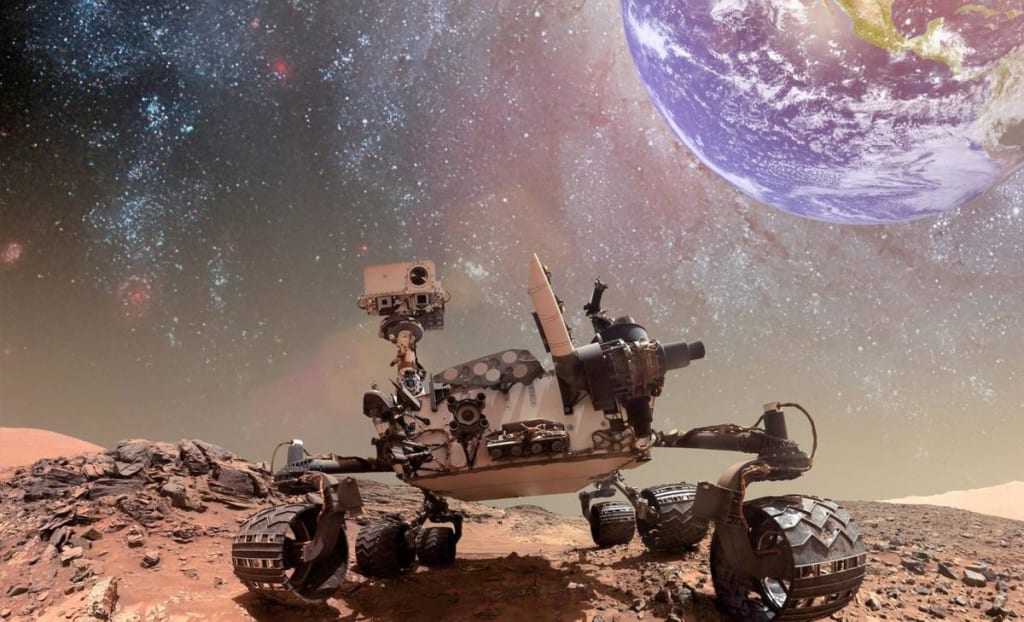
NASA’s Curiosity rover captured driving on Mars for the first time by HiRISE, marking a major milestone in space exploration and Mars research.
NASA’s Curiosity rover has been making history since it first landed on Mars in 2012, but in a recent groundbreaking event, it was captured in action driving across the Martian surface for the very first time. This incredible achievement, recorded by the High-Resolution Imaging Science Experiment (HiRISE) camera aboard the Mars Reconnaissance Orbiter, marks a significant milestone in humanity’s quest to explore the Red Planet.
On February 28, 2025, during the mission’s 4,466th sol (Martian day), HiRISE captured a remarkable image of Curiosity while it was actively driving. This moment was not just a technical feat but also a vivid reminder of how far space technology has advanced, allowing us to monitor a robot moving millions of miles away.
How HiRISE Captured the Curiosity Rover in Motion
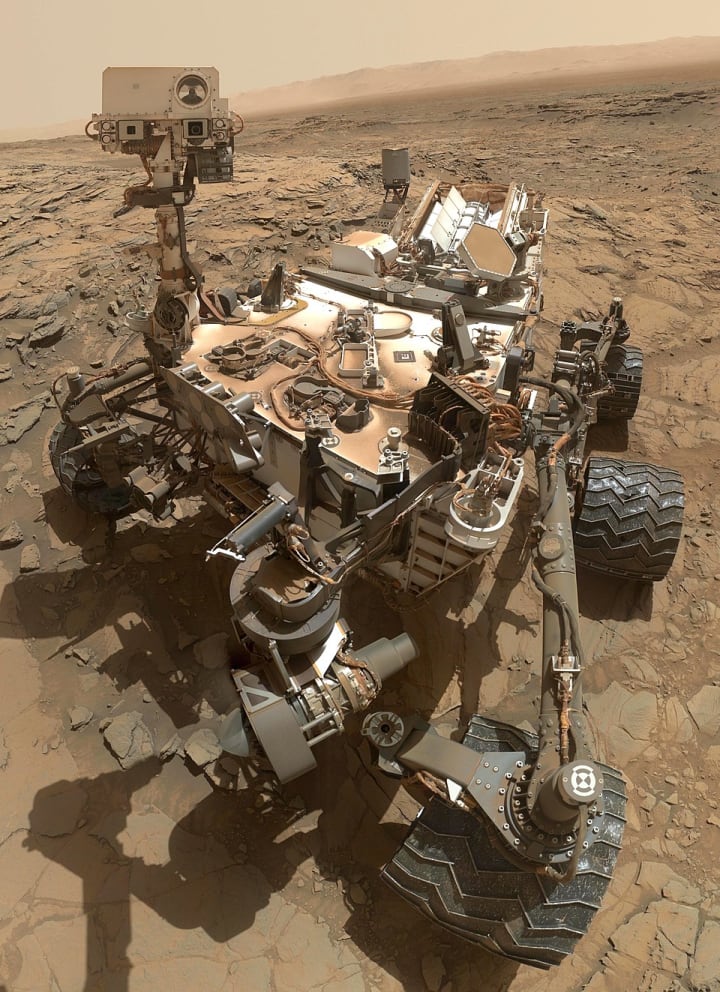
The HiRISE camera, operated by the University of Arizona, is one of the most powerful cameras ever sent to another planet. Designed to capture detailed images of Mars’ surface, HiRISE has provided scientists with invaluable data for years. However, capturing the Curiosity rover mid-drive was an exceptionally rare event.
In the new image, Curiosity appears as a small, dark speck traversing the Martian terrain. Behind it, a trail of tracks stretches for about 1,050 feet (320 meters). These tracks represent roughly 11 separate drives that the rover completed starting on February 2, 2025. Curiosity’s journey took it from the Gediz Vallis channel, a region shaped by ancient geological activity, toward a new science destination rich with intriguing rock formations.
Scientists believe this new target area contains boxwork structures — lattice-like features formed by mineral deposits left behind by groundwater billions of years ago. Exploring these formations could provide critical insights into the history of water on Mars and, by extension, the planet’s potential to have once supported life.
Curiosity’s Mission: A Decade of Discoveries
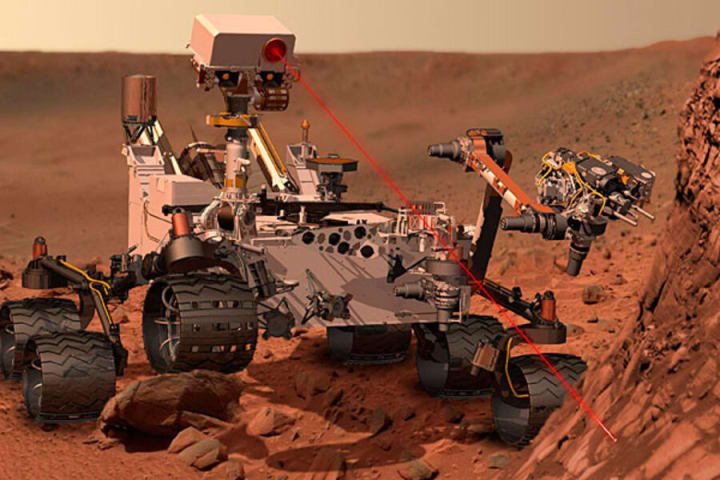
Since landing inside Gale Crater in August 2012, the Curiosity rover has been diligently working to answer one of humanity’s most profound questions: Did Mars ever have the right conditions to support microbial life?
Over the years, Curiosity has delivered strong evidence that ancient Mars had flowing rivers, lakes, and essential chemical ingredients necessary for life as we know it. It has also provided detailed analyses of the planet’s climate and geology, painting a complex picture of a once more Earth-like environment.
Despite the harsh conditions on Mars — including extreme temperatures, dust storms, and radiation — Curiosity has exceeded all expectations. It continues to ascend Mount Sharp, a towering peak at the center of Gale Crater, studying progressively older rock layers. Each new layer holds clues to the environmental changes Mars has undergone over billions of years.
The Challenge of Driving on Mars
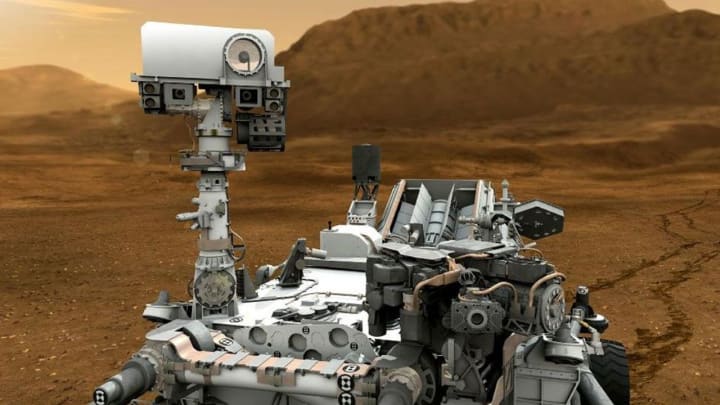
Driving on Mars isn’t as simple as setting a course and hitting the gas. Each move Curiosity makes is carefully planned and executed by a team of engineers at NASA’s Jet Propulsion Laboratory (JPL) in Southern California.
According to Doug Ellison, Curiosity’s planning team chief at JPL, every drive must account for a variety of factors. These include the steepness of the terrain, the composition of the soil, and the rover’s own software limitations. Even minor obstacles like small rocks can pose serious risks to the rover’s delicate wheels and equipment.
In this case, analysis of the HiRISE image's timestamp revealed that Curiosity was nearly finished with a 69-foot (21-meter) drive when the photograph was taken. Interestingly, while HiRISE usually captures images with a color strip at its center, Curiosity appeared in the black-and-white section of this particular shot. Nonetheless, the image provided an unprecedented view of the rover actively making its way across Mars.
What Lies Ahead for Curiosity
The latest HiRISE image shows Curiosity’s tracks leading toward a steep slope, which the rover has already successfully climbed since the photo was taken. If all continues to go as planned, Curiosity is expected to reach its new science destination within the next few weeks.
Once there, it will begin studying the boxwork formations in detail. Scientists are eager to analyze these structures because they may reveal information about the ancient groundwater systems that once existed on Mars. Such discoveries could significantly advance our understanding of the Red Planet’s habitability in the distant past.
Interestingly, the tracks left behind by Curiosity’s wheels might remain visible for many months, possibly even longer, depending on how the Martian winds shift and move the dust around.
The Broader Vision: Humanity’s Future on Mars
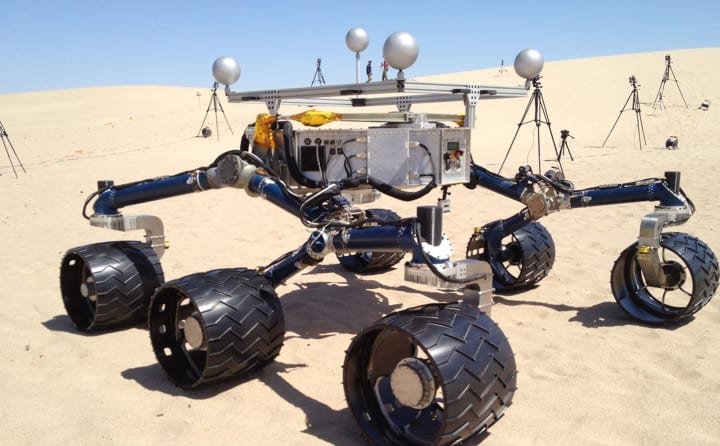
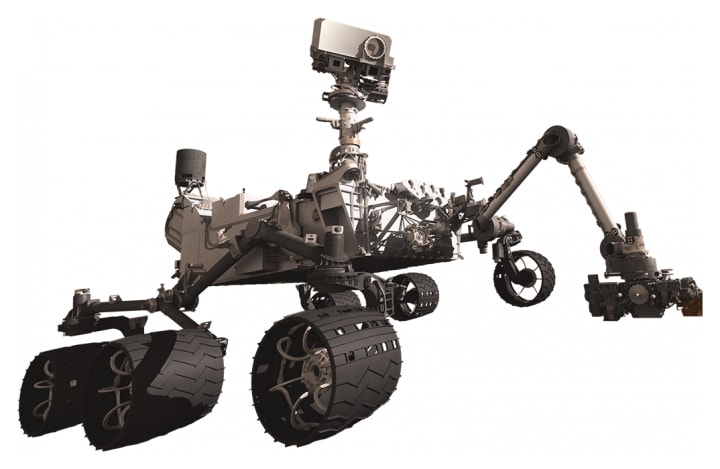
The Curiosity rover is part of a much larger, ongoing effort by NASA and other space agencies to explore Mars in unprecedented detail. NASA’s Perseverance rover, currently operating in a different region of Mars, is actively collecting rock and soil samples for future return to Earth. Plans are underway for complex missions to retrieve these samples, including advanced helicopters and even eventual human missions to Mars, targeted for the 2030s.
Each mission builds upon the discoveries of its predecessors. Curiosity’s findings are helping to inform future exploration strategies, design better rovers, and eventually prepare for human exploration. The knowledge gained from studying Mars' climate, geology, and potential for life will be critical as we move toward establishing a human presence on the Red Planet.
The recent capture of Curiosity driving across Mars isn’t just a fascinating image — it's a powerful symbol of human curiosity, ingenuity, and our relentless drive to explore beyond the boundaries of Earth.
About the Creator
Tech Horizons
Exploring the future of technology, AI, gadgets, and innovations shaping tomorrow. Stay updated with Tech Horizons!
Keep reading
More stories from Tech Horizons and writers in Futurism and other communities.
The Apple Watch Ultra 3 (2025): The Future Classic That Will Digitally Transform You
As we step deeper into the future of wearable technology, Apple is once again preparing to revolutionize the market with the highly anticipated **Apple Watch Ultra 3**. Slated for release in 2025, this next-generation smartwatch promises to deliver a digital upgrade unlike any other, blending style, performance, and innovation into one robust device.
By Tech Horizons9 months ago in Futurism
About Binding Prometheus
I want to start actively advocating on behalf of my own work, and the most valuable part of my canon is, without a doubt, Binding Prometheus, the play I have been working on since 2019 and only finished in 2023 as part of my MA. The play itself is an amalgamation of a million different inspirations. On one end, it evokes the Ancient Greek myth-play, deriving its own title from the earliest extant work of Western drama we have, Aeschylus’s Prometheus Bound. On the other end, it borrows significantly from the sci-fi bulwarks from over the years, namely Mary Shelley’s Frankenstein and Karel Capek’s Rossum’s Universal Robots. The play could be an episode of Black Mirror, I fear. I don’t know. I’ve only ever seen one episode of Black Mirror.
By Steven Christopher McKnight18 days ago in Futurism
Anti-Jamming Market Outlook: Strengthening Secure Communications Across Critical Sectors
Anti-Jamming Market Overview The global anti-jamming market is becoming increasingly critical as satellite-based navigation and communication systems face growing threats from intentional interference, signal spoofing, and electronic warfare. Anti-jamming solutions protect GPS and GNSS signals to ensure accuracy, reliability, and operational continuity across defense, aerospace, aviation, maritime, and critical infrastructure applications. Rising dependence on precision navigation, autonomous platforms, and secure communication networks is accelerating the adoption of advanced anti-jamming technologies. As governments and commercial operators prioritize resilience and security, the market is poised for sustained growth worldwide.
By James Smith6 days ago in Futurism



Comments
There are no comments for this story
Be the first to respond and start the conversation.