
Behind the Wheel: How AI Powers Self-Driving Cars and What It Means for the Future
"Exploring the Technology, Challenges, and Future Impact of AI-Driven Autonomous Vehicles"
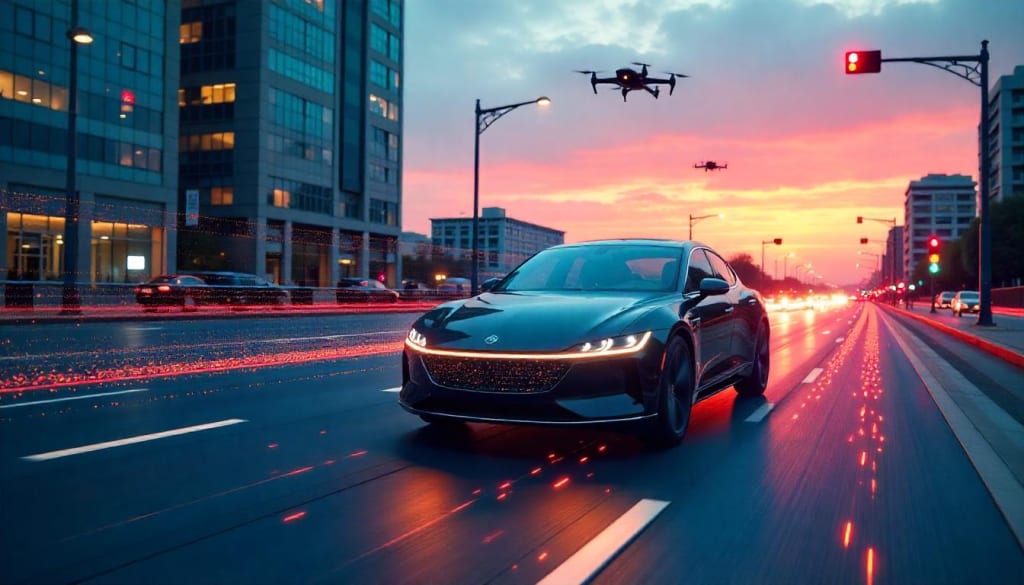
Not long ago, self-driving cars were science fiction. Today, they’re rolling on public roads, powered by some of the most advanced artificial intelligence systems ever developed. From Tesla’s Autopilot to Waymo’s fully autonomous vehicles, AI is not only reshaping how we drive—it’s redefining transportation itself.
What Makes a Car “Self-Driving”?
A self-driving car, or autonomous vehicle (AV), is capable of sensing its environment and navigating without human input. This isn’t just cruise control on steroids—it’s a combination of hardware and software working in real-time to drive safely through traffic, weather, and unexpected obstacles.
The technology behind it boils down to:
Sensors: Cameras, radar, LiDAR (laser-based sensing), ultrasonic sensors
AI Algorithms: For detecting objects, interpreting road signs, and decision-making
Machine Learning Models: Trained on millions of miles of driving data
High-Definition Maps: Ultra-precise maps to complement live sensor data
The Role of AI in Self-Driving Cars
Artificial Intelligence is the brain behind the wheel. It takes raw data from sensors and interprets it like a human would—with faster reaction times and no distractions.
Here’s how AI enables a car to drive:
1. Perception
AI processes sensor input to detect:
Other vehicles
Pedestrians
Lane markings
Traffic lights
Road signs
It builds a real-time model of the world around the car, constantly updating as things change.
2. Prediction
Once the environment is understood, AI predicts how other drivers and pedestrians will behave. Will that person cross the street? Is the car ahead about to change lanes?
Prediction is vital for smooth, safe navigation.
3. Planning & Control
Based on perception and prediction, the AI decides the best course of action:
When to accelerate, brake, or turn
How to change lanes
Whether to yield or proceed
Then it sends signals to the car’s controls to execute those actions—just like a human driver would.
Different Levels of Autonomy
The Society of Automotive Engineers (SAE) defines six levels of automation:
Level 0: No automation (human driver does everything)
Level 1: Driver assistance (e.g., adaptive cruise control)
Level 2: Partial automation (Tesla Autopilot)
Level 3: Conditional automation (car can drive itself, but human must intervene if needed)
Level 4: High automation (car can drive itself in most conditions)
Level 5: Full automation (no human involvement required at all)
Most systems on the road today are Level 2. Waymo and others are piloting Level 4 in some cities.
Real-World Applications
Self-driving cars are being tested and used in several practical settings:
Ride-Hailing: Waymo and Cruise are offering autonomous taxis in cities like San Francisco and Phoenix.
Delivery Services: Companies like Nuro use small AVs to deliver groceries or takeout.
Long-Haul Trucking: Startup Aurora is testing autonomous trucks on highways to solve driver shortages.
These aren’t futuristic concepts—they’re active programs running right now.
Benefits of Self-Driving Cars
Autonomous vehicles promise a range of benefits:
1. Safety
Over 90% of road accidents are due to human error. AI doesn't get tired, distracted, or drunk. With proper development, AVs could drastically reduce road fatalities.
2. Accessibility
Self-driving cars can restore independence to people who can’t drive due to age, disability, or health.
3. Efficiency
AI can optimize speed, acceleration, and route planning—cutting down on fuel use, emissions, and traffic congestion.
4. Time Savings
Imagine reclaiming the hours you spend commuting every week. You could work, relax, or sleep while your car handles the road.
Challenges to Overcome
Despite the hype, there are significant hurdles:
- Edge Cases
AI struggles with rare or unusual scenarios, like a mattress falling onto the highway or an unmarked construction zone.
- Weather
Snow or fog can interfere with sensors, making navigation difficult.
- Legal and Ethical Questions
Who’s responsible if an AV causes an accident? How should the car prioritize in an unavoidable crash?
- Infrastructure
Roads, traffic systems, and laws were designed for human drivers—not machines.
The Road Ahead
Here’s what the future could look like:
Fully Autonomous Cities: Imagine calling a self-driving pod to pick you up like an Uber, but no driver ever shows up—it just drives you safely to your destination.
Connected Vehicles: Cars that communicate with each other and with traffic lights for smoother flow.
Smart Infrastructure: Roads embedded with sensors to help AVs make better decisions.
We’re not there yet, but we're accelerating quickly.
Final Thoughts
AI is steering us toward a future where driving might become optional. While there are still technical, legal, and social challenges to solve, the progress is undeniable. Self-driving cars are already here in some form—and in the coming decade, they’ll become more common and more capable.
The real question isn't whether autonomous vehicles will arrive. It's how fast they’ll get here—and whether we're ready to share the road with them.
About the Creator
Keep reading
More stories from GadgetGround and writers in Futurism and other communities.
The Silent Partner: How AI is Rewriting the Rules of Creativity
We’ve long believed creativity was the last bastion of humanity, something that algorithms could never truly replicate. Yet quietly, almost imperceptibly, AI has moved from crunching numbers to holding a paintbrush, and it’s producing work that challenges our very definition of art.
By GadgetGround2 months ago in Futurism
About Binding Prometheus
I want to start actively advocating on behalf of my own work, and the most valuable part of my canon is, without a doubt, Binding Prometheus, the play I have been working on since 2019 and only finished in 2023 as part of my MA. The play itself is an amalgamation of a million different inspirations. On one end, it evokes the Ancient Greek myth-play, deriving its own title from the earliest extant work of Western drama we have, Aeschylus’s Prometheus Bound. On the other end, it borrows significantly from the sci-fi bulwarks from over the years, namely Mary Shelley’s Frankenstein and Karel Capek’s Rossum’s Universal Robots. The play could be an episode of Black Mirror, I fear. I don’t know. I’ve only ever seen one episode of Black Mirror.
By Steven Christopher McKnight18 days ago in Futurism
Another New Hope, Nope
Abstract In the Star Wars saga the Old Republic maintained peace without strong centralised rule for thousands of years, yet ultimately collapsed not because of a lack of ideals but because of corruption, inflation and financial capture. Over the long arc of galactic history, whoever controls money controls the galaxy. A New Jedi Order that ignores the power of the Banking Clan is structurally doomed, regardless of its moral aspirations. This article argues that Rey’s project, as imagined in the 2026 narrative horizon, cannot survive as a purely compassionate, decentralised pedagogical movement. If the new Jedi are to build a durable peace, they will be forced into alliances that lead them towards the ‘grey’ side of the Force. Rey’s realistic options narrow to two archaic yet resilient traditions: the Mandalorian creed, embodied by Grogu, and the matriarchal religion of the Witches of Dathomir. In a parallel to the Bene Gesserit in Dune, the text explores the provocative thesis that Rey’s only viable solution is not the restoration of monastic celibacy, but the creation of a hereditary aristocracy of Force users. Blood, not intentions, has always structured power in the galaxy. Luke was the son of a queen; Rey is the heir of Palpatine. ‘New Hope’ thus ceases to mean moral rebirth and comes to signify newborns, bloodlines and dynasties. The ultimate irony is that the House of Palpatine–Skywalker may be the only institution capable of surviving a millennium. Palpatine may have lost the war, but his principle – that blood outlives ideals – may yet rule for eternity.
By Peter Ayolova day ago in Futurism


Comments
There are no comments for this story
Be the first to respond and start the conversation.