
A Cosmic Map of Dark Matter’s Intergalactic Web
Space

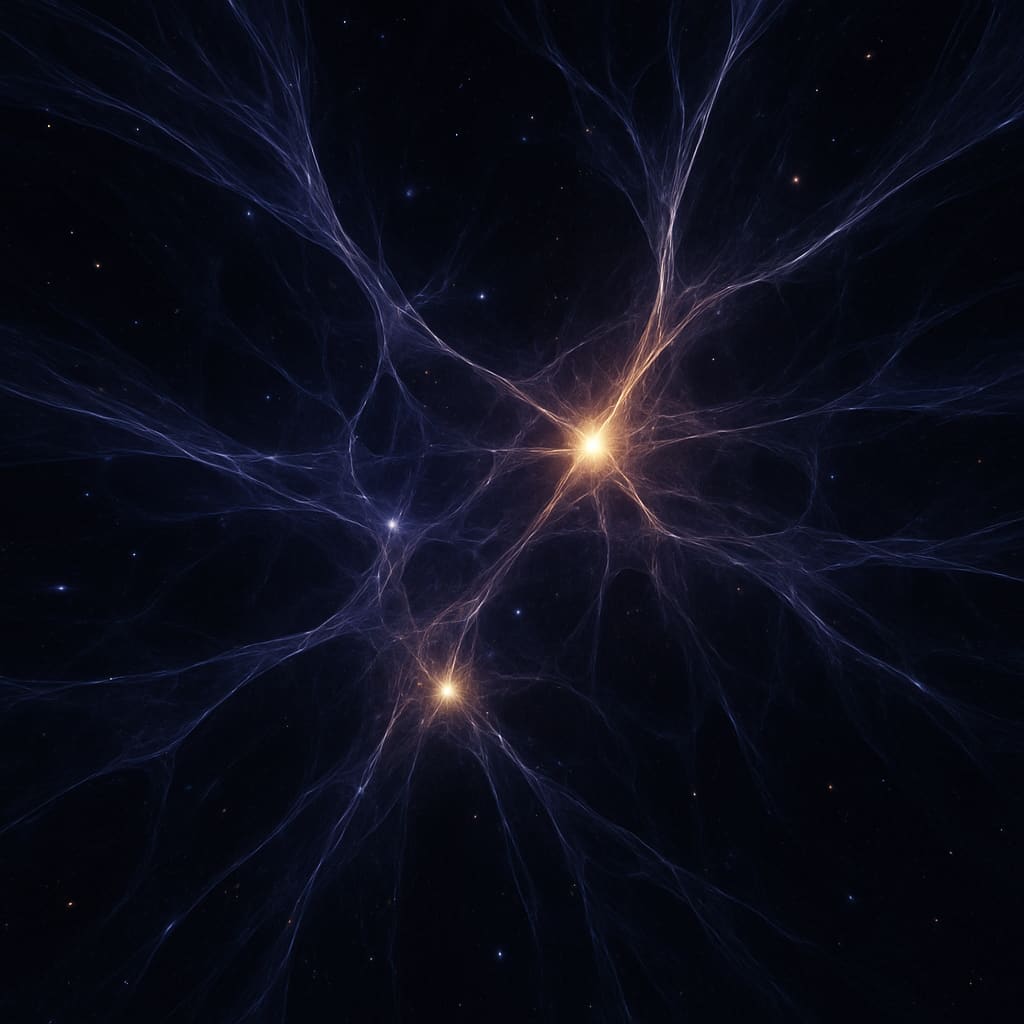
The European Space Agency’s Euclid telescope has given humanity something extraordinary: the first detailed three-dimensional map of the so-called “cosmic web” — a vast network of dark matter filaments that weave together the Universe on the largest scales. These invisible threads connect galaxies and galaxy clusters, forming the very scaffolding of the cosmos. What was once only a theoretical concept or a faint statistical shadow has now taken shape before our eyes.
The Invisible Framework of the Universe
It may come as a surprise, but the matter that we can actually see — stars, planets, gas, dust — makes up only about 15% of the Universe’s total mass. The other 85% consists of something far more elusive: dark matter. This mysterious substance does not emit, absorb, or reflect light, making it completely invisible to telescopes in any traditional sense. Yet, its presence is undeniable. Galaxies rotate the way they do, galaxy clusters remain bound, and cosmic structures form and evolve only because of the gravitational pull of this unseen material.
For decades, cosmologists suspected that dark matter was not scattered randomly but rather organized into gigantic filaments and nodes — creating a pattern reminiscent of a spider’s web. Now, thanks to Euclid, we can finally visualize this structure in three dimensions, tracing how it has evolved across billions of years.
How Euclid Sees the Unseen
If dark matter cannot be observed directly, how did Euclid manage to map it? The key lies in a phenomenon known as gravitational lensing. When light from distant galaxies travels toward Earth, it passes through regions filled with dark matter. The gravity from this dark matter subtly bends and distorts the light, creating faint but measurable signatures.
By capturing these minute distortions in the shapes of millions of galaxies, Euclid’s instruments effectively “reverse engineer” the distribution of mass along the line of sight. When billions of such measurements are combined, the result is nothing short of breathtaking: a three-dimensional reconstruction of the Universe’s skeleton, made of invisible matter.
A Universe That Looks Like a Web
The emerging picture is far from random chaos. Instead, the cosmos reveals itself as a highly structured network:
- Filaments — immense bridges of dark matter stretching across millions of light-years, linking galaxies together.
- Nodes — dense intersections where multiple filaments meet, giving birth to colossal galaxy clusters and superclusters.
- Voids — vast empty regions, some hundreds of millions of light-years across, where almost no galaxies exist.
In this way, the Universe resembles a gigantic cosmic spiderweb, with dark matter acting as the silk that holds it all in place. Our own galaxy, the Milky Way, is not floating aimlessly in space — it, too, is strung like a pearl along one of these filaments, part of a much larger intergalactic network.
Why This Discovery Matters
The creation of this three-dimensional cosmic map is not just a triumph of observational astronomy; it opens entirely new scientific frontiers:
- Tracing Cosmic Evolution — Scientists can now study how the cosmic web changed over billions of years, providing direct clues about the history of structure formation in the Universe.
- Probing the Nature of Dark Matter — Different theories about what dark matter is predict different filament patterns. Comparing the map to simulations could eliminate entire classes of models.
- Measuring Dark Energy — By observing how the web stretches and evolves, cosmologists can track the accelerating expansion of the Universe and refine measurements of dark energy, the mysterious force driving galaxies apart.
- Testing the Laws of Physics — Gravity behaves one way in our Solar System, but does it work the same way across cosmic scales? The new map may reveal whether Einstein’s theory of general relativity still holds true everywhere.
Living Inside the Web
It’s a humbling thought: everything we know, from the birth of stars to the formation of galaxies, happens within this invisible lattice of dark matter. Even the future of our Milky Way is shaped by the gravitational tug of unseen filaments, drawing us toward the nearby Virgo Cluster. In a very real sense, we are not isolated inhabitants of space but strands caught in a much larger, interconnected web.
Looking Ahead
Euclid’s mission is just beginning. Over the next several years, the telescope will observe billions of galaxies across more than a third of the observable Universe. Each new observation will refine and expand the map, turning a once-speculative idea into one of the most precise cosmological tools ever built.
By charting the dark matter web, scientists are not only unveiling the hidden architecture of the cosmos — they are also bringing us closer to answering some of the deepest questions in science: What is dark matter? Why is the Universe expanding faster and faster? And what does this cosmic design tell us about the ultimate fate of everything?
The three-dimensional map of the cosmic web is more than a scientific milestone. It is a reminder that behind the familiar glitter of stars lies an unseen order, an elegant structure that binds galaxies into clusters, clusters into superclusters, and superclusters into the grand design of the cosmos itself. For the first time, we can see that hidden design — and realize that we are part of it.
About the Creator
Keep reading
More stories from Holianyk Ihor and writers in Futurism and other communities.
An “Invisible” Black Hole Discovered Close to Earth
Astronomers have announced a discovery that sounds like the plot of a science-fiction film: just 1,500 light-years away from Earth, researchers have identified an “invisible” black hole. Unlike the spectacular black holes often portrayed in movies—surrounded by glowing disks of gas and violent bursts of radiation—this one gives off no light and shows no direct evidence of its presence. Instead, it lurks silently in the darkness of space, betrayed only by its gravitational pull on a nearby star.
By Holianyk Ihor4 months ago in Futurism
About Binding Prometheus
I want to start actively advocating on behalf of my own work, and the most valuable part of my canon is, without a doubt, Binding Prometheus, the play I have been working on since 2019 and only finished in 2023 as part of my MA. The play itself is an amalgamation of a million different inspirations. On one end, it evokes the Ancient Greek myth-play, deriving its own title from the earliest extant work of Western drama we have, Aeschylus’s Prometheus Bound. On the other end, it borrows significantly from the sci-fi bulwarks from over the years, namely Mary Shelley’s Frankenstein and Karel Capek’s Rossum’s Universal Robots. The play could be an episode of Black Mirror, I fear. I don’t know. I’ve only ever seen one episode of Black Mirror.
By Steven Christopher McKnight16 days ago in Futurism
United States Residential Remodeling Market Size and Forecast 2025–2033
Introduction The United States residential remodeling market has entered a transformative phase, driven by evolving homeowner lifestyles, rising property values, and an increased emphasis on sustainability and modernization. According to Renub Research, the United States Residential Remodeling Market is expected to reach US$ 804.02 billion by 2033, up from US$ 531.34 billion in 2024, growing at a CAGR of 4.71% between 2025 and 2033. This steady expansion reflects the essential role of remodeling in maintaining and enhancing the nation’s aging housing stock while aligning homes with contemporary living standards.
By Renub Research4 days ago in Futurism


Comments
There are no comments for this story
Be the first to respond and start the conversation.