
An “Invisible” Black Hole Discovered Close to Earth
Space

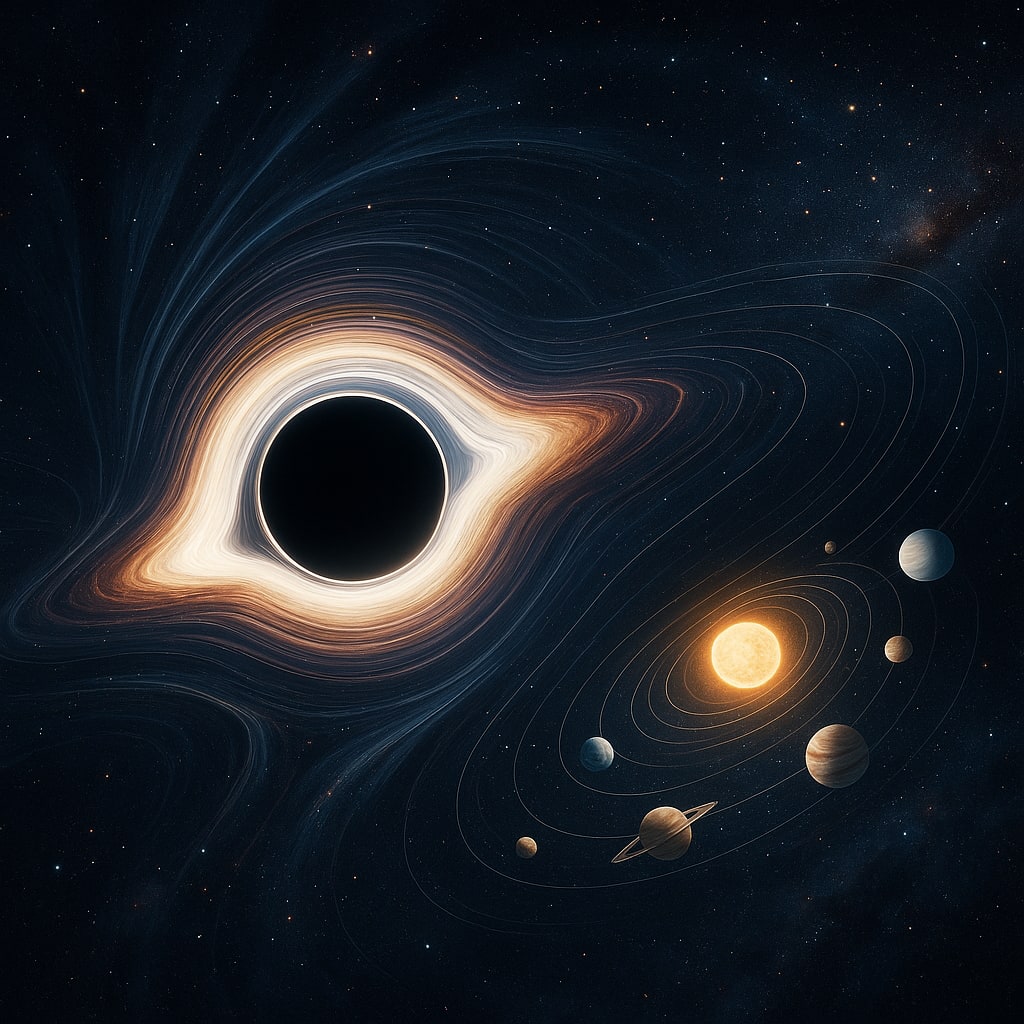
Astronomers have announced a discovery that sounds like the plot of a science-fiction film: just 1,500 light-years away from Earth, researchers have identified an “invisible” black hole. Unlike the spectacular black holes often portrayed in movies—surrounded by glowing disks of gas and violent bursts of radiation—this one gives off no light and shows no direct evidence of its presence. Instead, it lurks silently in the darkness of space, betrayed only by its gravitational pull on a nearby star.
A Hidden Neighbor in the Galaxy
Typically, black holes reveal themselves through their appetite. When they consume surrounding gas, dust, or even stars, the process creates immense heat and light, producing bright X-rays detectable by telescopes. This makes most active black holes relatively easy to spot despite their name.
But the newly discovered object refuses to follow this pattern. It is not actively feeding and therefore emits almost no radiation. To observers, it is as though nothing is there at all. The only clue lies in the motion of a nearby star, which orbits in a way that cannot be explained by visible matter alone. The star’s path appears to “wobble,” pulled by the intense gravity of a companion that cannot be seen. Careful analysis revealed that the hidden partner could only be one thing: a black hole.
Close Enough to Be Remarkable
When astronomers announced the find, one of the most striking details was its proximity. 1,500 light-years may sound unimaginably far, but in cosmic terms, it is practically in our neighborhood. For comparison, the supermassive black hole at the center of our galaxy, Sagittarius A*, is roughly 27,000 light-years away. The discovery demonstrates that black holes are not confined to the distant edges of the cosmos but may exist far closer to us than previously thought.
In fact, the star system lies in a region of the sky visible to the naked eye under dark conditions. This means that anyone standing outside on a clear night might unknowingly gaze in the direction of a system that hides a black hole—an eerie thought that emphasizes how much remains concealed in the universe.
Should We Be Worried?
The discovery naturally raises a pressing question: does this nearby black hole pose a threat to Earth? The reassuring answer is no. Black holes are extremely powerful, but their gravitational influence only extends over relatively short distances. At 1,500 light-years, this object is far too distant to affect our solar system in any meaningful way.
If Earth were within a few light-years of such an object, its pull could potentially disturb the orbits of planets or drag in stray matter. But from our current vantage point, this black hole is a safe and fascinating subject for study rather than a cause for alarm.
A Glimpse Into the Dark Side of the Universe
For astronomers, the true importance of the discovery lies in what it suggests about the hidden population of black holes in our galaxy. For years, scientists have suspected that many black holes remain invisible because they are not actively feeding. The Milky Way may contain millions of these silent objects, drifting unnoticed through space.
This discovery provides direct evidence that such hidden black holes exist and that they may be far more common than once believed. Much like finding a predator camouflaged in the jungle, detecting an “invisible” black hole requires indirect clues and careful observation.
Unlocking the Mystery With Gravity
The breakthrough highlights the growing importance of gravitational techniques in modern astronomy. By observing how massive but unseen objects tug on visible stars, scientists can map out the presence of black holes and even estimate their mass. This method is reminiscent of how the existence of dark matter was first suspected—by noticing that galaxies rotated in ways that visible matter alone could not explain.
In both cases, astronomers are learning to study the universe not only by its light but by the hidden gravitational footprints objects leave behind. It is a reminder that space is not defined solely by what we see but also by what silently shapes the cosmos.
The Road Ahead
The discovery raises intriguing questions for future research. How massive is this particular black hole? Are there other invisible companions waiting to be discovered even closer to Earth? Could mapping these objects reveal new insights into how stars die and how black holes form?
Astronomers are optimistic that with more precise instruments and long-term observations, they will uncover more of these cosmic phantoms. Missions like Gaia, which tracks the precise movements of stars, may reveal additional systems where invisible companions exert their pull.
A Universe Full of Hidden Giants
Perhaps the most astonishing realization is that the universe may be filled with such quiet monsters. They do not blaze like quasars or devour their neighbors in dramatic fashion, but they are there nonetheless—ancient remnants of stars, scattered throughout the Milky Way.
The next time you step outside and look up at the night sky, remember that behind the sparkling stars may lurk invisible giants, shaping the galaxy in ways we are only beginning to understand.
Suggested Image for the Article:
A star-filled patch of deep space, with one bright blue star in the foreground curving subtly in its orbit. Surrounding it is empty darkness—yet the positioning of the star hints that something unseen and massive is pulling at it. The background should be scattered with faint stars, emphasizing the mystery of the hidden black hole.
About the Creator
Keep reading
More stories from Holianyk Ihor and writers in Futurism and other communities.
The First Signs of Water in Venus’s Clouds: What NASA’s DAVINCI Mission Has Revealed
Venus has always been a planet of paradoxes. Often called Earth’s “twin” because of its similar size and rocky composition, it is, in reality, a world of extremes. Beneath its thick, yellowish veil of clouds lies a surface scorched by temperatures nearing 900°F (475°C), while the crushing atmospheric pressure is more than 90 times that of Earth. For decades, scientists assumed Venus was utterly inhospitable—not just for life, but even for something as simple as liquid water.
By Holianyk Ihor4 months ago in Futurism
About Binding Prometheus
I want to start actively advocating on behalf of my own work, and the most valuable part of my canon is, without a doubt, Binding Prometheus, the play I have been working on since 2019 and only finished in 2023 as part of my MA. The play itself is an amalgamation of a million different inspirations. On one end, it evokes the Ancient Greek myth-play, deriving its own title from the earliest extant work of Western drama we have, Aeschylus’s Prometheus Bound. On the other end, it borrows significantly from the sci-fi bulwarks from over the years, namely Mary Shelley’s Frankenstein and Karel Capek’s Rossum’s Universal Robots. The play could be an episode of Black Mirror, I fear. I don’t know. I’ve only ever seen one episode of Black Mirror.
By Steven Christopher McKnight16 days ago in Futurism
Smart Lock Market Size to Surpass USD 9.9 Billion by 2033 Driven by IoT Integration & Connected Living Trends
According to IMARC Group's latest research publication, global smart lock market size reached USD 2.7 Billion in 2024. Looking forward, IMARC Group expects the market to reach USD 9.9 Billion by 2033, exhibiting a growth rate (CAGR) of 15.43% during 2025-2033.
By Suhaira Yusuf3 days ago in Futurism


Comments
There are no comments for this story
Be the first to respond and start the conversation.