
The Touch of Silk: Erotic Rituals at the Heian Court
Positions, Perfume, Poetry, and Silence. Sex as an aesthetic act at the Heian court.

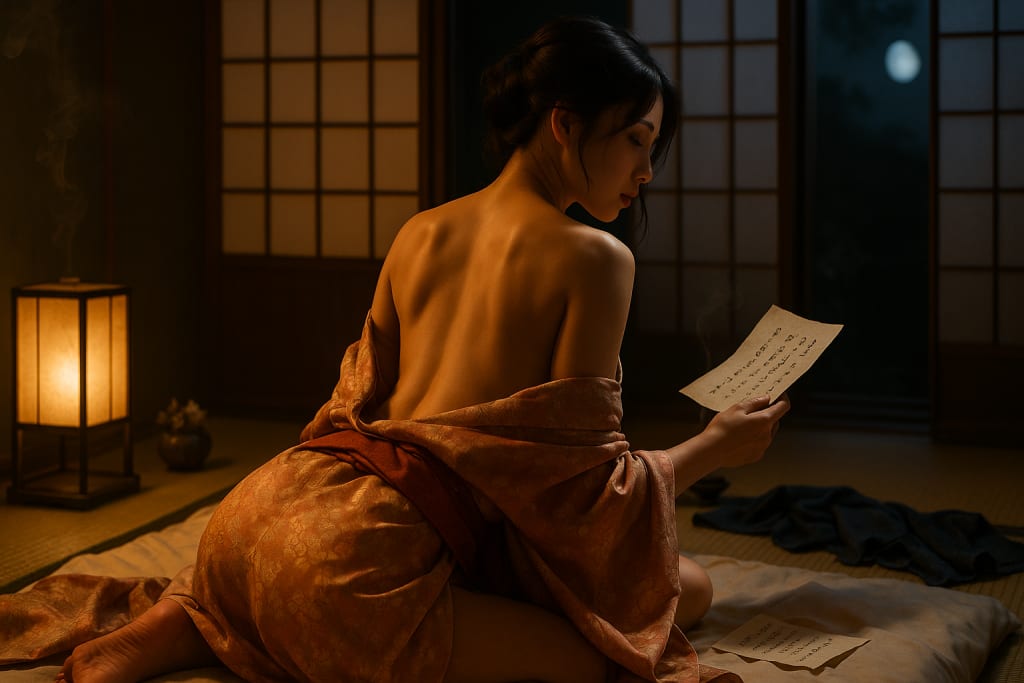
The paper is thin—almost translucent. Folded once. On its surface, delicate ink curves into a verse—five lines, seventeen syllables of restrained longing. The scent of plum blossoms lingers on it. It arrives in the twilight hour, placed discreetly by a maidservant on a lacquered tray. A woman of the Heian court unfolds it without a word, though her heart already knows the calligraphy. She reads, then closes her eyes.
Tonight, he will come.
In the shadowed elegance of the Heian era (794–1185), desire was not a matter of instinct. It was ceremony. Seduction unfolded slowly, like a scroll unrolled by candlelight. Every detail—the rustle of silk, the scent of incense, the carefully chosen poem—was part of an erotic ritual where pleasure was aesthetic, calculated, sublime.
The Language of Scent and Silence
To love in Heian Japan was to master the art of what is unseen and unsaid. Words were never direct. They floated between lovers like smoke from a bronze incense burner. Love letters were calligraphic masterpieces: the curve of a line more suggestive than flesh, the perfume of the paper more intimate than a kiss. Men used kanji—strong, precise. Women wrote in hiragana—soft, emotional. When these two scripts touched, so did their authors.
But seduction required patience. Weeks might pass in poetic exchange before a lover dared cross a threshold. The act itself—visiting a woman’s chambers under the veil of night—was half-real, half-dream. Lovers rarely saw one another fully. Instead, they explored skin through silk, breath through paper doors, desire through shadows.
The Story of Lady Shikibu and the Silk Pillow
Lady Shikibu was not the most conventionally beautiful woman at court. Her hair was thick, her gaze too sharp, her poems laced with irony. But her kimono always smelled of cloves, and her replies arrived faster than any man could anticipate. She never repeated herself. That was what made her dangerous.
One night, after weeks of flirtatious poetry, she allowed Lord Narichika into her chambers.
He found her seated by a paper lamp, her kimono loosened at the collar, one sleeve slipped down to reveal her shoulder like a moon rising from clouds. She said nothing. Only held out a sheet of calligraphy. He took it and read:
“Your name pressed into my pillow / still warm / with the weight of your absence.”
The lamp flickered. The only sound in the room was the fall of his cloak to the floor.
They made love in silence. Not a gasp, not a cry. Only the breath of shifting fabric and the slow exhale of incense. Her hands found him as if guided by poetry, his lips traced the collarbone like one traces the edge of a scroll. Later, he would write that her skin tasted like cedar and forgotten seasons.
When he rose to leave, the sky already pale, he found a second verse placed beneath his robe:
“Come again—but leave no name. / I prefer your memory / to your presence.”
She never saw him again. And she didn’t need to. He lived in her verses, like perfume on old silk.
Eroticism Without Flesh
The Heian court understood something modern culture often forgets: that the most powerful eroticism lives in anticipation. In the pause before the kiss. In the sleeve slipping from a shoulder. In the poem written but never sent.
Even The Tale of Genji, the great literary work of the era, is filled with these moments—secret visits, fainting women, robes slipped aside, lovers caught between duty and longing. Eroticism was an ache, not a scream—a lingering sigh rather than a shout.
And yet, behind all the elegance, the games were serious. A woman’s status could rise—or shatter—based on a single night. The stakes were never only romantic. They were political. Poetic. Permanent.
The Ritual and the Ruin
In today’s world, sex is fast. Visible. Loud. But Heian Japan reminds us that there is power in the unseen, the hinted, the held breath. In a world without exposure, every glance is magnified. Every whisper carries weight.
The touch of silk. The scent of clove. The press of a name written by hand.
That was desire.
And for those who lived and loved within the paper walls of Heian-kyō, it was enough to burn.
References
1. The Love Poems of Japan's Heian Court Were the Original Thirst Texts, Vice, 2018. Available at: https://www.vice.com/en/article/the-love-poems-of-japans-heian-court-were-the-original-thirst-texts (Accessed June 2025).
2. Harrison, G., Development of the Japanese Waka Poem, Deeper Japan, 2023. Available at: https://deeperjapan.com/journal/classical-words-contemporary-feel-development-of-the-japanese-waka-poem (Accessed June 2025).
3. Heian Period Sexual Politics, Marriage, and Sex, Japan Powered, 2020. Available at: https://www.japanpowered.com/history/sexual-politics-heian-period (Accessed June 2025).
4. Grubits, M., Things That are Near Though Distant: Extramarital Affairs in Heian‑Period Japan, New Voices, 2009. Available at: http://dx.doi.org/10.21159/nv.03.02 (Accessed June 2025).
5. Coerced Affection – Forced Affection & Rape as the First Act of Romance in Heian Japan, Rekishi Nihon, 2014. Available at: https://rekishinihon.com/2014/12/30/forced-affection-rape-as-the-first-act-of-romance-in-heian-japan-an-essay/ (Accessed June 2025).
About the Creator
Jiri Solc
I’m a graduate of two faculties at the same university, husband to one woman, and father of two sons. I live a quiet life now, in contrast to a once thrilling past. I wrestle with my thoughts and inner demons. I’m bored—so I write.
United States Hotel Market Size & Forecast 2025–2033: Experience-Driven Travel Fuels a New Era of Growth
United States Hotel Market Outlook The United States hotel market is poised for steady and resilient expansion, rising from US$ 255.33 billion in 2024 to US$ 422.10 billion by 2033, reflecting a compound annual growth rate (CAGR) of 5.76% during 2025–2033. Growth is being driven by strong domestic travel demand, rising interest in experience-based stays, continued investment in hotel development, and the digital transformation of guest services. As leisure and business travel stabilize across the country, hotels of all categories—from luxury resorts to economy motels—are benefiting from shifting traveler preferences and renewed mobility.
By Marthan Sir5 days ago in Filthy
You Know Her
Many people say, “I know her,” when they hear the name Mia Khalifa. They say it with confidence, as if they truly understand who she is and what her life means. But knowing a name is not the same as knowing a person. Mia Khalifa is one of the most searched names on the internet, yet she is also one of the most misunderstood public figures of our time.
By John Smith6 days ago in Filthy



Comments (1)
Fascinating how love in Heian Japan was all about the unsaid, like in those delicate poems. The way desire was ceremony there, with every detail part of an erotic ritual, is really something.