
The Door That Knew My Name
Some houses aren’t empty—they’re waiting.
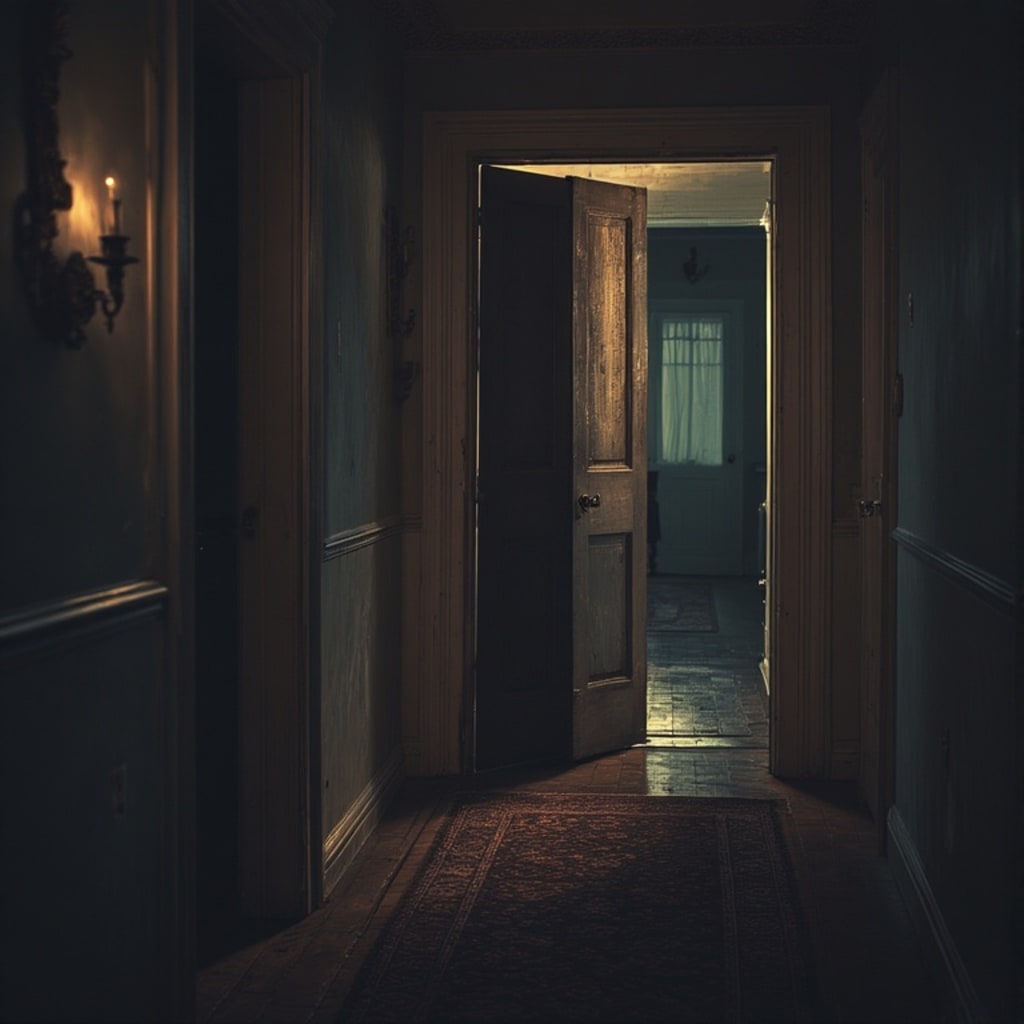
The first time the phone rang at two in the morning, I thought it was a prank. The second time, I ignored it. The third — the one that splintered my sleep and sat me upright with the taste of rust in my mouth — was different. The voice on the other end didn't waste words.
"Listen," it said. "Don't go into the room on the third floor."
I laughed, because that's what you do when someone tells you not to do something at two a.m. "Who is this?"
The line breathed. "It's your house."
My laugh died. I lived alone in a thin-walled Victorian I bought because the rent was mercifully low and because I liked the idea of living in a place that carried stories. Neighbors told stories about it — whispers in the attic, miners who never left, a family who vanished in 1923. Those tales were good at parties. They had not been meant for midnight phone calls.
"You're joking," I said.
"You already know." The voice was low, threaded with something like amusement. "Third floor. Don't open the door."
I hung up. My hand trembled. The lamp on the bedside table cast a tired circle of light; the rest of the room held its breath. The clock ticked too loud, as if trying to help convince me the world was still orderly.
In the morning I told myself I had dreamed it. People tell themselves that kind of lie because it's soft; it makes the day bearable. But the house protested. A floorboard groaned in the hallway where no one had walked. The curtains in the front room twitched though the windows were latched. At noon, as I climbed the stairs with a mug of coffee, I found a smear of something dark on the landing leading to the third floor. It could have been oil, or mud. It looked more like iron.
That night I locked the doors and slept with the television on until the glow felt like company. At one a.m., curiosity bruised the skin of good sense. I told myself it was practical: check whether there was a source, an explanation. I padded up the stairs, the hall light off so I wouldn't advertise my fear.
The third floor landing smelled wrong: cool and metallic, like a dismissed hospital. The door at the end of the hallway — the one that had always been painted a tired green — had a strip of light at its base, a gutter of weak yellow that shouldn't have been there. I stopped in the hall, listening. There was a sound: not a human breathing but a faint tapping, like someone setting type.
I pressed my ear to the door. Nothing at first, then the staccato again — like a pen being dragged across paper. I opened it.
The room was empty in the way an emptied safe is empty: neat, deliberate, as if the thing it had been holding had been removed with care. The bedframe sagged, wallpaper peeled in long ribbons, and a desk by the window held a single sheet of paper. My reflection in the glass looked wrong: paler, eyes rimmed with exhaustion.
On the paper, a note in my handwriting.
Don't go into the garden.
I dropped the paper. I had not written that. The air felt thick with the wrongness of it, an ache behind the teeth.
I locked the door behind me and didn't sleep. Dawn crawled in slow and apologetic, and I sat with the note in a kitchen that tasted like stale coffee. I took a photo of the paper with my phone because proof is the armor of the modern world. The image was a smudge; under the camera's lens the paper read blank, unmarked, as if the sentence had been visible only to my eyes.
Two days later, another note appeared. This one lay on the kitchen table beneath the sugar jar.
Go to the address: 57 Holloway Lane. Bring the lantern.
57 Holloway Lane was a place two towns over that an old library map had labeled "vacant lot." I didn't own a lantern. The instruction tugged at a string of memories I didn't know I had: my grandfather in photographs, his hands stained with coal, the stories my mother told with a laugh and a shiver. He'd been a miner. He'd moved towns. He'd been gone before I could understand his absence.
I packed a backpack like someone going on a mild adventure: a flashlight, a pocketknife, a raincoat, a bottle of water. I borrowed a lantern from my neighbor, Mrs. Crewe, who insisted I take a real one and not a torch. "Old houses like the light of a lantern," she said, handing it over as if passing a relic. Her palms smelled of soap and lavender.
Holloway Lane was colder than I expected. The houses leaned toward each other like old men talking privately. Number 57 sat with its bones showing: windowpanes boarded, porch slumped. The lantern hung from a rusted nail on the porch like a patient thing. Tucked under it was another note.
Bring the match.
I struck a match on the heel of my thumb. The sulfur burned bright and stupid. I lit the lantern and the porch came alive in a warm, trembling circle. The light looked ancient, the kind that made dust motes look like tiny planets. The door to the house was ajar.
Inside smelled like iron and old books. For a moment it was just an abandoned house, a museum of someone's neglect — wallpaper flayed, furniture collapsed. But in the middle of the parlor propped in a gilt frame was a photograph: a family portrait I knew before I knew why. A woman, two children, a man with dark eyes that seemed to pull light away.
On the back of the frame, a note — in my handwriting: Do you remember him?
My breath stalled. The man in the photograph was my grandfather. He had died before I was born. I knew his name from family conversations, an edge of pride and sorrow in my mother's voice. Seeing him here, in a house we'd never been to, felt like stepping into someone else's memory. But the smaller handwriting beneath my own said: He never left Holloway. He opened the door.
A draft moved through the room, and with it the hollow click of a key turning far down a hall. I turned toward the sound and saw, at the head of a narrow staircase, a door set into the plaster where there had been nothing on any blueprints I'd ever seen of the house. The wood was darker than the rest, the keyhole impossibly small, the craftsmanship precise. Beside it someone had painted, in a hand that looked painfully familiar: DON'T.
A key lay on the top step as if waiting for me. It was small. It was black. It felt like a thing that belonged to an older world. When I picked it up, it was warm.
I have never been a brave person. I do not pretend otherwise. I am a man who calls his mother after a plumbing leak and Googles instructions. But there are moments when something inside you pushes, and you either step forward or you let that push lull you into a life without answers. For reasons that make less sense every time I try to explain them, I slid the key into the tiny hole.
The key turned with a soft, reluctant click. The door breathed. The seam widened. The light from the lantern stretched and fell away into something that wanted the light the way a throat wants air.
Something moved in that dark. It was not human. It moved with a patience that felt older than houses, slower than animals. Pale points opened in the black, blinking like eyes or like reflections on wet stones. A voice came from the dark that sounded like paper being folded: my name, but older, threaded with the echo of someone else's mouth saying the same syllables.
"Don't," it said, my voice and not my voice at once.
Then the darkness spoke in a chorus — not loud, but filling — voices like pages turning, like breath pulled through book spines. It said a sentence I could not have known and could not deny.
"Welcome home."
The door closed behind me, not with a slam but with the precise, final motion of something that had been waiting a very long time.
In the dark beyond the threshold, where the lantern's glow died, the air tasted like pennies and rain and the old coal dust in my grandfather's hollows. For the first time since I moved into the Victorian, the stories felt less like stories and more like instructions. Somewhere in the hush, a clock started to tick in a rhythm that matched my heartbeat.
Then something soft and patient reached for my hand.
About the Creator
Marko
Wholesome ones
Keep reading
More stories from writers in Fiction and other communities.
So You Decided To Become a Nurse Practitioner:
So you decided to become an "Advanced Practice" nurse. Congratulations!... is what I would say if this was a good idea. Grad school? In this economy? What were you thinking? Likely it was something along the lines of either 1) “I've seen these other chucklefucks do it— Why can't I?” or even 2) “I've got a nice career, I should shake it up. I miss feeling like I have no clue what I'm doing.”
By Sandor Szabo4 days ago in Fiction




Comments
There are no comments for this story
Be the first to respond and start the conversation.