
Why Carrots Are Different Colors & Fun Facts
Carrots come in colors other than orange.


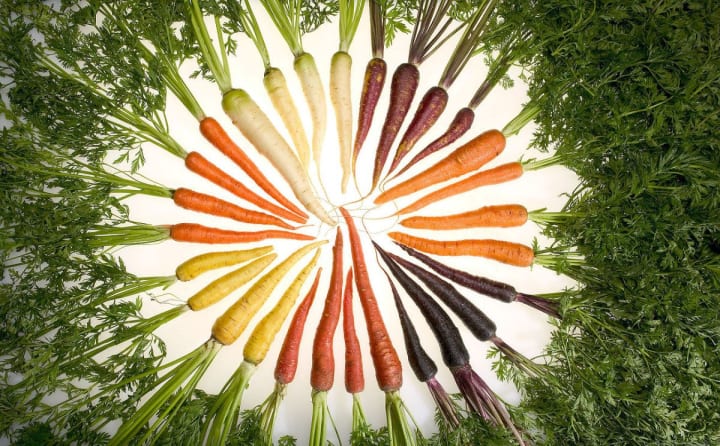
Most people know that the carrot is a root vegetable that is usually orange in grocery stores and at farmers' markets. What some people might not know is that carrots can be other colors, as well. They can be white, yellow, red, magenta, and purple.
Another interesting fact about carrots is that although most people eat the root and throw away the stems and leaves, these discarded greens are also edible. At one time, carrots were grown for their leaves and seeds rather than for their roots. Thousands of years later, people began to eat the root and discard the leaves.

Not All Carrots Are Equal
The color on the outside doesn't always match the color on the inside. Orange carrots are orange on the outside and inside because they contain a high amount of beta-carotene. Purple carrots are different colors inside because of their high anthocyanin content. Their insides could be either orange, red, or white.
Carrots are different colors because of their pigment. The orange color is due to carotenes, and the yellow color is due to anthocyanins.
The color also depends on how the vegetable is grown. The color is based on the time of year the seed is planted, weather conditions, the condition of the soil, and the amount of sun and water the seed receives. Farmers know how to plant and cultivate the carrots they want by abiding by those conditions.
Taste of the Different Colors of Carrots
All the colors do not taste the same. The taste is different, even though it might be a slight and subtle change among the colors. The small difference is noticed most when eaten raw rather than when they are cooked.
Nutrients of Carrots
The part that people eat is the root that contains many different nutrients. They also contain beta-carotene, which must be in a person's diet because the body cannot produce it.
Carrots contain a large amount of vitamin K, vitamin B6, carbohydrates, protein, fiber, and fat. Free sugars in carrots include sucrose, glucose, and fructose.
A carrot’s water content ranges from 86% to 95%, and the edible portion consists of around 10% carbs. Carrots contain very little fat and protein.
The nutrition facts for two small-to-medium raw carrots, or 100 grams:
- Calories: 41
- Water: 89%
- Protein: 0.8 g
- Carbs: 9.0 g
- Fiber: 2.7 g
- Fat: 0.1 g
Carrot Dishes
Carrots are eaten in a variety of ways. They are eaten raw as a snack and in salads. It is common for them to be chopped, boiled, fried, stir-fried, or steamed, and cooked in soups and stews.
Carrots are added to pot roasts and other main dishes for flavor and presentation. They can be cut into thin strips and added to mixed vegetables and rice. Small carrots in lunch boxes are often a great treat for kids and adults. The vegetable is so versatile that it can be puréed and fed to babies and given to pets.
Miniature Carrots

Miniature carrots aren't grown that way. They are larger carrots that have been shaved down to be appealing to customers, so the grocery stores can increase the price. Carrot juice comes from the shavings and is also sold.
Baby carrots are very sweet and tender because what you buy is actually the core and not the full-size carrot.
Tidbits About Carrots
- It is a myth that eating carrots improves vision.
- Some people are allergic to carrots.
- It takes about four months for the vegetable to go from seeds to mature carrots. It could take a shorter or longer period of time to grow, depending on the right conditions.
- Carrots can be stored in the refrigerator and will last for several months.
- Carrots are delicious as a snack when dipped in Ranch dressing.
- Over 875,000 tons of carrots are produced and sold in the United States each year.
- Carrots rank ninth out of 28 vegetable crops in the United States.
- California is known as the "Carrot Capital of the World." About 90 percent of carrots come from Kern County, California.
- Texas, Wisconsin, and Minnesota are also large producers of carrots.
- Commercial crops of carrots bring in more than $70,500,000 each year.
Feel Free to Comment
Sound off in the comment section about what you like or dislike about carrots.
About the Creator
Margaret Minnicks
Margaret Minnicks has a bachelor's degree in English. She is an ordained minister with two master's degrees in theology and Christian education. She has been an online writer for over 15 years. Thanks for reading and sending TIPS her way.
Reader insights
Outstanding
Excellent work. Looking forward to reading more!
Top insights
Easy to read and follow
Well-structured & engaging content
Expert insights and opinions
Arguments were carefully researched and presented
On-point and relevant
Writing reflected the title & theme
Keep reading
More stories from Margaret Minnicks and writers in Feast and other communities.
Is Popcorn a Healthy Snack?
Many people love popcorn and eat it often, even if they are not at the movies. Americans eat more than 17 billion quarts of popcorn a year, which averages out to about 43 quarts per person. People used to eat popcorn only when they went to the movies, but now, it is consumed at ballparks, other sporting events, picnics, and at home.
By Margaret Minnicks7 months ago in Feast
Why Matar Paneer Is India’s Ultimate Vegetarian Curry
There are some dishes that do more than just satisfy hunger — they create memories. For many Indian families, Matar Paneer is one such dish. It is warm, comforting, and deeply rooted in North Indian cuisine. Whether served during a Sunday family lunch or at a festive gathering, this simple yet rich curry has a way of bringing people together.
By Gaurav Guptaabout 18 hours ago in Feast
Eat During Chinese New Year
The Chinese New Year feast is traditionally abundant with meat dishes, but these 15 vegetarian recipes prove that plant-based eating can be just as festive, flavorful, and meaningful. Each dish carries auspicious symbolism while delivering incredible taste that will have everyone reaching for seconds—even the meat lovers at your table. From crisp greens to creative vegetable transformations, these recipes are designed to impress.
By yue . shui4 days ago in Feast
I wanted to title this something different, but worried that my chosen title might cause problems entering the United States in the future so this is the new title. It's the greatest title. No one has ever written a title better than this. (All titles unrelated to content).
Let me be honest. I am finding this difficult. Now, I like a challenge, a stretch, a bit of an obstacle course. “Write about the decline of the British Empire in the form of a narrative poem in which your protagonist is an artichoke” I read, and flex my fingers. “Write a haiku to evoke the sensation of sibilance using only the first half of the alphabet.” “Well”, I think to myself, “this should be fun.” But “write about a system that isn’t working”? A system that isn’t working? Now? In 2026? ONE system? My favourite system that isn’t working? The sexiest system that isn’t working? The one giving me the most angst day to day? The one giving me the most existential dread? I am, as I say, finding this difficult. I will own that I have contemplated writing a thousand words on why the steady “all on” setting on my fairy lights is the EIGHTH of seven options which must be sequentially activated to get there, because that is a system that some fool came up with and it definitely doesn’t work, and now who is paying the price, eh? But how can I write about my fairy lights when…. When…. When….
By Hannah Moore5 days ago in Humans



Comments (2)
I like Carrots slightly boiled or raw. I prefer not to over boil, because over boiling can destroy the nutrients and quality of taste.
Extremely interesting and colourful