
The Top 10 Places to Eat American Fare - And What That Fare Really Is.
Merry Monday Edition

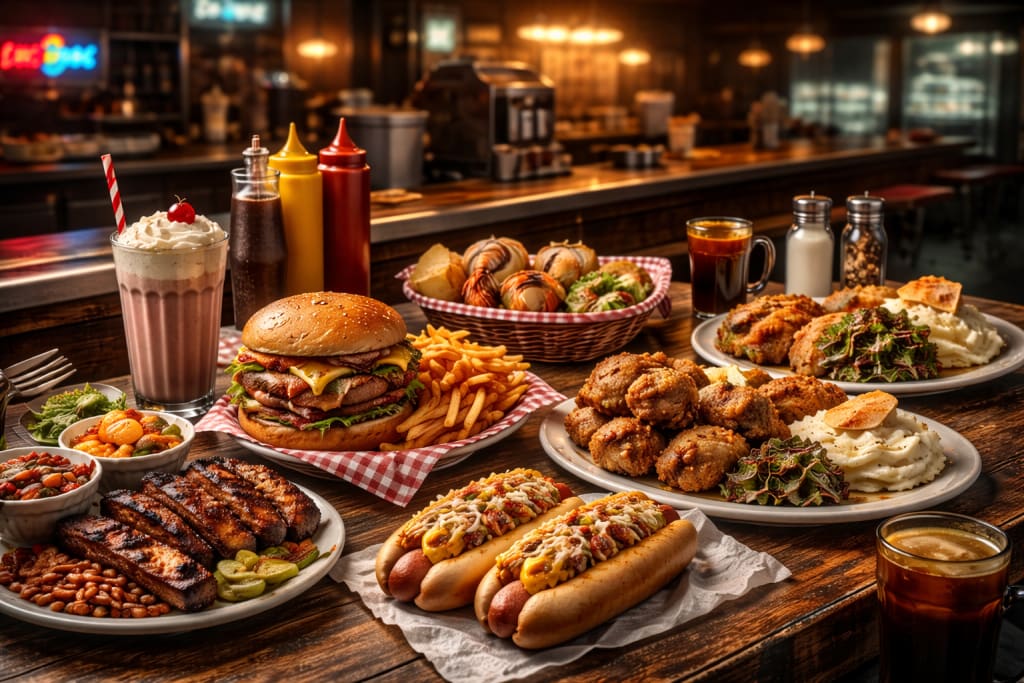
America has never been especially good at pretending. Our food didn’t come from royal courts or marble kitchens. It came from hunger, hard labor, long hours, and the simple need to make something filling out of what was available. American fare wasn’t designed to impress anyone. It was designed to work.
And somehow, against all odds, it became culture. These aren’t the “best restaurants.” These are the places where American food came into being and forged its identity. Where recipes survived not because they were trendy, but because people kept coming back. Again and again. For decades. This is where American fare lives!
1. The American Diner
Before fast food chains standardized everything, there was the diner. A long counter. Vinyl booths. Coffee that never stopped coming. Burgers sizzling behind a short-order cook who didn’t need to write anything down. Meatloaf on Wednesdays. Pancakes at midnight. Pie under glass domes.
The diner is America’s most honest restaurant. It doesn’t ask who you are or where you came from. Truckers, teenagers, night-shift nurses, retirees, and travelers passing through all sit side by side. Politics stays unspoken. Life gets discussed anyway.
The food is straightforward because it has to be. Burgers, fries, eggs, sandwiches, meals that don’t need explanation. This is nourishment for people who are tired and still have somewhere to be. If democracy ever needed a dining room, it already had one.
2. Texas Barbecue Joints
Texas barbecue isn’t food. It’s a commitment! Brisket that takes all night. Smoke that settles into your clothes. A line out the door that starts forming long before the meat is done. There are no shortcuts here, and nobody apologizes for it.
The origins are practical... Meat preservation, community gatherings, and feeding large groups, but the result became something else entirely. Barbecue turned patience into flavor. Time became the most important ingredient.
When you order, nobody asks how you want it. The pitmaster decides... Slices come wrapped in butcher paper, not on plates. Sauce is optional, and sometimes quietly discouraged. This is American food at its most stubborn. And it's most proud.
3. Southern “Meat-and-Three” Cafeterias
Walk into a meat-and-three, and the decision is already half made for you. You choose one meat... fried chicken, pork chops, or country steak. Then three sides: green beans cooked soft, mac and cheese baked until the edges are crisp, and cornbread that crumbles just enough to soak up gravy. This food didn’t come from abundance. It came from making sure everyone ate.
Meat-and-threes grew out of church kitchens, family tables, and communities where feeding people mattered more than impressing them. Portions are generous because they’re meant to sustain. Recipes are familiar because they’ve been passed down quietly.
Nobody rushes you out. Nobody reinvents the menu. This food doesn’t chase trends. It waits for you to come back.
4. New Orleans Po’ Boy Shops
The po’ boy didn’t start as a novelty. It started as solidarity. Built to feed working-class people cheaply and well, it became something bigger. Crispy bread, fried seafood, or slow-roasted beef, dressed with lettuce, tomato, and mayo, sometimes drowning in gravy.
You don’t eat a po’ boy delicately. You lean into it. It’s messy. It’s loud. It tells you exactly where you are the moment you take a bite. Po’ boy shops don’t care about decor. They care about getting it right. The bread matters. The balance matters. The history matters, even if it’s never written on the wall.
This is American food shaped by labor, culture, and place, impossible to separate from its city.
5. Midwest Supper Clubs
Supper clubs don’t advertise urgency. They expect you to stay awhile. Prime rib is carved thick. Relish trays that arrive without asking. Old Fashioneds are made the same way they were fifty years ago. Dim lighting. Familiar faces. Conversations that move at the speed of comfort.
These places were built for communities that valued ritual. Friday nights. Special occasions. Food as a reason to gather, not something to rush through.
The menu doesn’t change much, because it doesn’t need to. The experience is the point. Supper clubs are reminders that American food was once about time spent together, not efficiency.
6. Coney Dog Stands
The Coney dog is chaos disguised as simplicity. A hot dog buried under chili, onions, and mustard, eaten quickly and without apology. It’s cheap, filling, and unapologetically messy.
Born of immigrant ingenuity, Coney offers something fast and satisfying for people working long hours on little money. The result wasn’t refined, but it didn’t need to be. The taste ruled the day.
This is food that understands its role. It doesn’t aspire to elegance. It exists to get you through the day. Sometimes the night. American fare doesn’t always need to be pretty. Sometimes it just needs to work.
7. New England Lobster Shacks
Lobster wasn’t always a luxury. It was a fisherman's food. Abundant. Practical. Something you ate because it was there. Lobster shacks keep that truth alive. Picnic tables. Paper plates. Butter on the side. No garnish trying to steal the spotlight.
The best ones don’t complicate things. A lightly toasted roll. Cold lobster meat. A squeeze of lemon if you want it. The ocean does the rest. This is American food, reminding us that simplicity, done right, doesn’t need reinvention, because it doesn't get much better than that.
8. Southwest Chili and Taco Culture
Southwestern American fare doesn’t belong to one story. It belongs to many. Chili simmered all day. Tacos were built from necessity. Enchiladas, fry bread, layered with history. These foods came from borders that moved while people stayed put.
This is American food, born of blending cultures, overlapping, adapting, and surviving. Recipes evolved because they had to. Ingredients changed. Techniques merged. What remained was the flavor that tells the truth about where it came from.
9. Appalachian Home Kitchens
Appalachian food is quiet. Beans cooked slowly. Cornbread baked simply. Ham hocks stretched across multiple meals. Nothing wasted. Everything used. This food came from scarcity, not abundance. From mountains where growing seasons were short, and supplies were limited. What developed was a cuisine built on care and conservation.
You won’t find a flashy presentation here. What you’ll find is nourishment that carried families through generations. Food that didn’t need attention to matter.
10. Roadside Grease Pits and Drive-Ins
Neon lights. Gravel parking lots. Burgers wrapped in paper. Milkshakes are thick enough to fight back.
Drive-ins and roadside stands are American car culture on a tray. You eat leaning against your door, talking through open windows, watching headlights pass. This food isn’t about ambiance; it is the ambiance. Summer nights. Long drives. No reservations required. When America learned to move, this food moved with it.
The Iron Lighthouse Truth
American fare didn’t come from test kitchens or branding meetings. It came from people trying to make it through the day, and sometimes the night. These places matter because they fed workers, families, travelers, and towns. They stayed when trends passed. They disappeared when communities changed. And the ones that remain are doing something quietly heroic: holding memory on a plate.
Because you can learn a lot about a country by what it eats. And... even more by what it refuses to forget!
About the Creator
The Iron Lighthouse
Where folklore meets freeway. A guide to the strange heart of the American backroads...
Keep reading
More stories from The Iron Lighthouse and writers in Feast and other communities.
10 American Foods You Can Only Find in One Place
America’s got its fair share of iconic eats; cheeseburgers, hot dogs, apple pie... but the real culinary gold is hiding in plain sight! Tucked away in diners, bakeries, and mom-and-pop joints from coast to coast are dishes so hyper-local, they simply don’t exist anywhere else. These aren’t just regional favorites; these are one-town wonders, guarded recipes, and traditions you’ll need to travel for.
By The Iron Lighthouse6 months ago in Feast
Countdown Cookies
This is not a drill. These cookies are the bomb. Super simple and nigh-infinitely customizable, this addictive shortbread will leave your waistline in peril. I don't have any photos because the last batch of lemon variants didn't make it long enough and I'm finally out of flour.
By Maia Gadwall the metAlchemist6 days ago in Feast
National Pizza Day: Why One Simple Slice Means So Much
Pizza has a way of showing up when life feels heavy and when it feels worth celebrating. It is there after long days, during late-night talks, at family tables, and in quiet moments alone. That is why National Pizza Day feels less like a food holiday and more like a shared pause. It invites people to remember comfort, routine, and small joy. Whether it is a folded slice eaten on the street or a homemade pie cooling on the counter, pizza carries memory with it. This article explores National Pizza Day not as a marketing moment, but as a cultural habit. We will look at where it came from, why people care, and how a simple slice became something so deeply emotional.
By Muqadas khan3 days ago in Feast
Foot Bindings
I asked my grandmother how she knew she'd fallen in love. I am not sure I ever did love him, she said. This was before I met my husband. I was naive, a naked spring, a raw nerve of a thing. That cannot ever be me, I knew. Sadness swept in gently like a Moscow thaw. It is no simple thing, looking into a woman's vast soul and seeing its foot bindings. Now, in Italy divorced with my skin singed off, when I say I don't love him mean: I have succeeded at feeling nothing most days and it mostly works. Do you want the comfort of Nothing? Do you want Nothing, too? Be warned: you'll never be free, even when you are nothing. Here is what doesn't work: Accepting the stages of grief. Talking about it. Sitting with the feeling. Missing him—no, the person you were when you believed in death do us part. Writing poetry. That, too. When I say I don't love him I mean: I feel capsized in an endless, starved tide. What sometimes works: selective memory. You must forget ripe tomatoes and his beard and feeling perfectly sheltered in a big blue world. Forget coffee in bed, laughter watching TV, blowing out the candles on the birthday cake and the quiet all-encompassing knowledge that you are chosen. Remember only how love turned to a banal everyday survival act, a trapeze act unsure whether he will catch you, how the warmth stagnated and became sour, remember the foot bindings and remember the resentment boiling in your veins as you stick it out for the kids. Six-hour Netflix binges help, too. A man's fingers tracing your spine. Frozen pizza at 2 a.m. Random trips to the museum just to stand near things that last a while. The realization that crying won’t change anything. Seeing that life is just a dream, and refusing to participate in your own suffering. Bite your fist. Walk on eggshells around joy. When I say I don't love him, I mean he didn’t break my heart, he just stopped touching it and it forgot how to beat right.
By Ella Bogdanova4 days ago in Poets



Comments
There are no comments for this story
Be the first to respond and start the conversation.