


The writer Ermanno Volterrani — known in the Livorno area above all for his revaluation of the vernacular in collections of poems such as “My friend mullet”, but also the author of texts in Italian, among which the moving account of the events experienced by his father during the war in Albania stands out — presents the fictionalized biography of Gastone Biondi.
Gastone’s daughter, Caterina, and Otello Chelli, a leading figure in the Livorno culture and tradition, who wrote the preface of the book, collaborated in the drafting of the text.
Gastone Biondi was the owner of the famous Vittori liqueur factory that produced, and still produces — even if it has now been taken over by Arkaffè — the fantasia rum, the special ingredient for the preparation of rum punch, or rather, the “rumme”, let’s not confuse I beg you!
The origins of the drink are uncertain, legend has it that in the seventeenth century some bales of coffee, coming from a Saracen ship diverted by the knights of Santo Stefano, were confused with barrels of rum. The mixture, instead of ruining both elements, exalted them. In fact, it seems that Admiral Edward Vernon, of the English navy, in order to avoid the drunkenness of his men, ordered them to water the rum and they, to obey, drank it with tea, creating the basis for the grog. The Leghorns replaced tea with the more available and cheaper coffee, maintaining the tradition of “sail”, the slice of lemon astride the glass, often used to sanitize the rim but then, alas, dropped into the mixture, with the idea that “What the eye don’t see, the chef gets away with.”
The boiling punch should be drunk in the “gottino”, the glass cup, holding it between two fingers by the thick bottom, otherwise you get burned.
The name derives from the English punch which, in turn, dates back to the Hindi pancha, that is, five, as are the ingredients of the drink.
Punch, English like rum and Arabic like coffee, was the favorite drink before the war, a metaphor of Livorno, a crossroads of identity in this mestizo city, a fusion of seemingly irreconcilable ingredients. There was not a day that the people of Livorno did not drink the punch that has always been part of their tradition.
In the chronicles of the eighteenth and nineteenth centuries (Otello Chelli explains to us) there was a real rush to create the best punch and the producers put everything in it, from caramel to peppercorns. The bars were meeting places for the people, where they discussed and became acquainted, and also intellectual lounges. Francesco Domenico Guerrazzi and Angelica Palli, Fattori, Natali, Modigliani spent their time there, especially in the famous Bardi café.
Punch is mentioned in Artusi as a worthy accompaniment to cacciucco, it is said that it even gave the rude Buffalo Bill tears, and Carducci writes about it as follows:
“We drank black punch and with profound know-how, we never left a cup or glass without seeing the bottom.”
Livorno was the city of a hundred theaters, but also of one hundred and twenty-three bars, it was the Labronics who built the first coffee machines, which, in those days, were towers of shiny copper. “In Venice district alone”, Othello tells us, “in my day there were seventeen wineshops and the preferred drink, after Sammontana wine, was obviously punch, capable of stimulating that Leghorn spirit, that salacious motto, that lightning joke that today is being lost and diluted. “
In Piazza Vittorio Emanuele there was a bar, called “Il Diacciaio” because it was located in front of a very cold hotel, which sold “ponce peciato”, that is, blackened by a pinch of pitch. In Piazza Cavallotti no one gave up the “Persian” in the morning — cold water, mint and anise — to sober up the previous evening, then, already at ten, to accompany a piece of flat bread with ham or mortadella, nothing better than the first punch, to pass immediately to the digestive after lunch and the inevitable nocturnal punch.
In the fifties, however, the punch had decayed and it was Gastone Biondi who brought it back to the glories of the past.
It is with a voice broken by emotion that his daughter Caterina tells how the book was born by chance. Ten years after her father’s death, she reopened two boxes, finding in them a world of memories that brought her back to when, as a child, she played in her father’s factory, absorbing smells, assimilating voices, playing with old bills with her little friends, until that game turned into a passion and a profession for her too, who worked side by side with her father for a long time.
Gastone Biondi was orphaned at the age of nine, he studied and worked until he enrolled at university and found a job in a bank. But the meeting with his wife, whose relatives owned the liquor factory, was fatal, because it was love in both cases, to the point of making him leave the attractive banking job to take care of the factory full-time, founded in 1929 and which he took over in the 1950s, transforming it into the Vittori of Biondi company.
In Livorno, in those days, there was a lot of competition, there were twenty distilleries and branded liqueurs were starting to take over, but Gastone focused on quality, on the best ingredients for the production of his fancy rum. “He came”, says her daughter, “to old Gigi Civili with samples of the liqueur to have them tested.” He wanted to redefine the Livorno identity also through the labels.
Otello Chelli tells us that he met Vittori when, with his family, after his deportation, he was a “guest” in a colony adapted to a refugee camp. Here the young Otello traded with the Americans who asked for gin and he bought it in the Vittori distillery, thus managing to support the whole family. He then also had many contacts with Gastone Biondi.
To conclude, we report a poem by Ermanno, the author of the book, which contains the recipe for the glorious labronic mixture.
‘The ponce alla livornese, don’t you know how to make it’?
don’t worry, I’ll teach you!
Get a glass,
a little thicker than the coffee ones,
enough that it has a beautiful double bottom:
not to burn your fingers,
the ponce, you know,
should be drunk by taking it by the bottom,
In short…
you must take it by the ass.
For quite a lot, warm the glass with steam,
a teaspoon of sugar … abundant,
A lemon peel acts as a sail
and rum, Fantasia, do not be wrong,
Bacardi and Pampero are not fine!
You need Vittori’s drink,
accountant Gastone Biondi’s concotion
he invented it a fucking long time ago.
So, let’s go back:
again you warm the rum until it boils
and in the end,
fill the small glass with coffee,
a very strong one!
If you then think it pleases you,
the ingredients you may adapt to personal taste,
mixing Sassolino or Tre Stelle cognac
and the result doesn’t change:
to garganella the flavored punch
the gargarozzo will tickle you.
About the Creator
Patrizia Poli
Patrizia Poli was born in Livorno in 1961. Writer of fiction and blogger, she published seven novels.
Keep reading
More stories from Patrizia Poli and writers in Feast and other communities.
Massimiliano Nuzzolo, "La felicità è facile"
A good writer is like an actor, he interprets, he doesn’t necessarily give you his vision, he identifies with the characters even when they think in the opposite way. And Massimiliano Nuzzolo is a good writer, his stories have a precise and studied language, “supervised” as they say, of great effect, and also have a good framework and original arguments. “Happiness is easy” is a collection that reconciles with the genre of the short story, set aside in recent years, or used as an expedient by those who cannot express themselves with a wider breath. Here, however, there is content — even messages conveyed in a subliminal way — there is a structured and harmonious development of the plot, and finally, there is a caustic and fun but also lyrical style.
By Patrizia Poli3 years ago in Humans
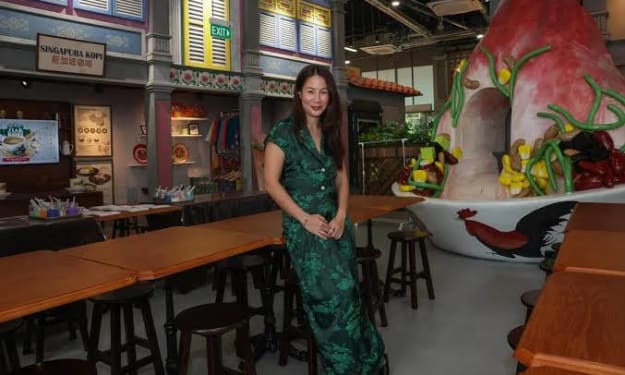
Widow invests $800,000 to start hawker culture experience centre in honour of late husband
In a touching tribute to love, memory, and cultural heritage, a Singaporean widow has invested nearly $800,000 to establish a hawker culture experience centre dedicated to preserving and celebrating the vibrant food traditions that her late husband cherished throughout his life. The centre, which opened recently in Singapore, aims to provide visitors with an immersive journey into the country’s beloved hawker culture while honouring the legacy of a man who spent decades supporting local food vendors. The project was initiated by Lim Mei Hua, whose husband, Tan Wei Chong, passed away three years ago after a long illness. Tan was widely known among friends and family as a passionate supporter of traditional hawker stalls and frequently spent his weekends exploring different food centres across Singapore. According to Lim, the idea of creating a space dedicated to hawker heritage had long been one of her husband’s dreams. “He always believed that hawker culture was the heart of Singapore,” Lim said during the centre’s opening ceremony. “After he passed away, I wanted to do something meaningful that would keep his passion alive and allow future generations to understand why these traditions matter.” Singapore’s hawker culture is a cornerstone of the nation’s identity. The bustling open-air food centres, filled with vendors serving affordable and diverse dishes, reflect the multicultural roots of the country. In recognition of its cultural importance, UNESCO added Singapore’s hawker culture to its Representative List of the Intangible Cultural Heritage of Humanity in 2020. Lim’s experience centre is designed to showcase this heritage through interactive exhibits, live cooking demonstrations, and storytelling sessions led by veteran hawkers. Visitors can learn about the origins of iconic dishes such as Hainanese chicken rice, Laksa, and Char kway teow, while also exploring the personal journeys of the hawkers who prepare them. The centre includes a small exhibition gallery featuring photographs, kitchen tools, and handwritten recipes collected from hawker families across the city. Many of these items date back decades, offering a glimpse into how culinary traditions have been passed down through generations. One section of the centre recreates a traditional hawker stall environment, allowing visitors to experience what it feels like to work behind the counter during a busy lunch rush. Young participants can try their hand at simple cooking techniques while learning about the discipline and dedication required to master hawker cuisine. Local hawkers have warmly welcomed the initiative. Many worry that younger generations may be less interested in taking over family stalls, which often involve long hours and physically demanding work. By highlighting the cultural significance of these businesses, Lim hopes the centre will inspire renewed appreciation among the public. “Hawker food is not just about eating,” said veteran vendor Ong Kee, who participated in one of the centre’s demonstration sessions. “It’s about history, family, and community. Places like this help remind people why our traditions should continue.” Beyond cultural preservation, the experience centre also aims to support hawkers economically. A portion of ticket sales will be directed toward training programs for aspiring food vendors, helping them learn both traditional recipes and modern business skills. Lim believes this approach can help sustain the industry while adapting to changing times. Tourism officials in Singapore have also expressed optimism about the centre’s potential to attract international visitors interested in culinary experiences. Food tourism has become an increasingly important part of the country’s travel industry, with visitors eager to explore authentic local cuisine. For Lim, however, the centre’s true purpose goes far beyond tourism or business success. Every corner of the space reflects memories of her husband—his favorite dishes, the stalls he frequently visited, and the stories he loved to share. “Whenever I see people enjoying the exhibits or learning about hawker culture, I feel like his spirit is still here,” she said quietly. “This place is not just about the past. It’s about keeping something precious alive.” Through her remarkable gesture, Lim has transformed personal grief into a lasting tribute that celebrates love, heritage, and the enduring power of food to bring communities together. Her $800,000 investment ensures that the spirit of Singapore’s hawker culture—and the memory of the man who cherished it—will continue inspiring generations to come.
By Fiaz Ahmed 2 days ago in Feast



Comments
There are no comments for this story
Be the first to respond and start the conversation.