
The New Food Pyramid Sounds Bold. That Doesn’t Mean It’s Settled.
A Necessary Counterpoint

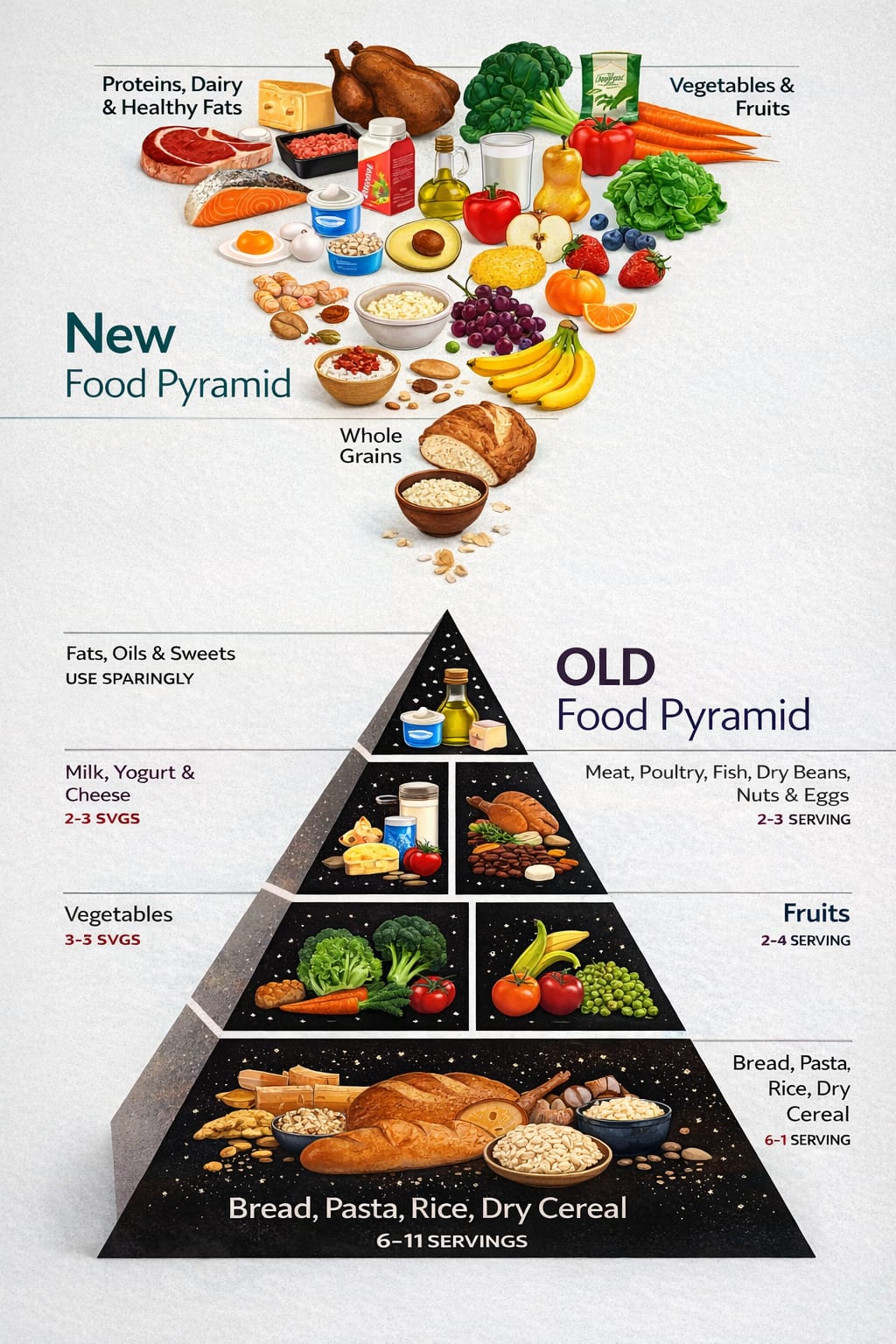
The food pyramid has been rewritten, flipped, and reframed. Protein is back in favor. Fat is no longer the villain. Ultra-processed food is finally named out loud.
This piece continues my earlier article, The Food Pyramid Has Been Flipped, which examined why the 2026 nutrition guidelines mark a sharp departure from decades of dietary advice.
On paper, this feels like progress.
But nutrition is not a courtroom where one diagram wins and the other is dismissed. It is a long argument with biology, behavior, economics, and time.
And that is where the new food pyramid deserves a second look.
When Correction Risks Becoming Overcorrection
The old pyramid overstated the safety of refined carbohydrates. That much is clear.
The new pyramid responds by swinging the spotlight toward protein and fat. The intention is understandable. Satiety matters. Muscle matters. Metabolic health matters.
But nutritional history has a pattern: when one villain is exposed, another hero is crowned too quickly.
High protein intake works well for some bodies. It does not behave the same way in all populations, ages, or health conditions. The science here is strong, but not universal.
Guidelines written for everyone must be careful not to reward one physiology while ignoring others.
Red Meat, Context, and the Problem of Headlines
One of the most controversial elements of the new pyramid is its relaxed stance on red meat and saturated fat.
Context matters here.
Whole cuts of meat consumed occasionally within a balanced diet are not the same as processed meats consumed daily. Yet visual guidelines struggle to communicate nuance. What they simplify, people amplify.
The concern is not that red meat exists in the pyramid. The concern is how easily nuance disappears once the message leaves the page.
Nutrition advice does not fail in laboratories. It fails in kitchens.
Ultra-Processed Foods Are the Real Enemy, Not Macronutrients
On this point, the new pyramid is strongest.
For the first time, ultra-processed foods are clearly identified as a structural problem, not a personal weakness. This reframing matters more than whether protein sits above vegetables or below them.
Still, the pyramid risks distraction.
If people debate butter versus olive oil while continuing to eat industrial snacks daily, the real victory is postponed.
Food systems shape behavior more than diagrams do.
The Problem With Diagrams in a Complex World
Pyramids imply hierarchy and stability.
But modern eating is fragmented. Cultural, economic, and psychological forces influence food choices as much as biology. A single structure struggles to represent that reality.
The danger is not that the new pyramid is wrong.
It is that it may be interpreted as final.
Nutrition science evolves slower than trends but faster than policy. Any diagram that presents itself as settled truth risks becoming outdated before the ink dries.
What I Think the New Pyramid Gets Right
To be clear, this is not rejection.
The new pyramid succeeds where the old one failed by:
- Valuing food quality over calorie math
- Naming ultra-processing as a health risk
- Rehabilitating fat from moral panic
- Acknowledging protein’s role in long-term health
These are meaningful corrections.
But correction is not completion.
What It Really Comes Down To
The new food pyramid is a necessary interruption, not a conclusion.
It challenges decades of oversimplification. It opens better questions. It pushes the conversation forward.
But nutrition does not need a new doctrine.
It needs humility, flexibility, and constant revision.
The most honest food guide may not be a pyramid at all, but a reminder:
Eat real food. Pay attention. Stay skeptical of anything that claims to have solved eating once and for all.
******
If you haven’t read the first piece yet, it provides important context for this one.
About the Creator
Aarsh Malik
Poet and storyteller who believes in the quiet power of words. Sharing self-help insights, fiction, and poetry on Vocal.
BUY COFFEE
Anaesthetist by profession.
...
Reader insights
Outstanding
Excellent work. Looking forward to reading more!
Top insights
Easy to read and follow
Well-structured & engaging content
Expert insights and opinions
Arguments were carefully researched and presented
On-point and relevant
Writing reflected the title & theme
Keep reading
More stories from Aarsh Malik and writers in Feast and other communities.
The Food Pyramid Has Been Flipped. Here’s What the New One Really Means.
For decades, we were taught to eat from the bottom up. Grains formed the foundation. Bread, rice, cereal. Protein and fats hovered higher, almost suspiciously. Sugar sat at the top like a guilty secret we all pretended not to touch.
By Aarsh Malik2 months ago in Feast
Pi Day Deals: Sweet Ways to Celebrate March 14 Every Year
Every year on March 14, something unusual happens across bakeries, pizza shops, and kitchens around the world. Math lovers smile, pie lovers celebrate, and people who never cared about numbers suddenly start searching for pie. That day is Pi Day. The date 3/14 matches the first digits of the famous mathematical constant 3.14, and over time it has grown into a celebration of food, curiosity, and simple joy. One of the biggest reasons people look forward to the day is the tradition of Pi Day deals. Restaurants and bakeries often offer pies, pizzas, and desserts at special prices. But Pi Day is not only about discounts. It is about gathering with friends, sharing food, and enjoying a small moment of fun built around a number that never ends.
By Muqadas khana day ago in Feast
Chipotle Tattoo BOGO: The Story Behind the Burrito Deal
Sometimes a free burrito is more than just a meal. Sometimes it becomes a small cultural moment that people remember for years. The phrase chipotle tattoo bogo began as a strange mix of food, loyalty, humor, and internet culture. At first glance it sounds like a joke. Why would anyone get a tattoo for a burrito? But thousands of people actually did.
By Muqadas khan2 days ago in Feast


Comments (3)
LOVE IT> HUGS
That last line I fully agree with. This pyramid seems balanced but also, each body is different. Health conditions in particular, as you mentioned. I can't have a lot of animal protein because I have kidney stones. 🤷 I try and eat well but also, for people who are struggling... The affordable food is not even food. It's all a mess right now and I hope that changes. Healthy food should be accessible to everyone.
Interesting, I didn't know they changed it, Though mine never looked like any of these. I think I have my own pyramid.