
Save the Milk for the Kids
Or, Gallivanting with Gracie

Save the Milk for the Kids
We all know where milk comes from. Human and animal communities around the world have used this rich and nutritious beverage for thousands of years. This mother’s gift has nourished many cultures in countless ways. In the Middle East, camel’s milk sustains nomads on desert voyages for as long as a month. Sheep milk turned to Feta cheese in Greece is used in the delicious dish known as Spanakopita, or Spinach Pie. In India, milk is boiled down to a fresh cheese, Paneer, which absorbs the many numerous flavors added to innumerable curries.
Milk as cheese can be found on the shelf in aerosol cans just begging to be squirted and formed into sticks that children love pulling into strings. It resides in wheels in musty caves, where mold is a blessing in disguise, and pops out in curds fresh from the fryer. Milk is also present in the form of cream in the delicious cocktail known as a White Russian, as well as being a frequent presence adorning a Bloody Mary. Cheese has even been used as a sculptural medium. And let’s not forget the elegant if somewhat lost tradition of Fondue. Both milk and its popular byproduct, cheese, are nearly impossible to avoid.
I am going to talk about one very specific type of milk: goat milk. I was intimately introduced to goat milk while working on a sustainable farm in Massachusetts. I arrived in the autumn, just as the leaves were turning brilliant shades of fire and the air was crisp with the smell of change. It was then that I was introduced to Gracie.
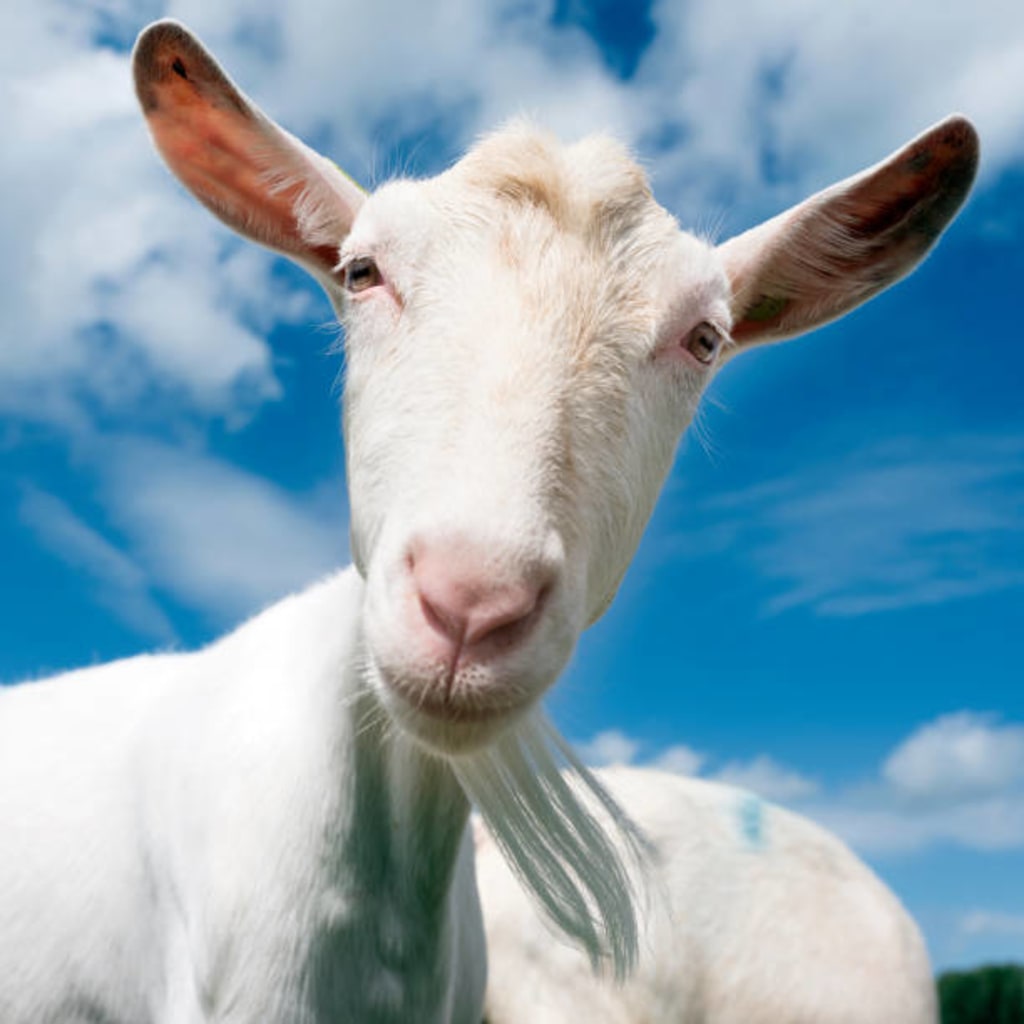
Gracie is middle-aged, strong, large-eyed, and has thick creamy hair. She has very particular habits and a stubborn disposition. She loves the early morning and demands wide expanses of personal space wherever she goes. She is stern with kids and an experienced mother herself. Last of all, Gracie is a goat.
As an outdoor educator and animal caretaker, one of my many duties was to milk the goats regularly. Their milk was used for drinking, for butters, for cheeses, and for soaps. It was of course also consumed by the kids after their birthing. Baby goats, or kids, have a very playful nature, and Gracie, as the resident grandmother goat, was hard-put to keep them under control. She would occasionally become annoyed if they tried to suckle from her as opposed to from their mother. However, this was nothing compared to her frustration at being milked by a human.
This is how I learned not to butt my head in. Gracie was not at all accepting of her role as a provider of milk to humans. Though she would tolerate the little kids playing and nibbling at her nipples, while controlling their rough-housing, her attitude towards humans was painfully clear: SAVE THE MILK FOR THE KIDS. Not human kids… goat kids. I say painfully because instead of me butting my head into her yard to do the milking, she used her head to butt me into the fence. If this didn’t teach me a lesson, nothing else would, she seemed to believe.
This conflict of interests led me to ponder: Is there a delicious substitute for goat’s milk? The answer, after some experimentation, appears in one of my favorite party desserts, which combines my love of color with my love of plant-based dining, in addition to the pleasure of being the potluck guest who is never concerned about being the one to bring a “repeat platter”. How many chip dips does one smorgasbord need? Even variations of guacamole can become redundant, and casseroles and brownies often consume half of the table.
Lo and behold! Do not be dismayed. Though many may hesitate to try it at first, eyeing it with suspicion, the standing ovation for my brilliant deep purple and rich cream cakes is nearly inevitable. Allow me to introduce you to the enticing, adorable, and intensely flavorful Beet and Goat Cheese Napoleon! Only the “goat cheese” is not from goats, rather for goats. Well, not exactly... but it is derived from plants, the primary food source of adult goats such as Gracie.
Like anything worthwhile, this recipe requires several processes. If you have your own herb garden, the growing and gathering of fresh chives, parsley and thyme adds a personal touch to your ultimate dish. A vegetable garden can yield both beets and shallots. Finally, the crucial piece of the puzzle: creating a delectable “goat cheese” that even Gracie would approve of. The process involves three basic steps of culturing; soaking the nuts overnight, blending them with liquids, and covering in a sanitized jar in a warm dark place for another sleepover.
Soak one cup of raw cashews and one cup of raw macadamia nuts, both rich and creamy members of the nut family, for at least three hours or overnight. It is important for the purity of the flavor to use filtered water. After draining the water from the soaked nuts, you will then put them into a food processor along with ¼ c of filtered water, 1 T of organic cider vinegar, the juice of one fresh lemon (watch out for the seeds), and ½ tsp of sea salt.
Now it’s time for sleepover number two! Puree this mixture into a fine blend and scoop it
Into a jar. Place a towel over the jar and store it overnight in a warm, dark place (a cupboard works great - just as you would for kombucha). The next day, you have the option of experimenting with adding any fresh herbs, spices, or even nuts and dried fruit you like. The “goat cheese” is ready to rock’n’roll! Set it aside in the refrigerator.
Beets: time to get sweet, savory and serious. 3-5 medium to large sized beets must be roasted at 400 degrees after removing the greens. (Save these for a tasty salad later!) The roasting will take around 35-40 minutes, depending on the size - they should be tender. After they have cooled, peel off the skins. If thoroughly baked the skins should slide away smoothly. Beets have a glorious purple hue, which will remain on your fingers… who can blame them after being roasted in preparation to be boiled?
They should then be cut into ¼ inch slices, as many as possible. The points and the ends will be difficult to work with and may be discarded. You can use a round cookie cutter to make uniform “slices” (size will depend on the size of beets) and cut out as many rounds as possible. Using a medium-size skillet, boil one cup of cider vinegar and one cup of sugar. Reduce the heat to a simmer and add beet slices in batches – do not overcrowd them. Cook them in the skillet, turning once after about two minutes. When they are cooked, place the slices on a paper towel-lined baking sheet to dry, then place the sheet in the fridge to chill.
As the beets enter the fridge, the “goat cheese” emerges! Stir the “goat cheese in a bowl with three teaspoons each of chives, parsley, and thyme, and add one teaspoon of fresh cracked black pepper. Set the mixture aside. In a saucepan over medium-high heat, bring orange juice to a boil. Simmer until the juice is reduced to 1/3 cup, which will take about four minutes. Allow the concentrate to cool, then pour it into a bowl, adding one teaspoon of thyme, 1 teaspoon of balsamic vinegar, ½ teaspoon of orange zest, and one small shallot (minced). Bring out a whisk and drizzle in olive oil and hazelnut oil in, whisking until smooth. Season the vinaigrette to taste with sea salt and freshly grated cracked black pepper and place it in the fridge to chill.
Finally, all is ready to assemble: Select one beet slice and spread about 1 tsp to 1 tablespoon of cheese mixture over the beet. Stack another beet slice on top to create a sandwich. Spread cheese over the second beet slice and repeat. Keep stacking the beet slices and the cheese alternately until a reasonable stack is created, culminating with a beet slice on top. (Create as many small “beet cakes” as you like). If the beets are large, you can slice each stack into wedges or in half. Place salad greens of choice (I prefer Arugula or a spring mix) on a serving platter and drizzle the orange juice vinaigrette on top. If you like, you can add a garnish of nuts (I have used walnuts or pistachios).
And there you have it – a Beet and “Goat Cheese” Napoleon fit for the queenliest of goats! Which is, if not entirely labor-free, is animal-free. As each slice is quite dense, a full platter or two goes a long way. Each succulent slice packs as much flavor, color, and punch as a belligerent butt from an ornery grandmother goat.
As Gracie would say, save the milk for the kids.
About the Creator
Keep reading
More stories from writers in Feast and other communities.
My Tous les Jours Trip
As someone who lives in a rural area, I don't get the chance to visit fancy restaurants or bakeries that often. So, when a friend told me about a French-Asian bakery that's less than an hour away, I knew I had to check it out and grab some pictures for social media. Tous les Jours ended up providing an immersive experience that went above and beyond my expectations--although I did leave with a few reservations.
By Kaitlin Shanks20 days ago in Feast
Kosher Food Market Size and Forecast 2025–2033
The global Kosher Food Market is entering a new phase of steady, sustainable growth, supported by rising consumer demand for certified products and heightened awareness of ethical, hygienic, and dietary standards. According to Renub Research, the market is expected to reach US$ 28.71 billion by 2033, up from US$ 21.89 billion in 2024, growing at a CAGR of 3.06% from 2025 to 2033. What was once viewed as a niche religious segment has transformed into a mainstream food category with universal appeal, attracting both Jewish and non-Jewish consumers who value transparency, safety, and responsible sourcing.
By Renub Research4 days ago in Feast
Getting Serious About Comedy (Part I)
If I were asked to remark on my life and the childhood that paved some road leading me to this point, I would have to say something about all the funny people who surrounded me for the last 26,872 days (and counting). Somewhere along that road, I became a big fan of laughter and the comedy that spawns it – and, I mean not only my own laughter, but the laughter of others, some of which I have actually been responsible for inducing.
By John Oliver Smith6 days ago in Humor


Comments
There are no comments for this story
Be the first to respond and start the conversation.