
Russia Wine Market Size & Forecasts 2025–2033
Domestic Production, Premiumization, and Digital Retail Redefine Russia’s Wine Landscape

Russia Wine Market Outlook
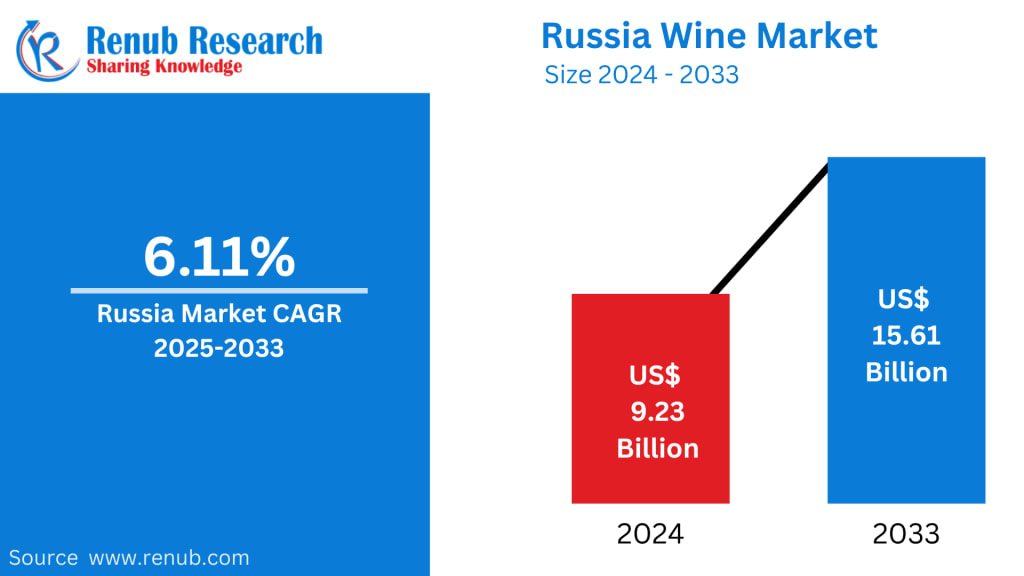
The Russia wine market is poised for sustained expansion over the next decade, reflecting evolving consumer preferences, expanding domestic production, and regulatory support for local wineries. According to Renub Research, the Russia wine market was valued at US$ 9.23 billion in 2024 and is forecast to reach US$ 15.61 billion by 2033, growing at a CAGR of 6.11% from 2025 to 2033.
This steady growth is supported by rising wine consumption across urban centers, a shift away from traditional spirits, increasing investment in vineyards, and government-backed initiatives aimed at strengthening domestic wine production. Russia’s wine industry has transitioned from a relatively niche segment to an increasingly sophisticated market driven by quality, branding, and consumer education.
Russia Wine Industry Overview
Wine is a fermented alcoholic beverage produced primarily from grapes, with a cultural history spanning thousands of years. In Russia, wine consumption has undergone a notable transformation over the past two decades. Once overshadowed by vodka and other spirits, wine has steadily gained acceptance as a lifestyle beverage associated with dining, celebration, and social refinement.
Modern Russian consumers are increasingly knowledgeable about wine varieties, regions, and flavor profiles. Exposure to international trends, combined with improved availability of both domestic and imported wines, has contributed to the growing popularity of wine across demographics. Wine is now widely consumed during meals, celebrations, and formal gatherings, particularly in urban areas such as Moscow and St. Petersburg.
Another defining shift is the rise of locally produced wines, especially from regions like Krasnodar, Crimea, and Rostov, which are benefiting from favorable climatic conditions and increased technological investment. As domestic wines improve in quality and branding, they are increasingly competing with imported alternatives.
Key Growth Drivers in the Russia Wine Market
Rising Consumer Sophistication and Premiumization
One of the strongest drivers of growth in the Russian wine market is the premiumization trend. An expanding middle class and rising disposable incomes have encouraged consumers to trade up from low-cost alcoholic beverages to higher-quality wines. Wine is increasingly perceived as a symbol of sophistication and modern lifestyle, particularly among urban professionals.
Consumers are seeking diversity in grape varieties, regions of origin, and production techniques. Red, sparkling, and rosé wines have gained traction as consumers become more experimental and informed. Wine bars, tasting events, and educational platforms have further elevated consumer knowledge and appreciation.
Domestic producers are responding by improving quality standards, investing in branding, and highlighting regional terroirs. A notable example is Abrau-Durso Group, Russia’s leading sparkling wine producer, which has expanded its international footprint by initiating sparkling wine production in India, signaling growing confidence in Russian winemaking expertise.
Expansion of Vineyards and Domestic Wine Production
Government support has played a crucial role in strengthening Russia’s domestic wine industry. Subsidies for vineyard development, tax incentives for winemakers, and favorable regulations for locally produced wines have encouraged investment across key wine-growing regions.
Krasnodar and Crimea, in particular, have emerged as strategic hubs for wine production due to their suitable soil and climatic conditions. Modern vineyard management practices, improved grape varieties, and advanced winemaking technologies have significantly enhanced the quality of Russian wines.
Geopolitical factors and import substitution policies have further incentivized domestic production. According to the International Organization of Vine and Wine, Russia was among the few countries to record an increase in wine production in 2024, growing by 19% to 5.4 million hectoliters, ranking 11th globally. This expansion underscores the growing importance of local production in meeting domestic demand.
Growth of E-Commerce and Online Wine Sales
Digital transformation is reshaping the Russian wine market. E-commerce platforms specializing in wine have expanded rapidly, offering consumers convenience, wider product selection, and access to detailed product information. Online channels have been particularly effective in reaching consumers beyond major metropolitan areas.
Social media marketing, influencer recommendations, and educational content have helped younger consumers discover wine brands and understand tasting and pairing concepts. Regulatory adjustments allowing controlled online alcohol sales have encouraged both traditional retailers and producers to strengthen their digital presence.
The COVID-19 pandemic accelerated the adoption of online alcohol purchases, and this behavior has largely persisted. As logistics infrastructure and digital trust improve, e-commerce is expected to remain a vital distribution channel for the Russian wine market.
Challenges Facing the Russia Wine Market
Economic Volatility and Price Sensitivity
Despite positive growth prospects, the Russian wine market faces challenges stemming from economic fluctuations, inflation, and currency volatility. These factors directly influence consumer purchasing power and price sensitivity, particularly in mid-range and premium wine categories.
Imported wines are especially vulnerable to exchange rate instability, which affects pricing and margins. Sanctions and trade restrictions further complicate sourcing and logistics for foreign brands. As a result, consumers often shift toward more affordable domestic wines during periods of economic uncertainty.
To remain competitive, producers and retailers must balance pricing strategies with quality, focusing on value-driven offerings and strong brand positioning.
Complex Regulatory Environment
Russia’s wine industry operates within a highly regulated framework. Strict rules governing labeling, certification, advertising, and excise taxation create compliance challenges for both domestic and international players. Frequent regulatory updates increase operational complexity and cost.
Import regulations and geopolitical tensions have intensified scrutiny of foreign alcohol brands, limiting product diversity and slowing new product launches. While protectionist policies benefit local producers, they also reduce competition and innovation.
Streamlining regulatory procedures and enhancing transparency could improve market efficiency and encourage broader participation from international players.
Russia Wine Market by Product Segments
Sparkling Wine Market
Sparkling wine holds a prominent position in Russia’s wine culture, traditionally associated with celebrations and festive occasions. Locally produced sparkling wines from Crimea and Krasnodar are gaining popularity due to improved quality and competitive pricing.
International sparkling wines from France, Italy, and Spain continue to attract premium consumers, while younger demographics favor sparkling wines for their light, refreshing characteristics. With ongoing investment in production technology and branding, the sparkling wine segment is expected to maintain robust growth.
Dessert Wine Market
Dessert wines represent a niche but premium segment within the Russian wine market. These wines are often associated with luxury dining and cultural heritage, particularly those produced in Crimea and the Black Sea region.
Although overall market share remains limited, dessert wines appeal to connoisseurs and high-end consumers seeking indulgence and craftsmanship. Growth in fine dining and gourmet experiences is likely to support steady demand in this segment.
Red Wine Market
Red wine dominates wine consumption in Russia, driven by its compatibility with traditional cuisine and perceived health benefits. Domestic red wines made from Cabernet Sauvignon and Merlot grapes have shown significant improvements in quality.
Imported red wines from Georgia, France, and Italy continue to enjoy strong demand in urban centers. Marketing strategies emphasizing terroir, heritage, and craftsmanship are helping elevate domestic red wines into premium categories.
Rosé Wine Market
Rosé wine is one of the fastest-growing segments, particularly among younger consumers and women. Its light profile, visual appeal, and versatility make it popular for casual and social occasions.
Domestic producers are expanding rosé offerings using innovative fermentation techniques, while imported rosés influence premium trends. As casual wine consumption increases, rosé is expected to gain further traction.
Russia Wine Market by Distribution Channel
Offline Wine Market
Offline retail remains the backbone of wine distribution in Russia. Supermarkets, hypermarkets, specialty wine stores, and hospitality venues account for the majority of sales. Consumers value personalized service, in-store tastings, and expert recommendations.
Restaurants, hotels, and duty-free outlets play a significant role in premium wine sales. While online sales are growing, offline channels continue to dominate due to regulatory constraints and cultural shopping preferences.
Regional Insights
Central Russia Wine Market
Central Russia, led by Moscow, represents the largest and most dynamic wine market in the country. High-income consumers, dense urbanization, and exposure to global trends drive strong demand for premium and imported wines.
Wine festivals, education programs, and wine tourism further strengthen consumption. Continued urban growth and retail modernization are expected to sustain long-term demand.
Northwestern Russia Wine Market
Northwestern Russia, particularly St. Petersburg, benefits from proximity to European markets and a cosmopolitan consumer base. A vibrant restaurant scene and tourism support demand for premium and boutique wines.
Although high import costs can limit variety, strong consumer appreciation for international wine culture ensures steady growth in this region.
Urals Wine Market
The Urals region is an emerging market for wine consumption, driven by economic growth in cities such as Yekaterinburg. Rising middle-income populations and expanding retail infrastructure are improving market accessibility.
While logistical challenges and limited wine culture remain barriers, continued development positions the Urals as a promising secondary growth market.
Key Questions Answered in the Report
How big is the Russia Wine industry?
The market was valued at US$ 9.23 billion in 2024 and is projected to reach US$ 15.61 billion by 2033.
What is the growth rate of the Russia Wine market?
The market is expected to grow at a CAGR of 6.11% from 2025 to 2033.
Who are the key players in the Russia Wine market?
Major companies include ARIANT Wine Group, Abrau-Durso CJSC, Igristye Vina ZAO, PJSC Fanagoria, and FSUE PJSC Massandra.
What factors are driving market growth?
Premiumization, rising disposable incomes, urbanization, wine culture development, and government support for domestic production.
Final Thoughts
The Russia wine market is entering a phase of structural maturity, characterized by higher quality standards, stronger domestic brands, and evolving consumer preferences. While economic and regulatory challenges persist, the industry’s resilience, supported by local production growth and digital innovation, positions it for sustained expansion through 2033.
As wine continues to replace traditional spirits in social and dining contexts, Russia’s wine industry is set to play an increasingly prominent role in the country’s broader beverage market.
About the Creator
Diya Dey
Market Analyst
My Tous les Jours Trip
As someone who lives in a rural area, I don't get the chance to visit fancy restaurants or bakeries that often. So, when a friend told me about a French-Asian bakery that's less than an hour away, I knew I had to check it out and grab some pictures for social media. Tous les Jours ended up providing an immersive experience that went above and beyond my expectations--although I did leave with a few reservations.
By Kaitlin Shanks16 days ago in Feast
The Food Pyramid Has Been Flipped. Here’s What the New One Really Means.
For decades, we were taught to eat from the bottom up. Grains formed the foundation. Bread, rice, cereal. Protein and fats hovered higher, almost suspiciously. Sugar sat at the top like a guilty secret we all pretended not to touch.
By Aarsh Malikabout 14 hours ago in Feast
The steps to losing a child
Step One: Lose a child. Not what anyone wants to happen and nothing you can do to change it, but you can go through steps to becoming happy again. You can go through steps to loving again. You can go through steps to become a new you because after losing a child you will never be the same person you once were.
By Tabitha Hinkley3 days ago in Fiction



Comments
There are no comments for this story
Be the first to respond and start the conversation.