
North America Meat Substitutes Market Size and Forecast 2025–2033
Plant-Based Proteins Gain Mainstream Momentum as Innovation, Health Awareness, and Sustainability Reshape North American Diets

Introduction
The North America meat substitutes market is undergoing a powerful transformation as consumers rethink what they eat, how food is produced, and the long-term impact of dietary choices on health and the environment. Once considered a niche category limited to vegetarians and vegans, meat substitutes have now entered the mainstream food ecosystem, appealing to flexitarians, health-conscious consumers, and sustainability-driven buyers alike.
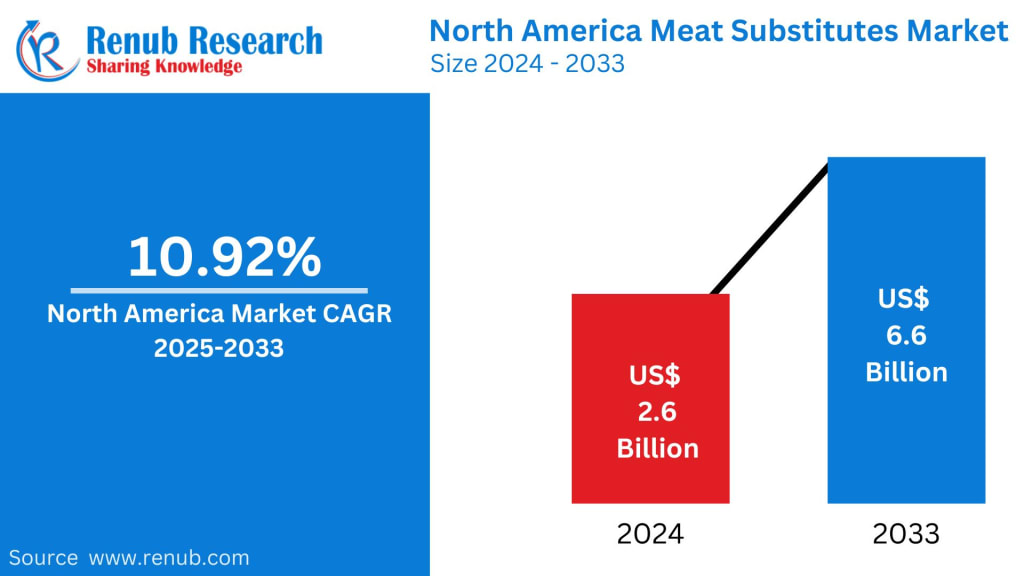
According to Renub Research, the North America Meat Substitutes Market was valued at USD 2.6 billion in 2024 and is expected to expand significantly to USD 6.6 billion by 2033, growing at a compound annual growth rate (CAGR) of 10.92% during 2025–2033. This impressive growth reflects changing consumer preferences, rapid advancements in food technology, and increased awareness around nutrition, climate change, and ethical food sourcing.
North America Meat Substitutes Market Overview
Meat substitutes are food products designed to replicate the taste, texture, appearance, and cooking performance of conventional meat while being derived primarily from plant-based sources. Common ingredients include soy, pea protein, wheat gluten, grains, and fermented components such as tempeh. These alternatives allow consumers to enjoy familiar dishes—burgers, sausages, tacos, and stir-fries—without relying on animal protein.
In North America, meat substitutes are widely available across supermarkets, specialty stores, restaurants, and fast-food chains. Their growing presence in everyday dining reflects a broader shift toward balanced eating habits that prioritize wellness, sustainability, and ethical considerations. The availability of convenient, ready-to-cook plant-based products has further reduced barriers to adoption, making meat substitutes accessible to a broader demographic.
Market Growth Drivers
Rising Health Awareness and the Shift Toward Plant-Based Lifestyles
One of the most influential drivers of the North America meat substitutes market is increasing consumer awareness of diet-related health issues. Concerns over heart disease, obesity, high cholesterol, and lifestyle-related illnesses have prompted many consumers to reduce their intake of red and processed meats.
Plant-based meat alternatives offer comparable protein content while typically containing lower levels of saturated fat and no dietary cholesterol. This nutritional advantage has resonated strongly with Millennials and Gen Z, who are leading the rise of flexitarian, vegetarian, and vegan eating habits. Public health advocacy, celebrity endorsements, and social media influence continue to reinforce the benefits of plant-forward diets.
Health data further supports this shift. The Centers for Disease Control and Prevention (CDC) reported that adult obesity prevalence in the United States reached 40.3% between August 2021 and August 2023, highlighting the urgent need for healthier dietary patterns. Meat substitutes are increasingly viewed as a practical way to manage weight, support heart health, and lower the risk of chronic disease without compromising taste or convenience.
Advancements in Food Technology and Product Innovation
Technological innovation has played a critical role in elevating the quality and acceptance of meat substitutes across North America. Modern food processing techniques—such as high-moisture extrusion, fermentation, and precision flavor engineering—have significantly improved texture, juiciness, and mouthfeel.
Manufacturers are now using diverse protein sources including pea, soy, lentil, and wheat gluten to closely mimic animal meat. Fortification strategies are also being adopted to improve amino acid profiles and nutritional density. These innovations have helped overcome earlier skepticism surrounding taste and realism.
In March 2025, Salata Salad Kitchen expanded its plant-based offerings by introducing Grilled Tofu Salad and Signature Grilled Tofu Wrap, signaling how foodservice players are embracing innovation to meet evolving consumer demand.
Environmental and Ethical Considerations
Environmental sustainability and animal welfare concerns are increasingly influencing purchasing decisions in North America. Traditional meat production is associated with high greenhouse gas emissions, excessive water usage, and deforestation. In contrast, plant-based meat substitutes are widely perceived as more environmentally responsible.
Younger consumers, in particular, are highly motivated by ethical considerations related to animal farming practices. Retailers and restaurants have responded by expanding plant-based menus and highlighting sustainability credentials. Corporate sustainability initiatives and government-backed environmental goals further reinforce the shift toward alternative proteins.
Market Challenges
High Production Costs and Price Sensitivity
Despite rapid growth, the meat substitutes market faces cost-related challenges. Advanced processing technologies, protein extraction methods, and continuous research and development contribute to higher production expenses. As a result, plant-based meat products often carry a premium price compared to conventional meat.
This price gap can deter budget-conscious consumers, particularly during periods of inflation or economic uncertainty. While large manufacturers benefit from economies of scale, smaller companies may struggle to maintain competitiveness. Achieving cost efficiency without sacrificing product quality remains a key industry challenge.
Consumer Perception and Taste Acceptance
Although product quality has improved significantly, some consumers remain skeptical about the taste, texture, and perceived “naturalness” of meat substitutes. Early-generation products created lasting impressions of bland flavor and excessive processing.
Additionally, misconceptions about nutritional adequacy—especially regarding protein content—persist among traditional meat consumers. Older demographics, in particular, are generally slower to adopt dietary changes. Addressing these perception barriers through education, cleaner labels, and improved sensory experiences is essential for continued market expansion.
Segment Analysis
Tempeh Meat Substitutes Market
Tempeh is gaining popularity in North America due to its high protein content, fiber, and probiotic benefits. As a fermented soy product, it aligns well with consumer demand for minimally processed, functional foods. Its firm texture and nutty flavor make it suitable for a variety of applications, including stir-fries, salads, and sandwiches. Manufacturers are increasingly offering flavored and convenience-focused tempeh products.
Tofu Meat Substitutes Market
Tofu remains one of the most established and widely consumed meat substitutes in North America. Made from soybeans, tofu offers complete plant protein with low saturated fat levels. Its versatility allows it to be used across cuisines, from traditional Asian dishes to modern Western recipes. New pre-marinated and ready-to-cook formats are further boosting mainstream adoption.
Wheat-Based Meat Substitutes Market
Wheat-based alternatives, particularly seitan, are valued for their chewy, meat-like texture and high protein content. These products are widely used in restaurants and meal kits as substitutes for beef or chicken. Technological improvements in seasoning and preparation have enhanced flavor profiles, making wheat-based substitutes increasingly appealing.
Burgers and Patties Segment
Plant-based burgers and patties represent the most recognizable and fastest-growing segment in North America. Designed to closely replicate traditional beef burgers, these products have achieved widespread acceptance through foodservice partnerships and retail availability. Continuous innovation in juiciness, texture, and nutritional fortification continues to drive demand.
Sausages Segment
Plant-based sausages are gaining traction due to their familiar formats and strong flavor profiles. Available in breakfast, bratwurst, and spicy varieties, they serve as an accessible entry point for meat reducers. Manufacturers are focusing on lower sodium content, cleaner labels, and enhanced nutrition to attract health-conscious consumers.
Distribution Channel Insights
Specialty stores play a vital role in promoting premium and niche meat substitute products. These outlets cater to health-conscious consumers seeking organic, allergen-free, and sustainably produced alternatives. Personalized service, product education, and sampling opportunities help build consumer trust and awareness.
Country-Level Analysis
United States Meat Substitutes Market
The United States dominates the North America meat substitutes market due to strong innovation, consumer awareness, and widespread retail availability. Advanced R&D capabilities and extensive foodservice partnerships have transformed plant-based eating into a mainstream trend. In May 2025, T. Hasegawa USA introduced Plantreact, a fermentation-based flavor solution designed to replicate authentic meat flavors in plant-based products.
Canada Meat Substitutes Market
Canada’s market is experiencing steady growth driven by demand for clean-label, high-protein, and sustainable food options. Supportive government initiatives and expanding retail presence have strengthened adoption. In January 2022, PlantPlus Foods LLC, a joint venture between ADM and Marfrig Global Foods, acquired Sol Cuisine Ltd., enhancing its North American footprint.
North America Meat Substitutes Market Segmentation
By Type:
Tempeh
Textured Vegetable Protein
Tofu
Other Meat
By Source:
Soy
Wheat
Pea
Others
By Product Type:
Burger/Patties
Strips & Nuggets
Sausages
Ground
By Distribution Channel:
Food Service Channels
Retail Channels
Supermarkets & Hypermarkets
Specialty Stores
Online
By Country:
United States
Canada
Mexico
Rest of North America
Key Players Covered
Amy’s Kitchen Inc.
Associated British Foods PLC
Cargill Inc.
Conagra Brands Inc.
Hormel Foods Corporation
Impossible Foods Inc.
Maple Leaf Foods
Nestlé S.A.
The Kellogg Company
Final Thoughts
The North America meat substitutes market is no longer an emerging trend—it is a structural shift in how food is produced and consumed. With strong growth prospects, continuous innovation, and increasing consumer alignment with health and sustainability values, the market is poised for long-term expansion.
As prices gradually stabilize and taste acceptance improves, meat substitutes are expected to become a routine part of everyday diets across North America. For food manufacturers, retailers, and investors, the sector represents a compelling opportunity at the intersection of nutrition, technology, and environmental responsibility.
About the Creator
Marthan Sir
Educator with 30+ years of teaching experience | Passionate about sharing knowledge, life lessons & insights | Writing to inspire, inform, and empower readers.
Keep reading
More stories from Marthan Sir and writers in Feast and other communities.
Africa Confectionery Market Size & Forecast 2025–2033
Africa Confectionery Market Overview The African confectionery market is entering a phase of accelerated growth, driven by rapid urbanization, a young population, and increasing disposable incomes across the continent. According to Renub Research, the Africa Confectionery Market was valued at approximately US$ 4.71 billion in 2024 and is projected to reach around US$ 8.74 billion by 2033, expanding at a compound annual growth rate (CAGR) of 7.11% between 2025 and 2033.
By Marthan Sir28 days ago in Feast
My Tous les Jours Trip
As someone who lives in a rural area, I don't get the chance to visit fancy restaurants or bakeries that often. So, when a friend told me about a French-Asian bakery that's less than an hour away, I knew I had to check it out and grab some pictures for social media. Tous les Jours ended up providing an immersive experience that went above and beyond my expectations--although I did leave with a few reservations.
By Kaitlin Shanks17 days ago in Feast
Australia Seeds Market to Grow to USD 1.5 Billion by 2033 on Adaptive Agriculture & Sustainable Practices
The Australia seeds market is progressing as agricultural systems evolve and adapt to both economic and environmental challenges. According to IMARC Group, the Australia seeds market reached USD 1.3 billion in 2024 and is expected to grow to USD 1.5 billion by 2033, with a compound annual growth rate (CAGR) of 1.20 % during 2025–2033. This steady expansion reflects rising demand for high-yield, resilient seed varieties, supportive agricultural policies, and broader trends toward sustainable farming practices within Australia’s dynamic agricultural sector.
By Rashi Sharma4 days ago in Feast
Center Stage with Gina C.
*** I'm keen to republish the interviews I did for my series with Vocal creators. It's been a few years and I thought it might be nice to revisit these wonderful conversations. I'll be releasing them one at a time for a few weeks/months.
By Heather Hubler5 days ago in Interview




Comments
There are no comments for this story
Be the first to respond and start the conversation.