
My Mom's Picadillo
My mom will haunt you if you don't follow the directions


One of the things I hate most about recipes online is the long story that comes before it. The entire history of where the ingredients for a butter cake come from, the author’s entire food-on-the-road blog, or everything that’s happened in the world since it was formed. A lot of advertisements floating around the sides or in between the text. Then follows the general ingredients, and more dialogue. A few photos. THEN you get the recipe measures and directions. If you want the recipe, skip right to the end below. I promise not to tattle on you.
All that reading becomes irritating to me because I’m not a foodie. I don’t watch the Food Network or that mean man who yells at people on his show. I may have seen a food or drink mentioned in a TV show and want to know what’s in it; for example, on Supernatural, Dean mentions how good a “purple nurple” cocktail is. Of course I had to look that up. I usually look up a couple of recipes to get the main gist of the ingredients and then make my own version of it if I have the right ingredients.
I grew up in a Spanish-Italian family. You could smell onions and garlic from down the street, and I’m sure it’s still embedded in the walls and ceilings of the homes we lived in. My mom grew up during the Depression when food was incredibly scarce. A good cook could make several meals from their food ration tickets and share with other families on the block. When one family didn’t have the right ingredients, they traded with others so the right dishes could be prepared. In many Latin towns, chickens still roam the streets freely. At one time, those chickens were a sign of prosperity; check out Key West, Miami, or Ybor City in Florida. Chicken décor everywhere. Chickens everywhere.
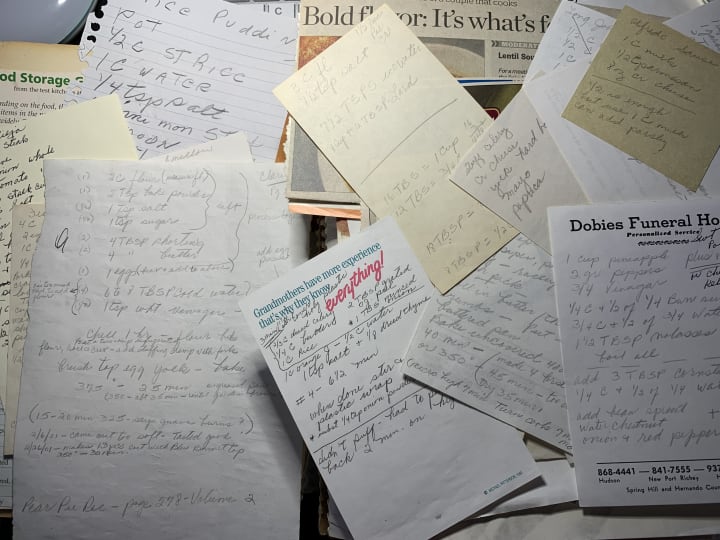
My mother took Home Economics classes during her junior and senior high school years. Her recipe books date back from 1943 until she died in 2018. In each book were hand-written recipes, scraps of paper, newspaper clippings, can labels, box directions, bag-of-bean labels, and other paper-like sheets. These fat notebooks grew over time, and she added new ones as needed. Sometimes she’d just slip a scrap of paper in the front of book without gluing it in its little space. When she passed away, all ten grandchildren received at least one of those books. A treasure to be tasted.
More interesting are the notes she left behind. “Yo-yo didn’t like.” (My dad’s nickname.) “Barbara liked it.” “No salt.” “3/4 cup.” “Good.” “Never again.” She was bold to try new recipes, but honest enough to leave her own review for later. With the millions of recipes she had, it was hard to keep track of the ones everyone liked or ones too difficult to make again. She had a multitude of scraps of paper include one from a funeral home. She got a recipe at someone’s wake. While others were mourning. To say my mother was dedicated is understated.
Sometimes her dedication was beyond acceptable in my humble opinion. A new meat dish would appear, and she’d tell us she was trying out a new recipe. I learned later that “new recipe” was code for “don’t ask.” She’d wait for our opinion on the food, and then announce something like, “Cow tongue,” “brains,” or “tripe.” Organ meats are not for everyone, I can tell you that. Those recipes were relegated to the “don’t make again” pile. A more common dish, liver and onions, is a favorite for some people. I refuse to set foot inside house or restaurant where that’s being made because the smell makes me retch. I just can’t do it.
She made everything from scratch, as people of her generation always did. Shopping around the edges of the store for vegetables, fruit, cheese, dairy, meat, fish. Inside aisles for the staples: flour, pasta, rice, sugar, bread, etc. That’s why I never had a pop-tart until my late teens. My first taste of fast-food was when I was 18 years old. Where we lived for most of my life, there was no pizza delivery. We just didn’t eat like that. At home: eat it or starve.
I will let you know the recipe I include at the bottom is indeed the recipe she made. She had a habit of leaving out one vital ingredient to her daughters-in-law so that to my brothers, the food “didn’t taste the way my mom used to make it.” OF COURSE, IT DIDN’T. She wasn’t letting the outsiders have the full recipe. Maybe a hambone was missing, or bay leaves, or capers. Something small but contributing a lot to the flavor of a meal.
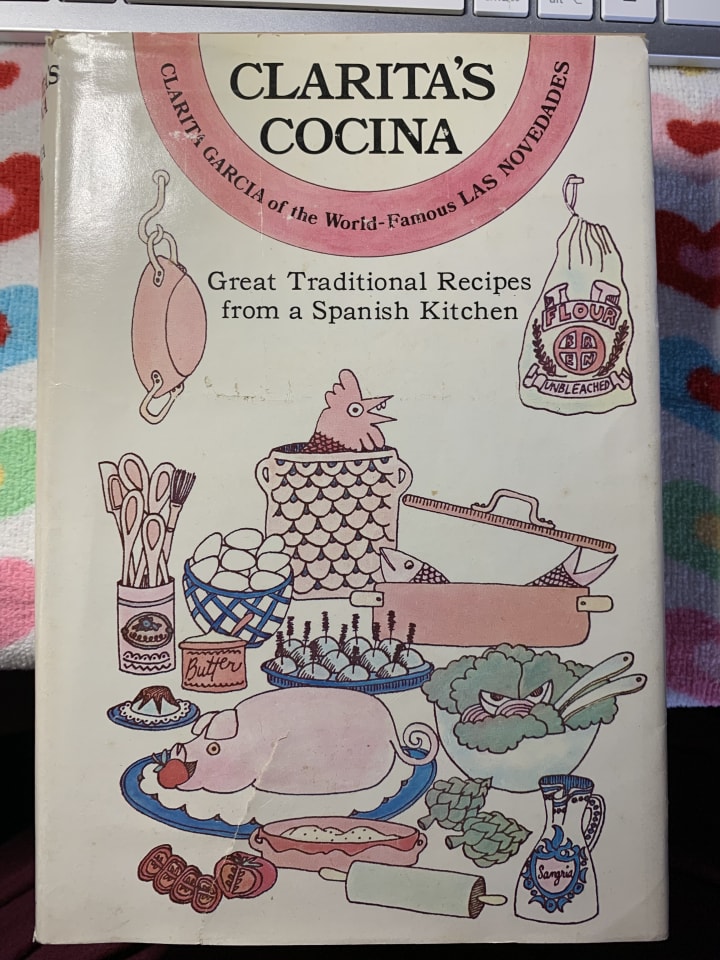
A bible for Spanish cooking is Clarita’s Cocina by Clarita Garcia from Spain. My aunt bought me an autographed copy of the book for my wedding shower 33 years ago. I still have that book; my mom’s copy went to my brother. Since we’ve gotten comfortable with technology, I’ll pull up a recipe on my Alexa right in front of the cutting board rather than splashing bits of food on the pages of a nice recipe book. My mom’s recipe books have calories in them and on them.
Most of the dishes she made came on top of rice or noodles. It was a cheap way of bulking up a food. Today’s Latin or Italian restaurants serve rice or noodles on the side which seems weird to me. Why on the side? It’s not like French fries or broccoli. It’s all mixed together. Black beans and rice, yellow chicken and rice, ropa vieja, and picadillo. At each restaurant, I’ll order one of those and compare it to my mom’s versions to see if it passes muster. Most do not. I’ve seen some weird ingredients, like raisins.
RAISINS don’t belong in picadillo. Clarita said so. She does have a “country-style” picadillo with chopped walnuts, but that’s also blasphemy. No. If it ain’t in my mom’s recipe, I’m not adding it. On the other hand, when I cook my own tragedies, I toss in whatever I have on hand. My meatloaf is never the same every time I make it. Maybe I don’t have certain ingredients; maybe some leftovers need to be used up. Like casseroles, meatloaf is a great way to hide ingredients. Just not cow tongue.
My brother wrung this recipe out of our mom, and he dutifully wrote down everything word for word as she recited it. She could make this without thinking, so she warned that everything must be done exactly. Count those olives. Count the drops of hot sauce (6, not 7 drops). Burgundy cooking wine (not just Burgundy from the liquor store). Everyone has their own recipe for white rice, and you can use yellow rice as well. Your choice.
My Mom’s Picadillo
(As transcribed by my brother Del)
4 lbs ground chuck………….extract ALL oil, chop up/brown (really – get that oil out)
• ¼ cup olive oil warmed up in another pot
Fry until soft (with the olive oil):
• 1 chopped green pepper
• 4 medium tomatoes, chopped
• 6 garlic cloves, chopped
Pour ground chuck in pot
Add:
• 3 bay leaves
• 2 tsp oregano
• 3 oz bottle of capers, drained
Cover and cook 10 minutes
Then add:
• 16 stuffed olives, cut into 4
• ¼ cup red wine vinegar
• ½ cup Burgundy wine
• 8 oz tomato sauce
• 6 drops hot sauce
• 1 tsp brown sugar
If too dry add ¾ cup of water. If it tastes flat, add tsp of salt
Then re-cover and cook 30-45 minutes until water evaporates, uncover
Rice:
• Boil pot water
• Rinse rice while waiting, 3 real good times
• When water boils add tbsp salt
• Add rice
• Lower heat to medium
• Gently stir then every 6 minutes
• Gently stir
• Cook exactly 13 minutes
• Race to sink rinse with water immediately to stop cooking
• Put rice back in pot
• Stir in tbsp oil
• Put covered pot back on hot stove while off to finish cooking

About the Creator
Barb Dukeman
I have three books published on Amazon if you want to read more. I have shorter pieces (less than 600 words at https://barbdukeman.substack.com/. Subscribe today if you like what you read here or just say Hi.
Keep reading
More stories from Barb Dukeman and writers in Feast and other communities.
Healthy Food and Diets
It’s completely unfair. In case you never noticed, healthy food costs more than processed food, and healthy food doesn’t last as long in the fridge (or on the shelf), which means food shopping more often and spending more money. This is so unfair. According to US News, roughly 40% of all Americans are obese, and WebMD says that more than 70% of women are overweight or obese. With these numbers, wouldn’t it make sense to regulate the price of healthier foods and stop making Ramen a dollar for 6 packages? We’ve become addicted to quick and easy, and throwing together a last-minute meal with our hectic schedules means getting food out of a can or a box. Add to that the conundrum that sometimes the other people in the house don’t want to eat what I prepare because it’s…healthy.
By Barb Dukeman4 years ago in Feast
Eat During Chinese New Year
The Chinese New Year feast is traditionally abundant with meat dishes, but these 15 vegetarian recipes prove that plant-based eating can be just as festive, flavorful, and meaningful. Each dish carries auspicious symbolism while delivering incredible taste that will have everyone reaching for seconds—even the meat lovers at your table. From crisp greens to creative vegetable transformations, these recipes are designed to impress.
By yue . shui3 days ago in Feast
Astragalus: An Ornamental, Supportive, and Culinary Herb
Astragalus Root/Milkvetch Astragalus is a popular remedy for various ailments today. Commonly found in health food stores and herbal shops in the form of tinctures, grounded encapsulated powders, or as part of an herbal infusion, or sometimes added to teas, astragalus usually makes the list for its purported immune-system and energy-supporting benefits.
By J. Chauncey2 days ago in Feast
Pearl
1980 something. we all hung out at Pearl and you and i were nothing special, or so i thought. i mean we all danced, drenched in our own sweat, our own saline solution of fear, too many beers, shots, laughter, tears, fucks in the bathroom and i don't know when we began to be afraid. do you?
By ROCK aka Andrea Polla (Simmons)4 days ago in Fiction



Comments (1)
This was a whole adventure, not just a recipe! Your mom was a legend—gatekeeping ingredients, collecting recipes like treasure, and making sure everything was just right (13 minutes exactly, no more, no less!). Also, raisins in picadillo? Blasphemy. Loved every bit of this!