
Mexico Palm Oil Market Size & Forecast 2025–2033
Rising Demand from Food, Biofuel, and Personal Care Industries Reshapes Mexico’s Palm Oil Landscape

Mexico Palm Oil Market Outlook
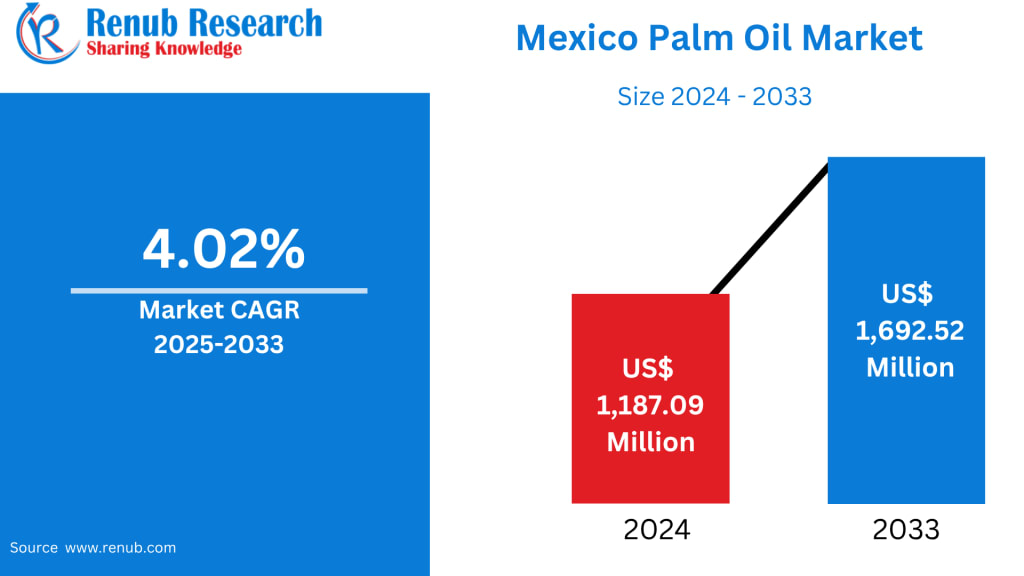
The Mexico Palm Oil Market is entering a phase of steady expansion, supported by rising consumption across food processing, personal care, animal feed, and renewable energy sectors. According to Renub Research, the market is anticipated to reach US$ 1,692.52 million by 2033, expanding from US$ 1,187.09 million in 2024, at a CAGR of 4.02% during 2025–2033.
Palm oil, extracted from the fruit of the oil palm (Elaeis guineensis), is among the most widely used vegetable oils globally due to its high productivity, cost efficiency, and versatility. Its semi-solid consistency at room temperature, high oxidative stability, and long shelf life make it suitable for both food and industrial uses. In Mexico, these properties have accelerated palm oil’s adoption across multiple industries seeking affordable and functional raw materials.
Traditionally reliant on imports from Southeast Asia, Mexico has also been strengthening its domestic palm oil production, particularly in southern states. Combined with growing urbanization, changing dietary habits, and renewable energy ambitions, palm oil has become a strategic commodity within the Mexican economy.
Understanding Palm Oil and Its Role in Mexico
Palm oil is a multifunctional edible oil used extensively in margarine, baked goods, instant noodles, snacks, frying oils, and processed foods. Beyond food, it is a critical input for cosmetics, soaps, detergents, oleochemicals, and biodiesel.
In Mexico, palm oil is increasingly preferred by manufacturers due to its cost-effectiveness, thermal stability, and availability in bulk. Food processors use it to maintain texture and shelf life, while personal care manufacturers value its natural emollient properties. At the same time, the energy sector is evaluating palm oil as a biofuel feedstock, aligning with Mexico’s clean energy targets.
Key Growth Drivers in the Mexico Palm Oil Market
Expansion of the Food Processing Industry
Mexico’s rapidly growing packaged food and snack industry is one of the primary drivers of palm oil consumption. Urbanization, busier lifestyles, and rising demand for convenience foods have fueled the use of palm oil in baked goods, confectionery, instant meals, and fried products. Its stability under high heat and low cost compared to other edible oils make it an ideal choice for large-scale food producers.
As multinational food companies expand their operations in Mexico, palm oil continues to gain traction as a core ingredient, particularly in mass-market food products.
Government Support for Domestic Palm Oil Production
To reduce import dependency and strengthen rural economies, the Mexican government has actively promoted domestic palm oil cultivation, especially in Chiapas, Tabasco, and Campeche. Subsidies, technical assistance, and agricultural development programs have helped farmers adopt oil palm cultivation as a reliable income source.
A major milestone was reached in December 2024, when IDB Invest financed US$15 million for Prolade S.A.P.I. de C.V., a Mexican palm oil company certified by the Roundtable on Sustainable Palm Oil (RSPO). This investment underscores growing confidence in sustainable palm oil development in Mexico and reflects international support for responsible agriculture in the region.
Rising Demand for Biofuels and Renewable Energy
Mexico’s transition toward cleaner energy is opening new avenues for palm oil in biodiesel production. With the country targeting 45% clean electricity by 2030, palm oil is being evaluated as a strategic feedstock to reduce dependence on imported fossil fuels.
In May 2025, reports indicated that meeting these clean energy goals could save Mexico US$1.6 billion annually in gas imports, reinforcing the economic case for alternative fuels. As investment in biodiesel infrastructure grows, palm oil’s role in the energy transition is expected to expand steadily over the forecast period.
Challenges Facing the Mexico Palm Oil Market
Environmental and Sustainability Concerns
Palm oil production is often associated with deforestation, biodiversity loss, and water pollution, raising concerns among consumers and regulators alike. As sustainability awareness rises in Mexico, companies are increasingly expected to source certified sustainable palm oil.
Compliance with standards such as RSPO certification can increase operational costs, especially for small producers. However, failure to adopt sustainable practices could limit market access, particularly with international buyers and environmentally conscious consumers.
Import Dependency and Market Volatility
Despite progress in domestic cultivation, Mexico still relies heavily on palm oil imports from Indonesia and Malaysia. This exposes the market to global price fluctuations, exchange rate volatility, and supply chain disruptions.
Geopolitical tensions and shipping constraints can also affect availability and pricing, making cost management a challenge for food processors and industrial users who depend on stable raw material supply.
Mexico Palm Oil Market by Application
Home Cooking Segment
Palm oil is gaining popularity in Mexican households as an affordable and heat-stable cooking oil. It is widely used for frying, sautéing, and baking, particularly among price-sensitive consumers. Retailers now offer refined and blended palm oil products tailored for domestic use. As awareness grows and distribution expands, household consumption is expected to rise steadily.
Food & Beverage Segment
This remains the largest application segment in Mexico’s palm oil market. From bakery items to snacks and processed foods, palm oil’s functional properties and economic advantages make it indispensable for large-scale manufacturers. Continued urban growth and changing dietary habits will keep this segment dominant throughout the forecast period.
Biofuel Segment
The biofuel segment represents one of the fastest-growing opportunities for palm oil in Mexico. Biodiesel production from palm oil is gaining momentum as the government pushes for energy diversification and emissions reduction. Investments in southern regions are expected to transform palm oil into a long-term energy asset.
Personal Care and Cosmetics Segment
Palm oil is widely used in soaps, shampoos, creams, and lotions due to its moisturizing and emulsifying properties. Mexican consumers are increasingly seeking natural and plant-based ingredients, boosting demand for palm oil in personal care formulations. Both domestic brands and international manufacturers are shifting toward certified sustainable palm oil to meet consumer expectations.
Animal Feed Segment
Palm oil and its by-products, such as palm kernel cake, are used as energy-rich ingredients in poultry and livestock feed. As Mexico’s meat and poultry production grows, demand for cost-effective feed supplements is rising. This segment is expected to grow steadily as feed manufacturers seek economical nutritional solutions.
Regional Insights of the Mexico Palm Oil Market
Northern Mexico
Northern Mexico is primarily a consumption-driven region due to its dry climate, which is unsuitable for oil palm cultivation. Urban centers like Monterrey and Hermosillo drive demand through food processing, retail, and household consumption. Efficient import and distribution networks play a crucial role in meeting regional demand.
Central Mexico
Central Mexico, including Mexico City and Guadalajara, represents the largest consumption hub due to high population density and industrial activity. The region hosts major food processing plants, hospitality chains, and retail outlets, making it a key distribution and consumption center for palm oil products.
Southern Mexico
Southern Mexico is the heart of domestic palm oil production, with Chiapas, Tabasco, and Campeche leading cultivation efforts. Favorable climate conditions, government support, and increasing private investment have turned the region into a growth engine for the national palm oil industry. Ongoing improvements in infrastructure and sustainability practices are expected to strengthen long-term production capacity.
Market Segmentation Overview
By Application:
Household Cooking
Food & Beverages
Oleo Chemicals
Personal Care
Animal Feed
Biofuel
By Region:
Northern Mexico
Central Mexico
Southern Mexico
Others
Key Players in the Mexico Palm Oil Market
The market features a mix of global producers and regional suppliers, all focusing on supply reliability, sustainability, and strategic partnerships. Each company is evaluated across five viewpoints: Overview, Key Person, Recent Developments, SWOT Analysis, and Revenue Analysis.
Major Companies Include:
Archer-Daniels-Midland Company
Boustead Holdings Berhad
IJM Corporation Berhad
IOI Corporation Berhad
Kulim Malaysia Berhad (Johor Corporation)
Sime Darby Plantation Berhad
United Plantations Berhad
Univanich Palm Oil Public Company Ltd.
These players are increasingly aligning their strategies with sustainability goals while expanding their supply networks in North America.
Final Thoughts
The Mexico Palm Oil Market is positioned for steady and sustainable growth through 2033, supported by strong demand from food processing, personal care, and renewable energy sectors. While environmental concerns and import dependency remain challenges, government support, domestic cultivation, and investment in sustainable practices are reshaping the industry’s future.
As Mexico continues to balance economic growth with environmental responsibility, palm oil will remain a crucial commodity—linking agriculture, industry, and energy in one evolving value chain. With rising domestic production and diversified applications, the market is set to become more resilient, competitive, and strategically important in the years ahead.
About the Creator
Keep reading
More stories from Aaina Oberoi and writers in Feast and other communities.
Australia Rice Market Size & Forecast 2025–2033
Australia Rice Market Outlook The Australia Rice Market is projected to grow from US$ 5.74 billion in 2024 to US$ 7.1 billion by 2033, expanding at a CAGR of 2.4% during 2025–2033, according to Renub Research. This steady growth reflects a fundamental shift in Australian food consumption patterns, driven by rising demand for premium, organic, and specialty rice varieties, alongside strong multicultural influences and health-conscious eating habits.
By Aaina Oberoiabout 24 hours ago in Feast
My Tous les Jours Trip
As someone who lives in a rural area, I don't get the chance to visit fancy restaurants or bakeries that often. So, when a friend told me about a French-Asian bakery that's less than an hour away, I knew I had to check it out and grab some pictures for social media. Tous les Jours ended up providing an immersive experience that went above and beyond my expectations--although I did leave with a few reservations.
By Kaitlin Shanks24 days ago in Feast
Miss Persephone's Manual to a Seemingly Ordinary Life
Miss Persephone was found at the dining table, her blue eyes swollen, her tears arriving and retreating like the tides of the ocean. Earlier that day, her family had visited her in the retirement home where she had lived for eight years. It was her eightieth birthday.
By Imola Tóth5 days ago in Fiction



Comments
There are no comments for this story
Be the first to respond and start the conversation.