
Mexico Chicken Market Size & Forecast 2025–2033
Affordable Protein, Urban Growth, and Fast-Food Expansion Drive Sustained Market Momentum

Mexico Chicken Market Outlook
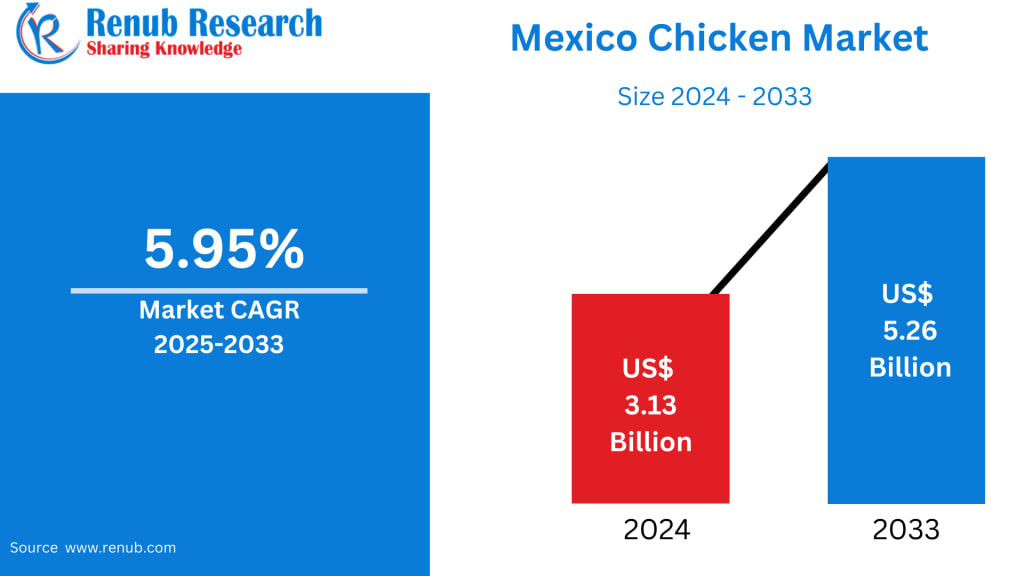
The Mexico chicken market is poised for steady long-term expansion, driven by rising demand for affordable, protein-rich food, rapid urbanization, and the fast-growing foodservice sector. According to Renub Research, the market was valued at US$ 3.13 billion in 2024 and is projected to reach US$ 5.26 billion by 2033, growing at a compound annual growth rate (CAGR) of 5.95% during 2025–2033. This growth reflects chicken’s entrenched position as the most accessible and versatile animal protein in Mexican households, restaurants, and institutional foodservice.
Chicken meat refers to the edible flesh of domesticated chickens and remains one of the most widely consumed animal proteins worldwide. In Mexico, it is especially valued for its affordability, adaptability to traditional cuisine, and strong nutritional profile. Chicken offers a high-quality source of lean protein, essential amino acids, and important vitamins and minerals, while being comparatively lower in fat than red meats. Its mild flavor allows it to absorb spices, sauces, and seasonings, making it suitable for diverse cooking styles including grilling, frying, roasting, stewing, and boiling.
From tacos and enchiladas to caldo de pollo, mole-based dishes, and street food preparations, chicken has become deeply embedded in everyday Mexican cuisine. The market’s growth is therefore not simply a result of price sensitivity but also cultural preference, expanding foodservice demand, and increasing health awareness among consumers.
The Role of Chicken in Mexican Diets
Chicken has emerged as one of the most consumed proteins in Mexico, surpassing many alternatives due to its balance of cost, nutrition, and versatility. Compared to beef and pork, chicken remains significantly more affordable, making it accessible to households across income segments. For low- and middle-income families in particular, chicken offers a reliable source of animal protein without placing excessive strain on food budgets.
The widespread availability of chicken across supermarkets, traditional markets, butcher shops, and specialty poultry stores further reinforces its role as a dietary staple. Strong domestic production capacity and improving cold-chain infrastructure ensure consistent supply across urban and semi-urban regions. In addition, the rise of modern retail and organized distribution has improved product safety, hygiene, and packaging standards.
Changing consumer lifestyles are also shaping demand. Urbanization, increased workforce participation, and the growing popularity of fast-food and takeaway meals are accelerating the use of chicken in quick-service restaurants, rotisserie outlets, and convenience foods. Meanwhile, health-conscious consumers increasingly favor chicken as a leaner protein compared with red meat. These structural and behavioral factors collectively underpin the long-term expansion of the Mexico chicken market.
Growth Drivers in the Mexico Chicken Market
Growing Demand for Affordable Protein
One of the most powerful drivers of market growth is the increasing need for affordable, accessible sources of protein. Chicken remains consistently cheaper than beef and pork, making it the preferred protein for cost-conscious households. In an environment of rising food inflation and economic uncertainty, consumers are increasingly prioritizing proteins that deliver high nutritional value at reasonable prices.
Chicken satisfies this demand by providing lean protein, essential vitamins, and minerals while maintaining price stability relative to other meats. Its shorter production cycle and higher feed efficiency compared with livestock also enable producers to keep supply steady and limit sharp price fluctuations. These advantages are particularly important in a country where food budget planning plays a central role in household consumption behavior.
Mexico’s growing population further supports demand. With the population exceeding 130 million and continuing to rise, the consumer base for affordable animal protein is expanding. Chicken’s dominance in home-cooked meals, street food, and institutional catering ensures that it remains the primary choice for protein across demographic groups. Notably, a large proportion of consumers continue to purchase whole chickens rather than individual cuts, as whole birds offer better value per kilogram and are easily adapted for multiple meals.
Expansion of Quick-Service Restaurants and Modern Retail
The rapid expansion of quick-service restaurants (QSRs), fast-casual dining, and modern retail infrastructure is significantly boosting chicken consumption across Mexico. Fried chicken, grilled chicken sandwiches, rotisserie dishes, and ready-to-eat meals have become increasingly popular among urban consumers seeking fast, affordable, and convenient food options.
Modern retail formats—supermarkets, hypermarkets, and convenience stores—have strengthened distribution networks for fresh, chilled, frozen, and processed chicken products. Improved cold-chain logistics and standardized food safety practices ensure consistent quality and year-round availability. At the same time, organized retail has expanded product variety, offering marinated cuts, portioned packs, and value-added items tailored to changing consumer preferences.
The aggressive expansion strategies of international and domestic QSR brands further reinforce demand. Chicken-based menus dominate fast-food offerings due to their broad consumer acceptance, ease of preparation, and cost efficiency. With hundreds of new outlets planned across major cities and regional centers, foodservice growth will remain a central engine for the chicken market throughout the forecast period.
Rising Health Awareness and Preference for Lean Meats
Health consciousness among Mexican consumers is reshaping dietary habits and reinforcing the shift toward leaner protein sources. Chicken is widely perceived as a healthier alternative to red meat due to its lower fat content, reduced cholesterol levels, and high-quality protein profile. These attributes make it suitable for weight management, muscle development, and heart-healthy diets.
Public awareness campaigns, increasing participation in fitness activities, and growing concern about lifestyle-related diseases are encouraging households to adopt healthier eating patterns. As a result, chicken is increasingly incorporated into balanced diets, home-cooked meals, and low-fat recipes. Foodservice providers and retailers are responding with grilled, baked, and low-sodium chicken products, as well as portion-controlled and nutritionally enhanced offerings.
This alignment with health and wellness trends positions chicken as the most future-proof protein category in Mexico’s meat sector, ensuring sustained demand even as consumers become more selective about their food choices.
Challenges in the Mexico Chicken Market
Disease Outbreak Risks and Biosecurity Issues
Poultry farming is inherently vulnerable to disease outbreaks, particularly avian influenza, which can severely disrupt production, restrict trade, and undermine consumer confidence. Disease-related culling leads to immediate supply shortages, price volatility, and revenue losses across the value chain.
Maintaining robust biosecurity systems requires ongoing investment in sanitation, vaccination, access control, and monitoring—costs that are difficult for small and medium-scale producers to absorb. Inconsistent enforcement of biosecurity standards can increase the risk of outbreaks, affecting processors, distributors, and retailers alike. As the market expands, strengthening disease prevention and farm management practices will remain critical for long-term stability.
High Production Costs Due to Feed and Energy Prices
Feed accounts for the largest share of poultry production costs, making chicken prices highly sensitive to fluctuations in global corn and soybean markets. Rising energy costs, transportation expenses, and dependence on imported feed inputs further compress profit margins for producers. These pressures are particularly challenging for smaller farms with limited access to cost-saving technologies.
While consumers remain highly price-sensitive, producers face limited ability to pass cost increases on to retail prices. As a result, long-term competitiveness depends on improving feed efficiency, adopting modern production systems, and investing in automation, renewable energy, and logistics optimization. Balancing affordability with profitability will be a persistent challenge for the industry.
Segment Analysis
Mexico Chicken Fresh / Chilled Meat Market
Fresh and chilled chicken remains the preferred choice for most Mexican households due to strong perceptions of freshness, taste, and quality. Traditional cooking methods and daily meal preparation practices favor fresh meat over frozen alternatives. Supermarkets, butcher shops, wet markets, and specialty poultry stores dominate distribution, offering whole birds, cuts, fillets, and marinated products.
Improvements in cold-chain infrastructure and retail refrigeration have expanded access to fresh chicken in urban and semi-urban areas while enhancing food safety standards. Fresh chicken is widely used in soups, stews, tacos, mole, and grilled dishes, reinforcing its cultural significance. Although price sensitivity persists, consumers continue to prioritize freshness for home cooking, driving sustained growth in this segment.
Mexico Chicken Processed Meat Market
The processed chicken segment is experiencing rapid expansion as urban lifestyles and time constraints increase demand for convenient food options. Products such as nuggets, sausages, patties, breaded fillets, deli meats, and ready-to-cook marinated cuts are gaining popularity among working professionals, students, and dual-income households.
Food processors are responding with healthier formulations, reduced-sodium options, and innovative flavors tailored to local tastes. Advances in packaging and preservation technology have improved shelf life, safety, and product consistency, enabling wider distribution through supermarkets, convenience stores, and foodservice channels. As convenience becomes a defining feature of modern consumption, processed chicken is expected to remain one of the fastest-growing segments.
Mexico Chicken Specialty Stores Market
Specialty poultry shops and traditional butcher outlets continue to play an important role in serving consumers who prioritize freshness, customization, and trusted sourcing. These stores often offer personalized services such as specific cuts, trimming, marination, and preparation according to customer preferences.
Despite growing competition from modern retail, specialty outlets maintain loyal customer bases, particularly in local neighborhoods and traditional markets. Many stores have upgraded hygiene standards, refrigeration systems, and packaging practices to align with modern expectations. As consumers seek a balance between quality and convenience, specialty poultry shops remain a vital component of Mexico’s chicken distribution ecosystem.
Online Retail Market of Mexico Chicken
E-commerce is emerging as a high-growth channel in the Mexican chicken market, driven by rising digital adoption, mobile payment systems, and the expansion of grocery delivery platforms. Online channels offer home delivery, flexible scheduling, and access to a wide range of fresh, frozen, and processed chicken products.
Retailers are strengthening cold-chain logistics, insulated packaging, and real-time delivery tracking to ensure product quality. Customer reviews, detailed product descriptions, and promotional pricing further enhance trust in online purchases. As subscriptions, loyalty programs, and same-day delivery services become more common, online retail is expected to capture a growing share of urban consumption.
Market Segmentation
By Product:
Chicken Meat
Fresh / Chilled
Frozen / Canned
Processed
By Distribution Channel:
On-Trade
Off-Trade
Supermarkets / Hypermarkets
Specialty Stores
Online Retail
Others
Mexico Chicken Market Price Trends
Historical Pricing (2020–2024):
Prices have fluctuated due to variations in feed costs, processing expenses, transportation challenges, and energy prices. Periodic supply disruptions linked to disease outbreaks and global commodity volatility have also influenced retail pricing.
Projected Pricing (2025–2033):
Future pricing dynamics will be shaped by climate-related feed availability, efficiency improvements in production, and competition from alternative protein sources. While affordability will remain critical, gradual cost optimization and technological adoption may help stabilize prices over the long term.
Mexico Chicken Market Import-Export Trade Statistics
Trade Overview:
Mexico maintains active poultry trade relationships, with imports and exports influenced by domestic supply conditions, regional demand, and international price movements.
Impact of Policies:
Tariffs, biosecurity regulations, trade agreements, and sustainability standards play a crucial role in shaping poultry trade flows. Compliance with health and environmental regulations will increasingly determine market access and competitiveness.
Competitive Landscape
All major companies in the Mexico chicken market are analyzed across four viewpoints:
Overview, Key Person, Recent Developments, and Revenue Analysis.
Key Companies Covered:
Cargill Inc.
JBS S.A.
Sigma Alimentos
Industrias Bachoco
Sukarne
Pilgrim’s Pride
Tyson Foods Mexico
Avimex
These companies are investing in production efficiency, processing capacity, branding, and distribution networks to strengthen their market positions amid rising demand.
Final Thoughts
The Mexico chicken market is on a strong growth trajectory, supported by affordability, cultural relevance, and shifting consumer lifestyles. From traditional home-cooked meals to fast-food chains and online grocery platforms, chicken remains the most versatile and accessible protein in the country.
With Renub Research projecting growth from US$ 3.13 billion in 2024 to US$ 5.26 billion by 2033 at a CAGR of 5.95%, the market reflects deep structural demand driven by population growth, urbanization, and evolving dietary preferences. While challenges such as disease risks and rising production costs persist, investments in biosecurity, technology, and modern retail infrastructure are strengthening the industry’s resilience.
As Mexico continues to modernize its food systems and consumers increasingly prioritize health, convenience, and value, chicken will remain at the center of the nation’s protein economy—an essential staple for households, restaurants, and the broader foodservice ecosystem alike.
About the Creator
Marthan Sir
Educator with 30+ years of teaching experience | Passionate about sharing knowledge, life lessons & insights | Writing to inspire, inform, and empower readers.
Keep reading
More stories from Marthan Sir and writers in Feast and other communities.
Global Flour Market Size and Forecast 2025–2033
Introduction Flour, one of humanity’s oldest and most essential food ingredients, continues to power modern food systems in ways few other commodities can match. From bread and pastries to noodles, snacks, and ready-to-eat meals, flour remains a foundation of daily nutrition across cultures and economies. While deeply rooted in tradition, the flour industry today is undergoing a significant transformation driven by evolving consumer lifestyles, technological advancements in milling, and increasing emphasis on health and sustainability.
By Marthan Sira day ago in Feast
My Tous les Jours Trip
As someone who lives in a rural area, I don't get the chance to visit fancy restaurants or bakeries that often. So, when a friend told me about a French-Asian bakery that's less than an hour away, I knew I had to check it out and grab some pictures for social media. Tous les Jours ended up providing an immersive experience that went above and beyond my expectations--although I did leave with a few reservations.
By Kaitlin Shanks19 days ago in Feast
The Ritual of Winter Challenge Winners
Welcome to the Winners Announcement for The Ritual of Winter challenge. This prompt focused on winter rituals and the meaning that settles into them over time. The top pieces stay grounded in ordinary acts and repeated routines, letting winter shape the work through pace, attention, and restraint.
By Vocal Curation Team6 days ago in Resources




Comments
There are no comments for this story
Be the first to respond and start the conversation.