
Making Artoklasia
A Greek Tradition
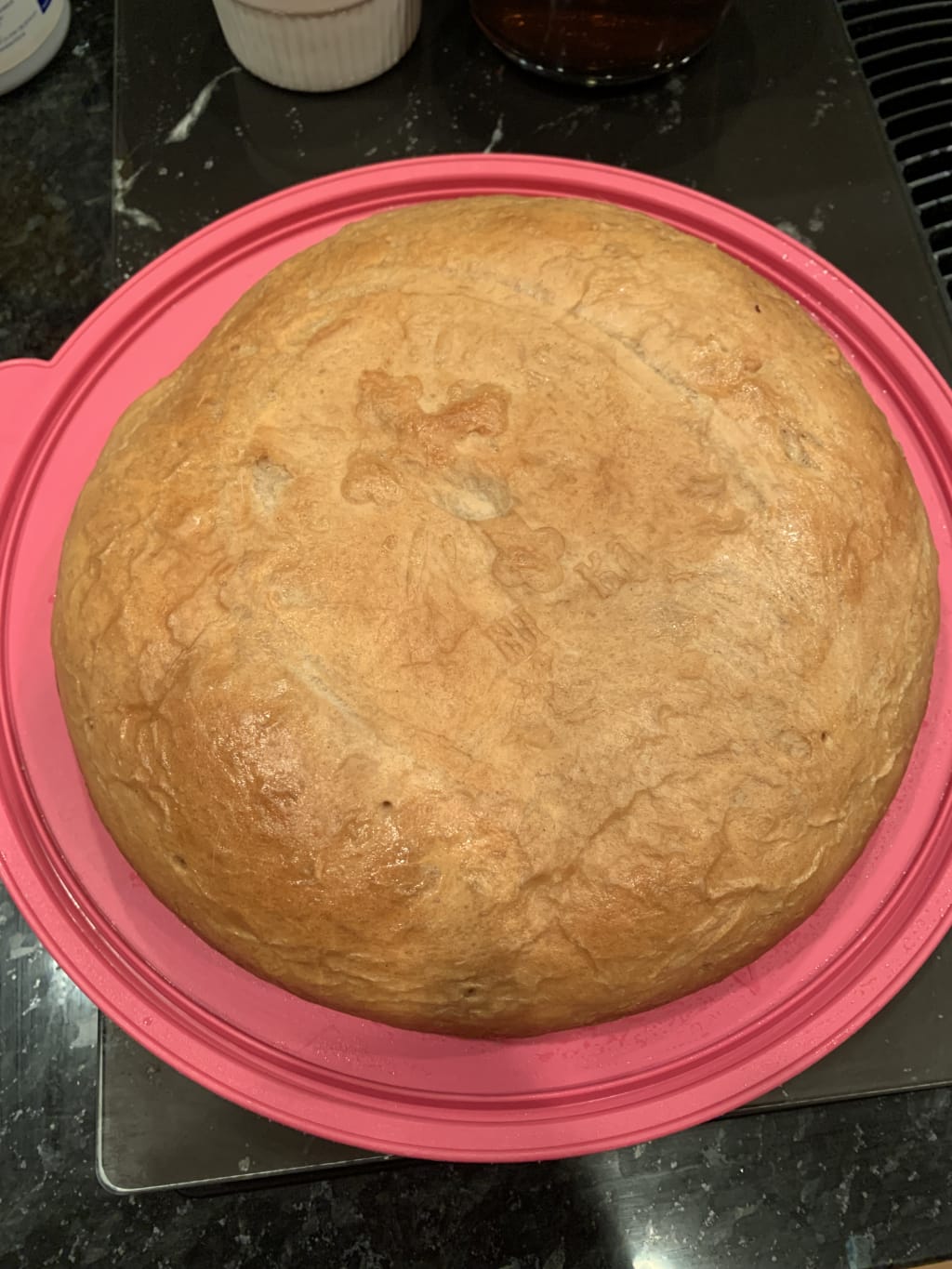
For the past few weeks, I have been a Martha instead of a Mary. I got it into my head that, since I have finally retired, I should start doing all the stuff I wanted to do but couldn’t because I was working. The Dormition Feast Day was coming up (August 15), so I endeavored to teach myself to make Artoklasia.
Artoklasia is a sweet, fragrant bread and is made only for Name Days or Feast Days. The word Artoklasia derives from a Greek compound word. The first syllable comes from artos and means “bread.” The second syllable comes from klasis, meaning “breaking.” Artoklasia literally means “breaking of bread.” Five round loaves of bread are baked in remembrance of the miracle Christ performed. (We don’t include the fish.) The miracle of the five loaves and two fish is recorded in all four Gospels of the Bible. Ever since I was a little girl, it was always a treat to receive a little chunk of this delicious bread at the end of Divine Liturgy.
While searching for the recipe, I learned that in other areas of the Orthodox world, the five loaves are stamped with the Prosforo (altar bread) stamp that Greek Orthodox use exclusively for the plain offering bread that is prepared by church members for Holy Communion. It was a little too ambitious for me when I tried a fancy bread stamp on one of my practice loaves. It either did not work well or I didn’t do it correctly. The interesting thing about bread stamps is that they were used in the ancient world. Various kinds of stamps were from commercial bakers who sold their bread with their own unique stamps – a marketing tool and a method of identifying the bread maker. Large quantities of bread were purchased for the Roman armies and the loaves were stamped by the bakers who made them. It was also a custom in pagan religious rites to offer bread loaves that were baked in the shape of an animal or stamped with an animal shape as sacrifices to the gods by those who could not afford to sacrifice a live animal.
Naturally, I had a little experience in baking bread when my mother was still in this life. All I had to do was call her and say, “Hey Mom, I made some bread dough but I’m not sure I did it right.” She would be at my door within minutes after I got off the phone with her! She always knew just by looking at the dough and touching it what I had done wrong. Sometimes, she would say the dough was “too loose.” When I asked her, "What does too loose mean?” -- if I was lucky, she would get frustrated with me and finish it herself.
Now, it’s all up to me. I have made Christopsomo (Christmas bread), and I have made Tsoureki (Easter bread) many times, but never Artoklasia. My first batch of dough was made using a recipe that yielded only one nine-inch round pita loaf. Getting it to rise was one problem, and the next problem was that after baking, the bottom crust was almost burned even though I had carefully followed the directions. The middle was not baked all the way either. After a quick Facebook call out for help, friends gave me tips on what I could do better the next time. Wetting a towel and heating it in the microwave and covering the dough helped the bread rise the next time. Another friend told me to get a bread thermometer. They have bread thermometers? A quick search on the internet yielded not only where to get one but at what temperature bread is done! Before I tried again, I recalled a book I bought a while back on baking bread, and I found still another tip – the author recommended a “baking stone”! According to the author, commercial ovens are calibrated to exact temperatures, but ovens for home use are usually hotter because they are opened and closed more often. The baking stone is placed near the bottom of the oven during preheating and left throughout the baking time. Also recommended was a dish of boiling water near the bottom of the oven.
Three days before August 15 (a Sunday in 2021), I used a recipe that yielded enough for five loaves. I used the baking stone and the boiling water near the bottom of the oven. The first two nine-inch round loaves came out perfectly! The tops were nicely browned and the bottoms were not dark. The digital thermometer at 198 degrees signaled they were done. The next three loaves were shaped and rounded and placed on a cookie sheet. Success!
Right after baking, I froze them to keep them fresh. On the day before the Dormition Feast Day, I thawed them to room temperature, wrapped them in a table cloth and took them to evening Vespers. Our priest had already started the service, so I quietly set the bread on one of the front pews. I took a seat near the middle isle and Father leaned toward me and asked, “Did I know you were bringing this tonight?” I winced and said something like, “Oops!” I forgot to let the church office know and schedule the Artoklasia service so he would know ahead of time. I placed the bread on a table for him, but he rearranged them later. Things must be done a certain way. Hymns were sung. The bread was blessed in a special service. Some of the bread was cut and distributed to the Vespers crowd and the rest was given at the end of the Dormition Liturgy the next day. Next time, I will remember to schedule with the church office, bring wine and olive oil, and a list of names to be prayed for. We prayed instead for everyone who celebrated their Name Day on the Feast of the Dormition such as Maria, Mary, Despina, Panagiota, Panagioti, and others who are named for the Ever-Virgin Mary or one of her titles such as “All Holy” (Panagia), or Despina (Lady or Maiden).
The entire process helped me feel close to my mother again. She passed away after complications from a stroke in 2006. Like so many other cultural and religious traditions, the preparation of the Artoklasia is a work of love. It is an offering to God. It is an offering to the parish. It is a prayer for loved ones who are no longer with us, and it is a prayer for the living.
Now that I have the process down, perhaps I won’t need to be so Martha next time!
About the Creator
Yiayia Mary
I am an American of Greek heritage. I love writing.
Keep reading
More stories from Yiayia Mary and writers in Feast and other communities.
Mimosas in the Spring
It was spring in Houston, Texas. I sat on the patio at my Yiayia’s house on Willard Street in the Montrose area. Yiayia means grandmother in Greek. Fat green grapes hung from the arbor above me. The vines were entwined in the latticework, and the big flat green leaves shaded me from Houston’s already blistering heat and humidity. I followed Yiayia outside and watched as she selected only the best grape leaves. She took them inside to wash and prepare them for one of my favorite dishes, dolmades (grape leaves stuffed with seasoned meat and rice) and drenched in avgolemono (egg and lemon sauce).
By Yiayia Mary4 years ago in Fiction
My Tous les Jours Trip
As someone who lives in a rural area, I don't get the chance to visit fancy restaurants or bakeries that often. So, when a friend told me about a French-Asian bakery that's less than an hour away, I knew I had to check it out and grab some pictures for social media. Tous les Jours ended up providing an immersive experience that went above and beyond my expectations--although I did leave with a few reservations.
By Kaitlin Shanks26 days ago in Feast
Hazelnut Market Size and Forecast 2025–2033
Introduction Once considered a niche ingredient mainly associated with chocolates and seasonal desserts, hazelnuts have now emerged as a global super-ingredient. From premium confectionery and bakery applications to plant-based beverages and wellness products, hazelnuts are enjoying unprecedented demand across multiple industries. This transformation is being driven by a combination of changing consumer lifestyles, rising health awareness, innovation in food processing, and the global push toward sustainability and clean-label products.
By Aaina Oberoi7 days ago in Feast



Comments
There are no comments for this story
Be the first to respond and start the conversation.