
How Do You Choose Fruits When You Buy Them?
Do you like fruit?

Due to the benefits of the fast transport system and the increasingly efficient storage space, many fruits and vegetables are available on the market almost all year round, regardless of the country of origin.
But to benefit from the highest nutritional value and the best flavor, choose to eat fruits and vegetables depending on their harvest season.
Here are some tips to help you select the freshest fruits and vegetables as specified in the U.S. Fruit and Vegetable Buying Guide. Department of Agriculture by the American Association of Family and Consumer Sciences, Handbook of Food Preparation.
The apples
Peak season: September - May.
Choose those fruits that are hard to touch. Avoid the soft and beaten ones. In terms of color, it varies from green to yellow to dark red, depending on the variety chosen.
Bananas
Peak season: All year-round.
Choose those fruits that are hard, without blows, green to yellow. If necessary, let them bake at room temperature in the dark.
Pineapple
Peak season: February - August
Defining this fruit is the aroma; do not buy a fruit that does not have a specific aroma.
To be ripe, the pineapple fruit must be golden, without too much green color. At the same time, it must be very soft. When the leaves are easily removed, the fruit is ripe. So the test you can do right in the store is to try to rip off a leaf.
As the pineapple fruits we find in our stores are mostly green, it should be noted that, unlike other fruits, green pineapple fruits, picked too early, do not ripen properly after harvest.
Past fruits are soft and have darker spots at the base and sides.
Plums
Peak season: June - September
As with the mango fruit, plums are not chosen based on color, but on the skin. Therefore, the color is not an indication of maturity in the case of plums. Some varieties are dark purple from the beginning of the ripening process, and the shade remains unchanged until full ripening.
Look for those with a smooth, soft shell that has a specific haze on them. Avoid wrinkled ones.
Grapefruit
Peak season: October - June
Choose the hard, round ones, without traces from the storage boxes, having a weight corresponding to the size, without being extremely light about the size of the respective leaf.
Avoid very large, swollen ones with a prominent shell texture.
Grapes
Peak season: June - December.
To have the qualities intact, the grapes do not have to be extremely strong, but delicate, tender, and full of juice. The woody part of the bunch should not be stiff, the drier it is, the longer the bunch has been picked.
Kiwi
Peak season: June - August
Choose fruit that, when pressed lightly, is elastic, immediately returns to its original shape, and is slightly soft to the touch.
Lemon
Peak season: All year-round.
The chosen fruit should be quite strong, and the peel should have a smooth and glossy texture. If they are too light about their size, it means that they are dry; no matter how much you squeeze it, you won't get too much lemon juice!
Mango
Peak season: April - August
The ripe mango fruit is chosen by pressing, not by color. The color of this exotic fruit is not a landmark of maturity. The only way to find out how ripe mango is is to press it with your finger.
A good-quality mango has a solid consistency and is soft to the touch. The size can vary from the size of a plum to the size of an apple, and the color from yellow to red. The skin should be smooth, stained black when very ripe.
A ripe mango smells nice - slightly fruity, especially in the stalk area. Due to its aroma, green mango fruit is sometimes used in the preparation of various dishes.
Oranges
Peak season: November - June
And in the case of oranges, the ratio between the weight of the fruit and its size must correspond, a lighter fruit means that the fruit is dry, respectively less juicy. The fruit should be firm and the skin not too rough.
Papaya
Peak season: All year-round.
The color of the papaya fruit varies from yellow-green to deep yellow. Baked and ready-to-eat papaya are the ones where the pulp comes out easily when the fruit is pressed between the palms.
Pears
Peak season: August-May
When pressed in the tail area, the pear should be slightly soft. The color varies from yellow to red.
If necessary, allow the fruit to ripen at room temperature.
Pomegranates
Peak season: September - November.
A fresh, quality pomegranate should have a thin, shiny, fresh, dark red, shiny air. If the skin is dull, the fruit is older. The weight of the pomegranate must correspond to the size.
Melon
Peak season: May - September
When choosing cantaloupe, it should be heavy and give off a sweet smell - but not very strong, in which case it is too ripe. The harder it is, the juicier and sweeter it is. The best indicator of maturity is the tail area. Press lightly on the area where the stem was cut; it must be soft, but not so much that the finger sinks into the fruit. You should feel that, after pressing, the shell recovers, it is elastic.
Unlike cantaloupe, the Honeydew variety must be chosen according to the appearance of the skin. It should be glossy, soft, and golden (not yellow).
Watermelon
Peak season: May-August
A ripe watermelon is heavy; this indicates that it is full of water. You can hammer to check maturity. Although the sound differs (depending on the variety, size, thickness of the shell), it says something: the more stuffy a melon sounds, the more "earthy" it is, the lower the chance of being raw.
But you have no way of knowing if it's too ripe. Do this test by comparing other melons of the same size and variety.
Another simple way to make sure you get a ripe watermelon is to look at the opposite end of the tail; there should be a yellow or brown spot or spot. This is the area where the watermelon has been in contact with the ground, and whether it is white or not, it means that the fruit has been picked too early.
Choose melons that have an asymmetrical, oval, or round shape. Avoid deformed, flattened, or protruding ones.
Strawberries
Peak season: June - August
If it smells the way you want it to taste, you've probably found a ripe strawberry. As with pineapples, if they don't smell like anything, chances are they won't taste good. Also, ripe strawberries should be bright red, spotless, and firm.
Peaches
Peak season: June - July
Ripe peaches have two shades. The part that was in direct contact with the sun turns red and the opposite side turns yellow. Make sure there is no shade of green around the tail.
The smell is also a landmark: if they have a pleasant aroma, it means that they will be tasty.
About the Creator
I Discovered A Better Way To Cook Cabbage
I recently posted this question on Facebook: I was surprised by some of the answers, especially about cabbage. Chicken: 40% Cabbage: 30% Salmon: 20% Others: 10% (including steak, crab cakes, fish, chili dogs, chicken salad, mac and cheese, cold cuts, potatoes, and ham)
By Margaret Minnicks4 days ago in Feast
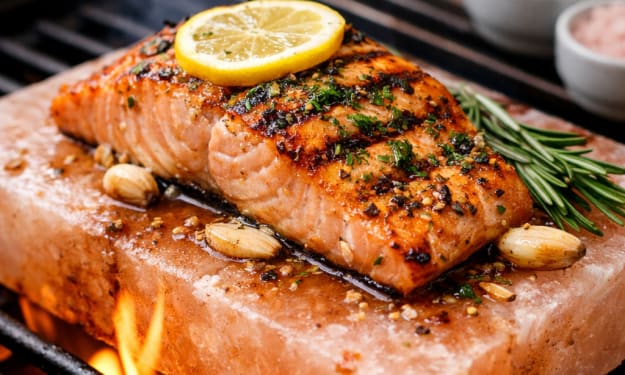
Grilled Salmon on Himalayan Pink Salt Bricks: Extraordinary Taste
That smoky piece of grilled salmon? People love how it tastes, full and hearty, yet light on the body thanks to good fats. Still, nailing the taste at home trips up plenty - too much salt shows up fast, or worse, the flesh turns stiff and parched before it's done.
By Hendra Edward3 days ago in Feast



Comments
There are no comments for this story
Be the first to respond and start the conversation.