
FDA Finally Bans Red Dye 3 From "Food"
This Stuff Is Everywhere


On January 15, the FDA officially pulled the plug on red dye 3, meaning it’ll be banned from foods and drugs. But don’t expect it to disappear overnight—this stuff is everywhere, and it won’t be fully phased out of grocery stores until 2027.
The ban comes after two studies linked red dye 3 to thyroid cancer in male rats.
"Two studies showed cancer in laboratory male rats exposed to high levels of FD&C Red No. 3 due to a rat-specific hormonal mechanism," the FDA explained in their announcement. "The way that FD&C Red No. 3 causes cancer in male rats does not occur in humans."
Red dye 3 has been controversial for years, and many companies have already started phasing it out. But since it’s still floating around in the U.S. food and drug supply, the FDA is giving manufacturers a few years to reformulate their products.
What is red dye 3, anyway?
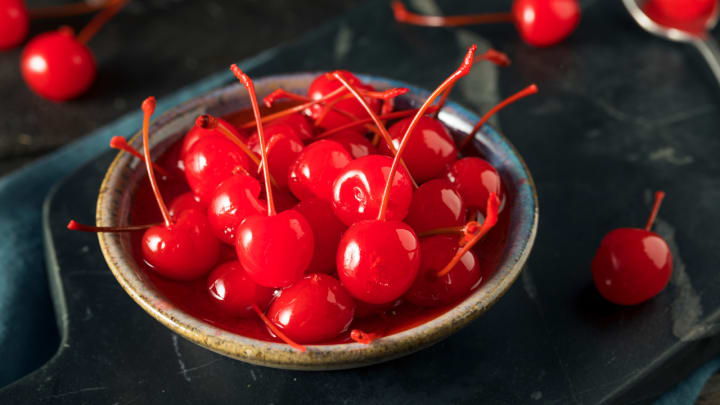
Also called erythrosine, Red Dye 3 is a synthetic dye made from petroleum. It gives foods that bright cherry-red color.
Back in 1990, the FDA banned it from cosmetics and topical drugs under the Delaney Clause, which prohibits color additives that have been found to cause cancer in animals or humans when ingested. (Studies on rats show a cancer risk at high doses, but there’s no solid evidence of the same effect in humans.)
"This ingredient doesn’t add anything to food aside from color—it doesn’t improve flavor, nutrition, or shelf life," says registered dietitian Scott Keatley, RD, co-owner of Keatley Medical Nutrition Therapy.
Other countries have already cracked down on red dye 3. The European Union restricted its use to certain processed cherries in 1994, and California passed a ban in 2023 that would have taken effect in 2027.
Where is red dye 3 hiding?
Many brands have already cut it, but red dye 3 is still in nearly 3,000 products, according to the Environmental Working Group. Here are some of the biggest culprits:
- Baking decorations
- Ice cream cones
- Frostings and icings
- Frozen dairy desserts
- Soft candy and gummies
- Meal replacement drinks and bars
- Cookies
- Toaster pastries
- Ice pops
- Baby foods
- Hard candy
Is Red Dye 3 really that bad?
The FDA is banning it because the law requires it, but they’re quick to point out that there’s no proof red dye 3 causes cancer in humans.
"This news isn’t surprising," says Wade Syers, D.Soc.Sci., a Michigan State University Extension food safety specialist. "The Food, Drug, and Cosmetics Act prohibits color additives found to induce cancer in humans or animals, and red dye No. 3 has been found to cause cancer in male rats under certain conditions. There’s no evidence it causes cancer in humans."
Some people worry that red dye 3 could impact children’s behavior. A 2021 report from the California Office of Environmental Health Hazard Assessment linked it (along with other food dyes) to hyperactivity and focus issues in kids.
But Keatley says concerns about red dye 3 and ADHD might be misplaced.
"We don’t consume enough red dye No. 3 over a day, a week, or even a month to compare it to rat studies," he explains. "Bigger concerns should be emissions from trucks and cars, lack of physical activity in schools, and the fact that so many kids eat mostly junk food."

Should you be worried?
There’s no need to freak out just yet. But if you’d rather avoid Red Dye 3, check ingredient lists—it may show up as "FD&C Red No. 3” or "FD&C Red 3.”
"Manufacturers have until Jan. 15, 2027, to remove it from their food products," Syers points out. "If you’re concerned about consuming red dye No. 3, check your labels and limit those purchases."
About the Creator
Rootbound Homestead
Rootbound Homestead is a community bound by roots. Leaving our old comfy life in FL to move to NY to start living cleaner, more simply, and with purpose. Garden hacks, tips and tricks, natural medicine, healing, animals, recipes and more!
Keep reading
More stories from Rootbound Homestead and writers in Feast and other communities.
Do You Know How Broken The Food System Is?
Boar's Head meats and Walmart apple juice are the most recent food recalls on the table. Romane has E. Coli. A North Carolina meat plant recalled over 35,000 pounds of ground beef due to a potential plastic particle contamination. Perdue recalls 167,000 pounds of chicken nuggets after consumers find metal wire in them.
By Rootbound Homesteadabout a year ago in Feast
Cassie and Johnny
I’m the kind of dame you notice. I’m no femme fatale, but you can’t ignore me, at least not until I warn you about what’s coming, then everybody ignores me. Hell, they usually blame me afterwards and give Johnny all the credit for saving the day, but my Johnny couldn’t save a seat at the movies without my help. Sure, he’s brawny, but brainy? Not so much. Like that time I asked him to spot me five bucks, and he said he didn’t see it anywhere on me, and believe you me, he looked but good.
By Harper Lewis5 days ago in Critique


Comments
There are no comments for this story
Be the first to respond and start the conversation.