
Corn Starch Market Trends & Summary: A Growing Global Shift Toward Natural, Sustainable Ingredients
How Rising Demand from Food, Pharma, and Industrial Sectors Is Powering a US$ 43.74 Billion Market by 2033

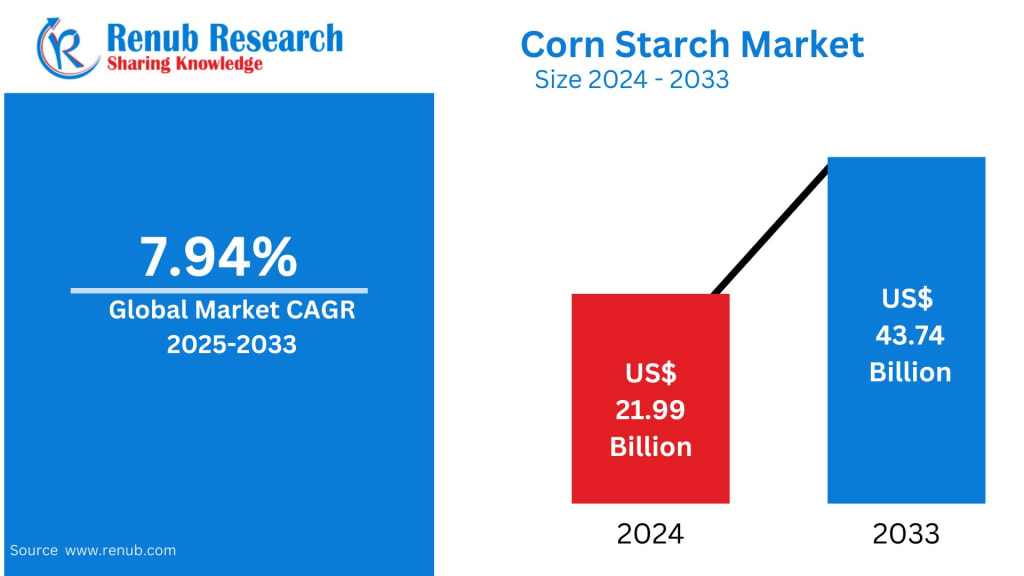
The global corn starch market is entering a phase of accelerated growth, driven by rising demand across food, pharmaceutical, paper, textile, and industrial sectors. According to Renub Research, the market—valued at US$ 21.99 billion in 2024—is projected to reach US$ 43.74 billion by 2033, expanding at a strong CAGR of 7.94% from 2025 to 2033. This surge reflects not only the ingredient's versatility but also the world’s shift toward natural, sustainable, and cost-efficient materials.
Corn starch, derived from the endosperm of corn kernels, has long been recognized for its thickening, binding, and stabilizing properties. But today, its relevance extends well beyond the kitchen. From excipients in drug manufacturing to biodegradable alternatives in packaging, corn starch has evolved into a crucial raw material across modern industries.
Global Corn Starch Market Outlook: A Versatile Ingredient Transforming Multiple Industries
As a fine, neutral-flavored powder, corn starch plays a vital role in cooking and baking—thickening sauces, stabilizing soups, and giving puddings their smooth texture. In processed foods, it acts as a binder and improves mouthfeel, making it a preferred choice for manufacturers aiming to achieve consistency without altering taste.
However, food applications represent only one dimension of this rapidly expanding market.
In pharmaceuticals, corn starch is widely used as an excipient, binder, and coating agent—helping maintain tablet structure while enabling controlled disintegration. The textile sector employs it to strengthen fibers and improve fabric finish, while the paper industry uses it to enhance durability and print quality.
Sustainability, a megatrend reshaping global manufacturing, has also propelled corn starch into the spotlight. As companies seek eco-friendly alternatives to petroleum-based materials, bioplastics made from corn starch have gained traction in packaging, agriculture, and consumer goods.
Key Growth Drivers in the Global Corn Starch Market
1. Rising Consumer Preference for Organic and Natural Ingredients
Health-conscious consumers are pushing global food companies to eliminate artificial additives and adopt cleaner formulations. Corn starch, being plant-based and free from synthetic chemicals, fits perfectly into this shift.
Companies like Ingredion have responded to the natural-ingredient movement with product innovations such as PURITY Bio 201, an organic native corn starch supplied across the U.S. and Canada. Used as a thickener, stabilizer, and texturizer, organic corn starch is experiencing growing demand across baked goods, sauces, beverages, and snacks.
The clean-label movement—favoring simple, recognizable ingredients—is expected to remain a long-term market driver.
2. Rising Focus on Gut Health and Demand for Resistant Starch
An increasingly researched category of corn starch is resistant starch, which is not digested in the small intestine and reaches the colon to act as a prebiotic. It supports beneficial gut bacteria, improves metabolic health, and may reduce the risk of colon-related diseases.
A pivotal study published in Cancer Prevention Research found that resistant starch may significantly reduce the incidence of certain cancers, especially in individuals with Lynch syndrome. With digestive wellness becoming a consumer priority, resistant starch is emerging as a high-value segment within the corn starch industry.
3. Growing Incidence of Celiac Disease Boosts Demand for Gluten-Free Products
Celiac disease has spurred a global shift toward gluten-free alternatives. The condition’s worldwide prevalence stands at 1.4%, according to PubMed, with rates reaching 3% in Sweden and 2.4% in Colorado among at-risk infants. Women are statistically twice as likely to develop the condition.
Corn starch—naturally gluten-free—serves as an ideal ingredient in gluten-free baked goods, snacks, dairy products, and confectionery. As awareness of celiac disease grows, the demand for gluten-free formulations continues to rise, supporting long-term market growth.
Obstacles Facing the Corn Starch Industry
1. Extreme Volatility in Raw Material Prices
Corn prices are highly sensitive to weather fluctuations, crop diseases, global planting conditions, geopolitical tensions, and competition from other sectors such as biofuels and animal feed. This volatility affects not only production planning but also profitability.
Small and mid-sized manufacturers feel this burden the most, as they often lack the financial flexibility to absorb sudden price spikes. As a result, companies are turning to strategic sourcing, supply chain diversification, and risk-mitigation strategies to navigate fluctuating raw material costs.
2. Health and Environmental Concerns Challenge Market Confidence
While corn starch is plant-based, its association with highly processed foods has affected market perception among health-conscious consumers. Additionally, concerns surrounding genetically modified (GM) corn, pesticide use, and environmental sustainability have spurred demand for non-GMO and organic alternatives.
Producers are now under pressure to adopt greener farming practices, improve traceability, and invest in cleaner processing technologies—changes that increase operational costs but are essential for market competitiveness.
Segmental Insights: Where the Corn Starch Market Is Growing Fastest
Food and Beverage: The Largest End-Use Industry
The food and beverage sector accounts for the lion’s share of global corn starch consumption. Widely used in:
soups and sauces
bakery formulations
snacks and confectionery
beverages
ready-to-eat meals
Corn starch helps meet surging demand for convenience foods, which continue to dominate retail shelves. Its multifunctionality ensures continued reliance across the packaged food industry.
Powder Corn Starch: Expanding Applications Across Key Industries
Powdered corn starch is preferred for its ease of handling, long shelf life, and wide applicability. Key uses include:
thickening and stabilizing food products
binding tablets in pharmaceutical manufacturing
improving paper strength and printability
finishing and strengthening textiles
formulating cosmetics
The rise of sustainable packaging materials has also expanded demand for powdered corn starch in bioplastics and biodegradable films.
Regional Market Outlook
United States: The Powerhouse of Global Corn Starch Production
With over 95% of U.S. feed grain production derived from corn, the United States remains the world leader in corn starch output. The country plants roughly 90 million acres of corn annually, predominantly across the Heartland.
Corn starch has exceptional market penetration in the U.S. pharmaceutical industry, where it is used extensively as a filler and binder in drug formulations. Abundant raw materials, advanced processing facilities, and strong export capabilities solidify the country’s global dominance.
Germany: A Hub for Sustainable Ingredient Innovation
Germany’s food, pharmaceutical, and industrial sectors rely heavily on corn starch for its natural and functional properties. The ingredient is used widely in:
soups, sauces, and desserts
paper strengthening
textile finishing
Germany’s commitment to renewable materials is advancing the adoption of corn-starch-based biodegradable plastics. However, the market continues to face pressure from fluctuating raw material costs and competition from potato and wheat starch.
India: Rapid Growth Driven by Processed Food Demand
India is experiencing substantial growth in corn starch consumption due to:
rising urbanization
booming packaged food industry
expanding pharmaceutical manufacturing
growth in paper and textile sectors
Corn starch’s affordability and versatility make it a preferred choice for manufacturers. Regional demand in Asia is further supported by investments like Cargill’s corn wet mill in Indonesia (2022), designed to meet rising starch and sweetener consumption across the continent.
Saudi Arabia: Growing Demand Across Food and Industrial Sectors
In Saudi Arabia, demand is rising for corn starch in:
packaged foods
bakery products
ready-to-eat meals
pharmaceutical excipients
textile and paper finishing
The Kingdom’s increasing interest in sustainable industrial practices is also accelerating the adoption of starch-based bioplastics.
Key Companies Shaping the Global Corn Starch Market
Major players include:
Cargill Inc.
Ingredion Inc.
Archer Daniels Midland Company (ADM)
Tate & Lyle
Associated British Foods plc
Tereos Group
SüdZucker AG
Global Bio-Chem Technology Group Co. Ltd.
These companies engage in product innovation, organic certifications, bioplastic development, and strategic partnerships to expand market presence.
Corn Starch Market Segmentation
By Type
Native
Modified
Sweeteners
By Form
Powder
Liquid
By End-User
Food & Beverage
Animal Feed
Paper & Board
Others
By Region (25 Countries Covered)
North America, Europe, Asia-Pacific, Latin America, Middle East & Africa — including major markets such as the U.S., Germany, China, India, Brazil, Saudi Arabia, and more.
Final Thoughts
The global corn starch market is undergoing a transformation fueled by health trends, clean-label demand, industrial innovation, and the global pursuit of sustainability. While challenges such as raw material volatility and environmental concerns persist, market leaders are embracing organic production, non-GMO sourcing, and eco-friendly applications to stay ahead.
With a projected valuation of US$ 43.74 billion by 2033, corn starch is not just a pantry staple—it's a key ingredient in the future of food, pharmaceuticals, packaging, and sustainable manufacturing.
About the Creator
Janine Root
Janine Root is a skilled content writer with a passion for creating engaging, informative, and SEO-optimized content. She excels in crafting compelling narratives that resonate with audiences and drive results.
Keep reading
More stories from Janine Root and writers in Feast and other communities.
Saudi Arabia Chocolate Market Size: A Deep Dive Into Trends, Growth Drivers & Future Outlook (2025–2033)
The Saudi Arabia chocolate market continues to evolve at a remarkable pace, fueled by cultural traditions, rising disposable incomes, and growing consumer appetite for premium, artisanal, and healthier chocolate options. According to Renub Research, the Saudi Arabia chocolate market was valued at US$ 1.32 billion in 2024 and is projected to reach US$ 2.00 billion by 2033, expanding at a CAGR of 4.75% from 2025 to 2033.
By Janine Root about a month ago in Feast
My Tous les Jours Trip
As someone who lives in a rural area, I don't get the chance to visit fancy restaurants or bakeries that often. So, when a friend told me about a French-Asian bakery that's less than an hour away, I knew I had to check it out and grab some pictures for social media. Tous les Jours ended up providing an immersive experience that went above and beyond my expectations--although I did leave with a few reservations.
By Kaitlin Shanks17 days ago in Feast
United States White Mushroom Market Size and Forecast 2025–2033
United States White Mushroom Market The United States White Mushroom Market is projected to expand from US$ 13.3 billion in 2024 to US$ 22.34 billion by 2033, growing at a CAGR of 5.93% from 2025 to 2033, according to Renub Research. Rising demand for plant-based, healthful meals, growing awareness of nutritional benefits, and continuous improvements in packaging, cold-chain logistics, and distribution are reshaping the industry. White mushrooms—often called button mushrooms—are now more accessible than ever through retail stores, online grocery platforms, and foodservice channels, making them a staple of modern American diets.
By Marthan Sir2 days ago in Feast




Comments
There are no comments for this story
Be the first to respond and start the conversation.