
Akra: a Haitian recipe
A response to Vance and trump’s fear mongering about Haitian immigrants (recipe is in bold).

Trump is a bombastic liar. Vance is in his pocket. Neither one should be afforded even the barest generosity or credibility. So it’s easy (and right) for us to dismiss their fear mongering claims against Haitian immigrants, on basic principle.
The fact that these “leaders” are targeting Haitians with their racist dog whistles shouldn’t come as a tremendous surprise. White supremacists have long sought to demonize and sabotage Haiti as a state, because they were the first and only nation to be created by a successful slave rebellion!
That legacy has painted a socioeconomic and geopolitical target on their state and people. These targets were fabricated and are maintained by people and powers who are too fragile to admit that a black led country of self-freed slaves could be allowed to succeed and thrive on the world forum.
But I’m not here to redress the long history of political and economic injustice forced on Haiti and Haitians by world powers like France and the United States.
I’m here to say, today, in the here and now: trump and Vance are dumbasses and liars for spewing fear mongering accusations that Haitian immigrants are bad neighbors.
But I’d like to go a step further with this refutation and share two things: advice and a recipe, because you don’t need to be afraid of Haitians or their cuisine!
Let's put on some Haitian music while ya read:
Now, before the recipe, my advice: if you ever have a chance to try food prepared by a Haitian person do it!
My ex wife is Haitian, and her grandmother is the best cook I’ve ever known. The meals I’ve enjoyed with her family back when we were together were some of the best meals I’ve had in my entire life.
Haitian food in general is beyond delicious. I’ve tried and enjoyed a bunch of it and I highly, highly, HIGHLY recommend giving it a shot.
If Vance and trump had occasion to actually sample Haitian cuisine they’d probably find some other culture to smack talk with their unhinged fear mongering, because Haitian food is utterly bomb.
Similar to other Caribbean cuisine, Haitian food (manje Kreyol) makes use of island and tropical fare. Rice and beans (diri a pwa) are a familiar staple, though you’ll find variety. Black rice (diri noir, also called djon djon) is tender, long grain rice richly flavored with dried mushrooms and sometimes shrimp. Often rice flavored with cloves, garlic, and other herbs, and drenched in sauces, including a delectable mear sauces or hearty bean sauce (sus pwa). Fried plantains, or yucca are a common side dishes, and they’re best soaked in sauce or covered with spicy pickled vegetables (pikleze).
Haitian chefs often introduce significant heat to their dishes, using sweet and hot scotch bonnet peppers (relatives of habanero). If you’re offered “Pima” (hot sauce) start with a small dab and see how well you tolerate the heat before loading up your meal.
Haitian seafood is some of the best in the world. Whether you’re sinking your teeth into stewed fish, or a plate of crab with stewed vegetables (zirik avec legim) salted herring pastries (aransol patte) you’ll be pleased!
But the most exquisite Haitian seafood is conch (lanbi). This aquatic snail with the famously recognizable shell is tender and succulent. If it’s prepared skillfully (and if a Haitian is cooking it, you’re probably in luck) it will be packed with flavor that you’ll crave for years to come. As a lover of good food, Haitian lanbi is hands down my all time favorite meal.
There’s also the celebratory National dish, pumpkin soup (soup joumou) which Haitians prepare and enjoy on new years to commemorate their independence and freedom! A dish that’s rich in flavor and in tradition.
But if you were only going to try one Haitian food, I might recommend fried pork (griot). The preparation is painstaking, first the pork is cut and washed in citrus. Then it’s soaked and boiled in a pepper marinade (epis). Then it’s fried to a crispy outside and a tender, juicy inside. Served with pickleze garnishes on a bed of diri a pwa, drizzled with generous spoonfuls of sauce, this dish will absolutely rock your world.
But really, the list goes on. Their goat stew (Tasso) is fantastic, their cornmeal breakfasts (maimoule) with avocado and fish is delicious, their fried chicken (poul) is incredible. If you ever have a chance to try a Haitian restaurant do not pass it up. If a Haitian person offers you a meal, do not turn it down. It will likely be the best food you’ve had in weeks or months, and if you’re lucky enough to try food from a very highly gifted Haitian chef (usually a Haitian grandma) then you may well be poised to enjoy the best meal of your life.
Second: the recipe I would like to share is for a Haitian fritter called AKRA.
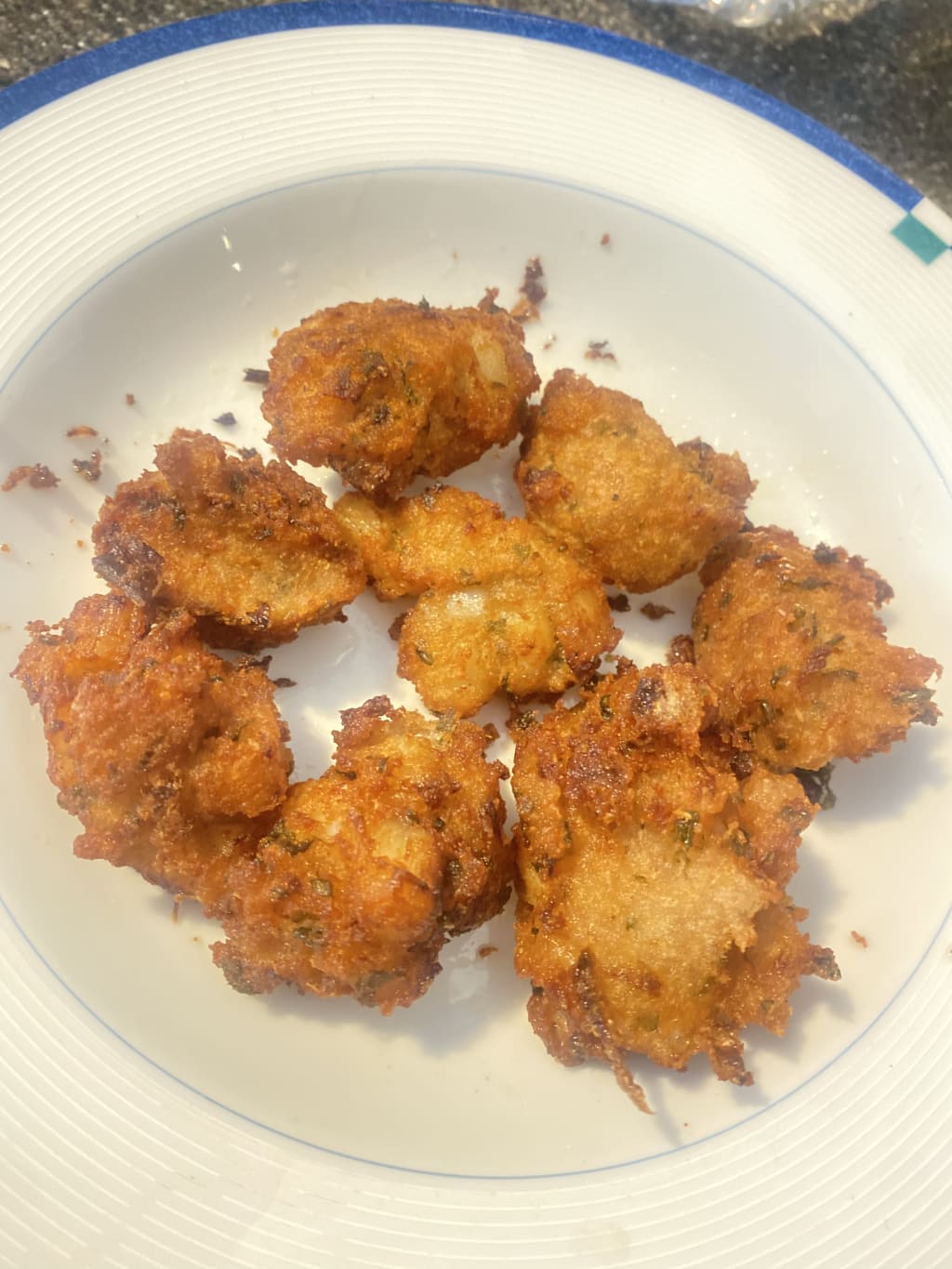
Haitian akra (also spelled accra) is a fried, savory treat made with grated malanga root, spices and more. It’s a crispy and wonderful appetizer or side dish that I’d be happy to enjoy as a main course. Akra is a resilient culinary tradition that has its roots in the same continent that birthed the human race!
The Haitian tradition makes use of locally abundant malanga root, but the basic idea and end result of a fried mash is a cultural carry over from West African accara, an “ancestor dish” made form mashed peas. When African people were uprooted from their homes and forced into slavery in the Caribbean they carried their language, music, religion, and culinary arts in their hearts, minds, and deeds.
Centuries later, the African diaspora all over the world find joy and comfort and identity in these foundational pieces of culture that have survived the wear of time as well as the atrocities of relocation and enslavement to inform and strengthen new descendent cultures.
Haitian akra is one such testament to the resilience and strength of the people of Haiti— and of their ancestors— it’s also delicious!
Good Haitian akra is fried to a crisp on the outside, with a tender, pulpy inside. The flavor of cooked malanga on its own is subtle and earthy, and a little bit nutty, but when it’s filled with tasty bits of bacalao (salted cod), and a splash of tangy heat from scotch bonnet peppers, then drizzled with the spicy sweetness of a epis (Haitian sauce), the dish is elevated in ways that really treat the palate.
Suffice it to say, if you like fried food and Caribbean flavor, you’d definitely love akra. It’s a satisfying dish.
Her family taught me some of the prep that goes into making Haitian food.
Some of my most formative and treasured moments in adulthood have been times spent with her side of the family: listening to music and sharing meals with loved ones has opened my eyes and my heart to a new depth of cultural immersion that I’d otherwise never have experienced or understood.
It has afforded me a positive experience of being welcomed despite being the outsider— if that makes sense…. The first time I met her family was one of the first times that I’d been the only white person in the room.
That had been a personally important barrier to break, because having lived most of my life with the privilege of rarely if ever being in tne minority had given me a naive and limited perspective on the social institutions that limit our world.
A comfort zone is a place of laziness and weakness and limitation and complacency— and there’s tremendous value in being invited and welcomed OUT of one’s comfort zone. Being with her family in those early days— being welcomed so fully to a home filled with music and food and laughter— pulled me out of that place of comfort in the best possible way.
So Haitian food has a special significance to me, that goes beyond it tasting absolutely incredible.
It’s a symbol of a long and proud history, which I’ve had the opportunity to witness, and which my biracial kids carry forward.
There’s a Haitian expression:
“Bon mizik, bon manje, bon moun” which translates to “good music, good food, good people.”
And those words have always sat with me in the form of this personal lesson: sharing a meal is one of the most powerful and effective ways to bridge a cultural gap. Because realizing the food is good is an undeniable reminder that the humans who made it can be good too.
When we eat a dish from a culture that’s not our own, we’re not just reminded of the hands that made that particular meal. We’re called to honor and admire the many people who perfected the meal and passed it down and enjoyed it as a cross-cultural staple over untold generations.
So!
Here’s what I know of the recipe for Haitian akra, taught to me by ex wife years ago who learned it from her mom and grandma, who learned it from their mothers’ mothers who were resilient enough to adapt it to new ingredients from accara after being uprooted from their homes.
***
HAITIAN AKRA: ingredients
What you’ll need:
1-2 lbs of Malanga root (sometimes called yautia in the super market, check the Caribbean produce section.)
1 or 2 scotch bonnet peppers, the redder the better. These look and taste similar to habanero but they tend to be sweeter.
A protein of your choice, traditionally akra is prepared with salted white fish (bacalao). But my ex wife more often prepared it with shrimp because that’s easier to find. I’ve even used sardines in a pinch. You could conceivably use herring or a different sea food to your preference.
Thyme, parsley, and salt
Vegetable oil for frying.
And if you wish to make a sauce to go with it you’ll need the following as well:
1 onion
1 sweet red pepper
Several cloves of garlic
A couple table spoons of Olive oil
And vegetable oil for frying
***
Steps:
1. Grate the malanga to the finest size possible. The consistency should be mush, not shredded ribbons. Stir in some parsley, and some salt.
2. Prepare your fill to mix with the malanga mash. Traditionally this is salted fish which is soaked and boiled. If you want it spicy, you can finely dice a scotch bonnet. We've also used shrimp, and ultimately the filling is up to you. This gets thoroughly stirred into the malanga…
3. Fry it up! Scoop the mixture into dumpling sized portions and fry until golden brown and crispy on the outside.
*note: when the malanga is raw, it is opaque and almost chalky color. When it is fully cooked it takes on grayish, semi-translucent hue. Crack open your first fritter to ensure its fully cooked before eating, as raw malanga is high in oxalic acid. Adjust your temperature accordingly to find the sweet spot where the insides cook thoroughly and the outside doesn’t burn.
4. (Bonus) Malanga can be served with sauce, if you wish. (You should wish! Everything is better with sauce.) In a frying pan sauté the following: finely diced red peppers, finely diced onion, finely diced scotch bonnet, garlic, and chicken bouillon in a generous portion of olive oil. Season generously with fresh thyme. Once the sauté cooks down, add a splash of vinegar (it’s better to use the juice from haitian pickled vegetables/ pikleze, but vinegar can work if you don’t have any.)
***
***
***
Thanks for reading!
If you’ve had the pleasure of trying Haitian food before, what are your favorite dishes?
Let me know in the comments :)
And if you haven’t been lucky enough to try any yet, keep an eye out for the opportunity, don’t pass it by!
EDIT:
Check out this awesome write up on Nigerian Akara by author Cathy (Christine Acheini) Ben-Ameh!
https://shopping-feedback.today/feast/akara-fritters-flatulence-and-the-deep-fried-diaspora#comment-c237be7c-2260-4a5f-9d18-c7a10ad40e6a%3C/p%3E%3Cstyle data-emotion-css="14azzlx-P">.css-14azzlx-P{font-family:Droid Serif,Georgia,Times New Roman,Times,serif;font-size:1.1875rem;-webkit-letter-spacing:0.01em;-moz-letter-spacing:0.01em;-ms-letter-spacing:0.01em;letter-spacing:0.01em;line-height:1.6;color:#1A1A1A;margin-top:32px;}
From there I highly recommend checking out her poetry too, her writing is absolutely worth your time :)
About the Creator
Sam Spinelli
Trying to make human art the best I can, never Ai!
Help me write better! Critical feedback is welcome :)
reddit.com/u/tasteofhemlock
instagram.com/samspinelli29/
Keep reading
More stories from Sam Spinelli and writers in Feast and other communities.
My Tous les Jours Trip
As someone who lives in a rural area, I don't get the chance to visit fancy restaurants or bakeries that often. So, when a friend told me about a French-Asian bakery that's less than an hour away, I knew I had to check it out and grab some pictures for social media. Tous les Jours ended up providing an immersive experience that went above and beyond my expectations--although I did leave with a few reservations.
By Kaitlin Shanks17 days ago in Feast
United States White Mushroom Market Size and Forecast 2025–2033
United States White Mushroom Market The United States White Mushroom Market is projected to expand from US$ 13.3 billion in 2024 to US$ 22.34 billion by 2033, growing at a CAGR of 5.93% from 2025 to 2033, according to Renub Research. Rising demand for plant-based, healthful meals, growing awareness of nutritional benefits, and continuous improvements in packaging, cold-chain logistics, and distribution are reshaping the industry. White mushrooms—often called button mushrooms—are now more accessible than ever through retail stores, online grocery platforms, and foodservice channels, making them a staple of modern American diets.
By Marthan Sir3 days ago in Feast



Comments (1)
Very good stuff! 😃 Thank you for highlighting my article too 🙏🏾