
A Treasured Memory
“What exactly is this, Grandma?” I inquired, intrigued.
“You'll see, and you'll definitely want more,” my grandmother promised.
“No, thank you; this is not my cup of tea,” I replied snobbishly.
I was still curious about what she was doing, so I sat next to her in the scorching sun of the Sahara Desert. The oppressive heat would force anyone to seek out an air-conditioned refuge. Even a fly couldn't fly around here. But here I was on vacation in this remote County of Tenira, on the outskirts of Sidi Bel Abbes, Algeria, to see my grandmother, whom I hadn't seen since I was a baby.
My mother thought it would be a great idea for me to reconnect with my cultural roots and get away from my obsession with social media. She believed that this trip would forever change me. I believed she was dilutional. Since there was no sign of modern technology or electricity around, I watched my grandmother every move in awe.
She carefully poured 4 kg of Semolina into a sieve and filtered it methodically. The bowl gradually filled with fine grains, one grain at a time. She then added one teaspoon of yeast.
“Who are you feeding? An army?”
“Instead of staring at me, go get me some water.”
“Fine! There's no need to be so bossy.”
I went to the hut, which was made of sand, straw, and water. Inside was a wood-fired clay oven with a small counter on one side. There were dried herbs hanging from the ceiling as well. Like everything else in this so-called house, it was quite minimalistic.
I grabbed a jag from the counter and filled it up with water that she had collected from the on-site well and stored in a barrel.
“Here! If you need more, I'll go get some,” I was proud of myself for being useful for at least one thing.
My grandmother slowly poured the water with one hand while mixing the Semolina with the other.
“How much water are you pouring?” I asked curiously.
“When you've been doing this for a long period of time, you develop an eye for everything,” she joked, leaving me with even more questions.
“How?”
“Today's generation knows nothing but to look at themselves and take pictures with that thing,” she laughed.
“That thing! You mean a smartphone?” For the first time, we laughed together and felt like we could connect and learn from each other.
She then sprinkled a pinch of sea salt in the bowl. The mixture gradually came together to form a dough. She then placed the dough on a 6-inch wooden table and began knitting it for another 15 minutes, or until the dough was elastic and easily spreadable. She then placed the dough in the bowl after smearing oil on the surface to prevent it from sticking.
“What should we do now?” I inquired impatiently.
“We wait for the dough to double in size.”
“How long?”
“Patience is a virtue. But, if you're curious. Depending on the humidity in the air, it could take up to 30 minutes. You can help me chop the vegetables.”
“Sure!” I said it hesitantly. I'd never cut a vegetable before. I was terrified of doing it in front of my grandmother.
She handed me a small but razor-sharp knife and a basket containing 20 green peppers and ten large yellow onions. She could see the terror in my eyes as I stared at the basket, unsure of what to do. She took a yellow onion and demonstrated how to remove the skin. She then put it in the salt water bowl and told me to do the same. We thinly sliced them and placed them in a pot to caramelize to a golden brown. She then demonstrated how to roast green peppers and garlic gloves over an open flame to achieve a meaty texture and sweet flavor.
Then, in a large skillet, she heated the oil and mixed in a variety of herbs and spices, including harissa powder, cinnamon, black pepper, paprika, and a bay leaf. The light roasted herbs were then combined with the caramelized onions, roasted pepper strips, buttery roasted garlics and sliced tomatoes. The mingling of the various aromas resulted in a wonderful, nostalgic, and sweet aroma being released from the mixture.
At that point, I realized I was missing out on a plethora of wonderful life experiences and things. I wish I hadn't squandered those precious hours scrolling and staring at a tiny screen instead of being out here experiencing life.
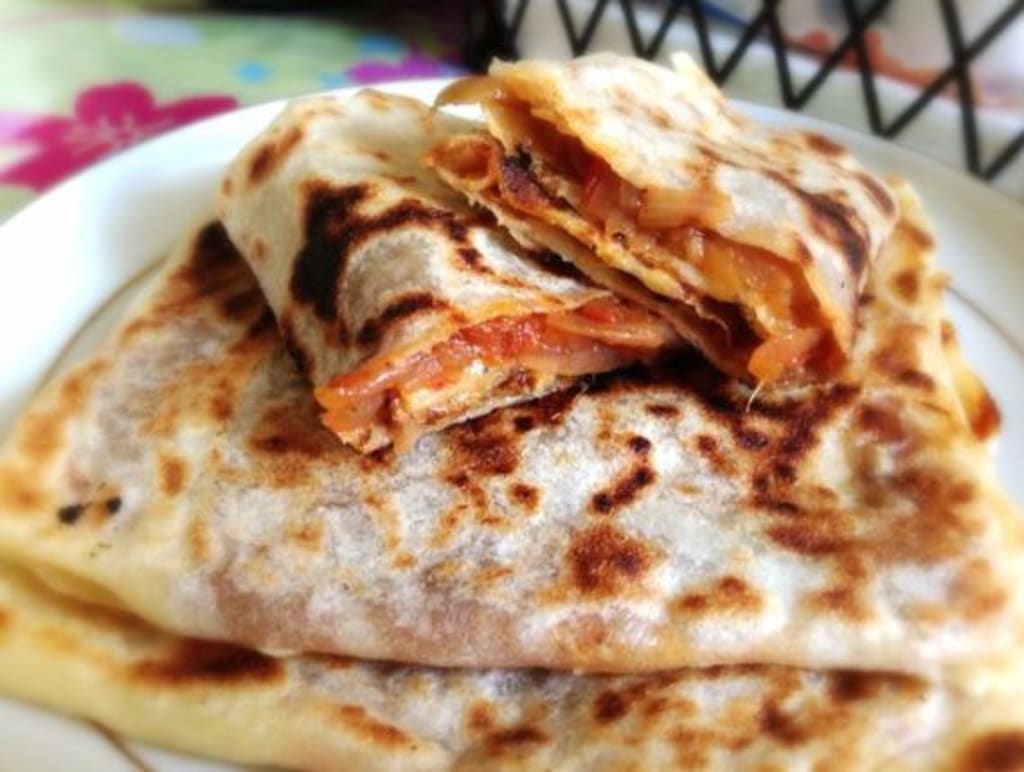
After the dough had doubled in size, she divided it into 20 balls. She oiled the dough and stretched it until it was as thin as paper but strong enough not to break. She stuffed it with the prepared mixture before folding it in half to form a square. She then folded and pinched the edges to seal it. She placed the filled dough on a hot pan, pressing it down until it was flattened.
My gaze was fixed on her every move, astounded and awed, soaking up any lessons I could to replicate her recipe when I returned home to Canada. I couldn't wait to sit down with my grandmother and finish the entire platter. Throughout the process, I was completely focused on what my grandmother was doing; I didn't even bother asking what she was making.
“What is it?” I expressed my interest in this new food.
“Mhadjeb”
“Meh.....,” I attempted to pronounce it. Anyway, all I wanted to do was eat it.
She handed me the Mhadjeb and I had my first taste of this exotic, Berber cuisine. My taste buds tingled with delight instinctively and my heart was full of unfathomable emotions. There are no words to describe what I was feeling. All I knew was that my heart had been opened to new culinary adventures.
About the Creator
My Tous les Jours Trip
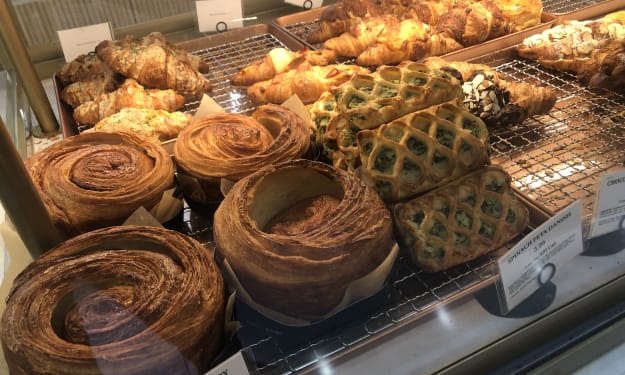
As someone who lives in a rural area, I don't get the chance to visit fancy restaurants or bakeries that often. So, when a friend told me about a French-Asian bakery that's less than an hour away, I knew I had to check it out and grab some pictures for social media. Tous les Jours ended up providing an immersive experience that went above and beyond my expectations--although I did leave with a few reservations.
By Kaitlin Shanks23 days ago in Feast



Comments
There are no comments for this story
Be the first to respond and start the conversation.