
A Taste of Home
Can man live by bread alone? Pretty sure I could.


Spud Bread. Soda Farls. Pratie Apple. Pancakes. Apple Jonathan. My Nana.
These delicacies – each a bread of variation thereof – account for most of the carbohydrates that saturated my childhood. And how I miss them!
They were scrumptious. They were special. They were home.
If I were told my Nana had been a Master Baker, I’d have a hard time not believing it. Every day, at every meal – and a few in between – some edible work of baking art would appear on the kitchen table. She could not only bake near unimaginable goodies, but she was every bit as talented as an all-around Top Chef who could coax delicious delectables from an amalgam of simple ingredients that happened to lurk idly in the cupboards and fridge.
My grandparents had followed my parents and me from Ireland to Canada. Dada had had a stroke shortly after we emigrated. Nana had opted not to tell my mother. We were 3000 miles away and it was long before transatlantic travel was commonplace. No sense worrying her only child, Nana thought. Besides, Dada had improved somewhat and, perhaps, would eventually be right as rain again. That was her plan, at least for the short term.
But the plan was banjaxed when my mother and I went back to Belfast for a visit the following summer. When my mother saw her father’s failed appearance, shuffling steps and speech difficulties, they told her the sad tale of his infirmity.
There was nothing for it, my mother (their only offspring) knew, but to bring the pair of them to live with us in Canada.
It was no mean feat.
As it turned out, Dada’s stroke had caused what I imagine was a form of vascular dementia. Within two years, he was in the hospice where he died only a few months later.
And Nana stayed with us.
She was not only a formidable baker, my Nana, but a savvy businesswoman at a time when few women populated the work force. Throughout my mother’s childhood and for a good few years after, she had run a guest house in a wee town called Portstewart on Ireland’s North Atlantic shore. It was never without residents. As she gained the reputation of a gracious and welcoming host, the heavenly dishes that emanated from her miraculous larder were known far and wide. So successful was her business that she had to take on two part-time maids and a full-time cook to help her. As you may imagine, this was an anomalous reality for women in the 1910s, ‘20s, ‘30s and ’40s.
Most of her patrons, at least for part of the year, were people seeking ‘the air’ for respiratory troubles. Spend a few weekends at the seaside was, apparently, a common recommendation when delivering diagnoses to pulmonary patients. The place was packed with folk from every walk of life. I know this because I’ve inherited her collection of well over a thousand photographs, each of which tells a tale of life in those years. The clothes, the cars, the swim suits (or ‘bathing togs’) and just the general bonhomie they convey are a joy to behold.
There were a lot of priests involved. Let me explain. My grandparents were such devout and religious Catholics that they were both members in the lay order of Franciscans, something with which most people, like me, know nothing about. Both of them brought their Franciscan habits – in which to be buried – with them when they moved to Canada. I imagine at some time in the early years of her holiday rental business a Bishop or Monsignor (maybe a Cardinal), suffering from some form of respiratory ailment, had found out about my Nana’s venture and, having been treated like royalty, recommended it and the lavish catering to the entire Diocese of Belfast. Of the thousands of photos, at least half feature young to middle-aged men sporting clerical collars. Then after my grandparents moved in with us, and until my Nana’s death 15 years later, our own house was the Canadian destination for many a visiting priest. And the local priests would often stop by for tea and a bit to eat, or a wee drink of something potent. They’d spend hours, usually just talking but, sometimes, these visits would result in a Rosary or Mass being said.
Imagine being a kid and trying to get away with any bad behavior in that environment. If, on the odd occasion I might need to be corrected, an entire legion of adults would be privy to my disobedience. I could have been, literally, A Holy Terror.
With all of my Nana’s visitors, and the many relatives who lived with us when they first emigrated to Canada, the kitchen didn’t get much time to rest. There was always something on the stove or in the oven, if not many things. While she was able, Nana did most of the cooking. My mother had yet to retire from teaching, so what a boon it was to have her mother there to lend a very big helping hand.
The cooked meals were always substantial and tasty, and deserve this mention, but her baking likely sent wafts of near ambrosia to the angels above. I think my father and I were the two most appreciative of her baking. Not a day went by that there weren’t loaves or farls of soda bread, wheaten bread and potato cake on offer. Nothing went to waste. Ireland had suffered through centuries of sanctioned starvation and the poor had access to very little foodstuffs. Flour, buttermilk and potatoes were staples and, though they seem a lowly selection, they combined in many ways to produce my food of choice during my early years.
And Nana’s baking was a most special treat for me.
Mum was the word when my parents were at work all day and I would come home from school at lunchtime, then after school, long before they returned. I was always a chunky kid, for no apparent reason, and spent many months – years even – on medically-prescribed diets that limited me to skim milk, Hollywood bread (similar to Weight Watcher’s), saccharine – the fake sugar of the day, at the time believed to cause cancer in poor little mice, diet pops and everything in small portions. Of the breads and cakes and tarts Nana magically produced on a daily basis, I was restricted in intake.
But, oh the aromas, the aura of decadence that filtered through the house when soda bread was baking in the oven; or when apples were stewing for pratie apple; or potatoes boiling for potato cakes. Needless to say, I always felt cheated by my restricted food allotment, and the normal fare I got was less than gratifying.
And Nana knew. And she went into stealth mode. Any day my mother or father weren’t likely to be home at lunch, Nana baked me a feast. Sometimes two. Pancakes and pratie apple were staples that, I’m sure, would each have come in at 1000 calories a serving. I would rush home (and I was pretty fast, weight aside) from school twice on those days, eager…salivating at the promise of partaking in whatever goodies Nana had conjured up for me.
Of all these baked goodies, my then and future favorite was, and remains, soda bread. It’s hard to believe such glorious satisfaction could be realized from such lowly ingredients: flour, buttermilk, baking soda, salt. That’s the lot. Seems easy enough, doesn’t it?
It’s all in the handling, though. And no one could handle it like Nana. My mother was also what we’d call a ‘dab hand at the baking’ and, the odd time, I managed to produce something edible but, when the master baker was in charge, the fluffy floury inner scone with the lightly browned bottom, hollow to the tap, was the stuff of the gods. I remember sitting in front of my parents’ bedroom TV, a plate of scone bread (soda, wheaten and such) one lunchtime, with a side of pancakes, buttered and sprinkled with sugar, crying as I ate, because of just how much I loved my Nana, and how lucky I was to have her on my side in this War of the Five Roses.
Every one of these floury treats I’ve named deserves its own recipe, but there really aren’t any to share. It was all by sight and feel.
A couple of hands of white flour (mixed with whole wheat for wheaten bread), about a teaspoon of baking soda and the same of salt. Mix that, then pour in enough buttermilk to make a workable dough. Bake on a floured griddle or in a baking tin at 350 F until done.
Determining when, exactly, it was done and ready takes a bit of a seasoned eye, too.
Currant soda was an elaboration on the plain scone, adding a handful or so of currants (raisins are better) to the mix. That’s about as adventurous as it gets and yet remain a bona fide, authentic, proper Irish soda bread.
When Nana was gone and soda bread became a Saturday-only offering, my mother would be most annoyed and insist we’d get sick (every time; we never did) when my father and I would cut ourselves a bit as soon as it came out of the oven, then slather with butter – liquid gold as it melted – and polish off nearly the entire thing. There would be enough set aside for Sunday after-Mass breakfast though it wasn’t unheard of for my mother to have to make a second loaf.
I can’t dream of ever matching either my Nana’s or my mother’s prowess at the scone baking – be it bread or farls – and I’ve tried many times. When I was in my 20s, for some reason, my attempts turned out reasonably well. But the few times I’ve dared to produce anything even approaching the look and taste of their baking efforts, I achieved neither look nor taste. And, since there’s only me left, I know I’ll never again get to salivate over, and indulge, in anything as good as the manna of my youth.
The Nana Manna if you will.
About the Creator
Marie McGrath
Things that have saved me:
Animals
Music
Sense of Humor
Writing
Keep reading
More stories from Marie McGrath and writers in Feast and other communities.
Love Letters Through Time
Context: Grace (Gráinne) Gifford, was a participant in the Irish nationalist struggle against British rule, which led to ‘The Easter Rising’, Easter Monday, 1916 in Dublin, Ireland. She was betrothed to one of the leaders, who were due to be executed the morning after being taken prisoner. Joseph and Grace were married the night before in his prison cell. Joseph (Seosamh Pluinceid)) was one of the leaders of The Rising, a signatory of the Irish Proclamation and, in death, a revered Irish hero. These are my imaginings of ‘her’ final words to him. I include a few words in Irish Gaelic as the movement that led to the rebellion favored speaking Irish, instead of English. I would wager a guess, as they were both poets and writers in the Irish republican movement that she would have chosen to marry her love of country with her love of him in expressing her devotion.
By Marie McGrathExclusive • 11 months ago
My Tous les Jours Trip
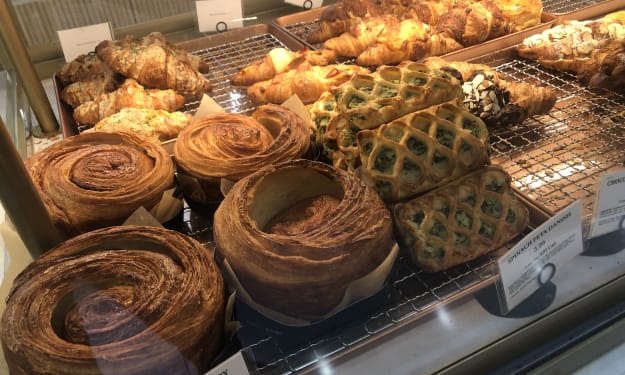
As someone who lives in a rural area, I don't get the chance to visit fancy restaurants or bakeries that often. So, when a friend told me about a French-Asian bakery that's less than an hour away, I knew I had to check it out and grab some pictures for social media. Tous les Jours ended up providing an immersive experience that went above and beyond my expectations--although I did leave with a few reservations.
By Kaitlin Shanks21 days ago in Feast



Comments (3)
Your recounting of Nana's baking and the warmth she brought to your home is truly heartwarming. Thank you for sharing this touching story.
This was pure Nana Manna magic! Warm, nostalgic, and absolutely delicious in every way—both in memories and mouthwatering details. I could practically smell the soda bread baking! Loved the mix of humor, heart, and holy mischief. A proper feast of a story!
what a lovely story and that recipe... you little holy terror--well.. i may give it a try one day!