
Why MEP BIM Is Essential for Modern Commercial Construction
Eliminating Coordination Conflicts and Construction Delays Through Intelligent MEP Modeling


Modern commercial construction projects are defined by density, complexity, and risk. Mechanical, electrical, and plumbing (MEP) systems now consume a significant portion of construction budgets and coordination effort, especially in sectors such as healthcare, data centers, mixed-use developments, airports, and large commercial facilities.
MEP BIM is no longer a value-add or optional coordination tool—it has become essential infrastructure for constructability, cost control, and schedule certainty in today’s commercial construction environment.
The Reality of MEP Complexity in Commercial Buildings
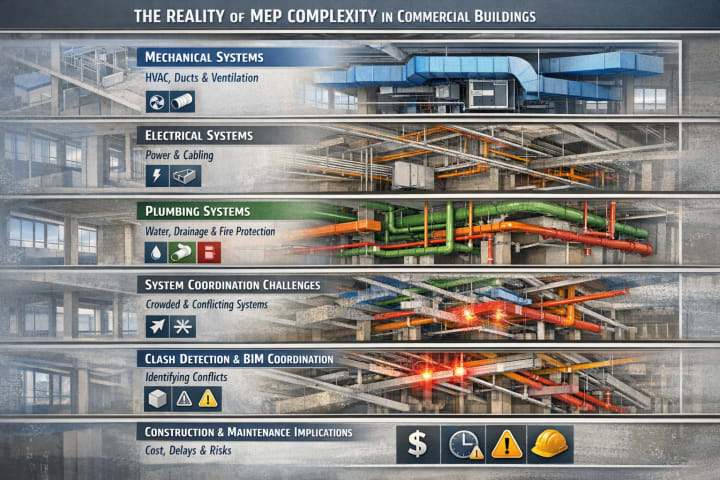
In modern commercial buildings:
- MEP systems occupy 40–60% of total construction cost
- Ceiling plenums are congested with HVAC, electrical, fire protection, and data systems
- Systems must comply with energy codes, life-safety regulations, and performance standards
- Late-stage coordination errors lead to expensive rework and project delays
Traditional 2D drawings cannot accurately represent this level of system interaction. MEP BIM addresses these real-world construction constraints by enabling model-based coordination before materials are fabricated or installed.
Why Traditional MEP Design Methods Fail on Modern Projects
Commercial construction today demands:
- Tighter schedules
- Faster design-to-construction transitions
- Multi-trade coordination across multiple stakeholders
2D MEP workflows fail because they:
- Hide spatial conflicts between trades
- Rely on assumptions rather than verified clearances
- Push problem-solving to the field instead of the design phase
- Increase RFIs, change orders, and installation errors
MEP BIM shifts coordination upstream, where issues are cheaper and faster to resolve.
How MEP BIM Directly Impacts Commercial Construction Outcomes
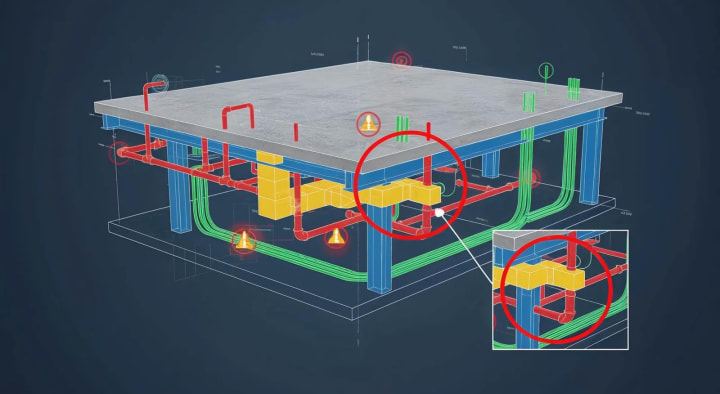
1. Trade Coordination & Clash Elimination
MEP BIM enables:
- Multi-trade coordination models
- Automated clash detection across HVAC, electrical, plumbing, fire protection, and structure
- Resolution of conflicts before construction begins
This reduces:
- Field rework
- Schedule disruptions
- Trade stacking and labor inefficiencies
2. Constructability & Installation Accuracy
MEP BIM supports:
- Precise routing of services
- Verified equipment clearances
- Installation-ready layouts for field teams
- Contractors receive buildable models, not abstract design intent.
3. Schedule Control & Phasing
Commercial projects often operate on compressed timelines.
MEP BIM allows teams to:
- Sequence installations accurately
- Coordinate prefabrication strategies
- Reduce trade interference during construction
This results in predictable schedules and fewer critical path disruptions.
4. Cost Control & Change Management
MEP BIM improves cost certainty by:
- Identifying design conflicts early
- Supporting accurate quantity takeoffs
- Reducing change orders caused by coordination failures
For owners, this translates into fewer budget overruns and clearer financial forecasting.
5. Compliance with Codes & Performance Standards
Commercial buildings must meet:
- Energy efficiency requirements
- Fire and life-safety codes
- Mechanical and electrical performance standards
MEP BIM allows teams to:
- Validate system layouts against code requirements
- Coordinate inspections more efficiently
- Reduce compliance-related redesigns
MEP BIM as a Requirement for Design-Build & Integrated Delivery
In design-build and IPD (Integrated Project Delivery) environments, MEP BIM becomes a shared coordination platform where:
- Designers, engineers, contractors, and fabricators work from a single source of truth
- Decisions are made collaboratively and early
- Risk is managed proactively rather than reactively
- Many owners now require MEP BIM deliverables as part of contract documentation.
MEP BIM and Prefabrication in Commercial Construction
Prefabrication depends on model accuracy. MEP BIM enables:
- Spool drawings for fabrication
- Preassembled MEP racks
- Reduced on-site labor
- Improved quality control
This is especially critical in:
- Hospitals
- Data centers
- Airports
- High-rise commercial buildings
- Lifecycle Value Beyond Construction
MEP BIM continues to deliver value after handover by supporting:
- As-built documentation
- Facility management workflows
- Maintenance planning and asset tracking
- Future renovations and expansions
Owners benefit from digitally accurate building systems, not outdated drawings.
When MEP BIM Becomes Non-Negotiable
MEP BIM is essential—not optional—when projects involve:
- Dense ceiling spaces
- Complex mechanical systems
- High-value electrical infrastructure
- Mission-critical facilities
Aggressive construction schedules
In these scenarios, proceeding without MEP BIM introduces avoidable risk.
Strategic Conclusion
Modern commercial construction cannot afford coordination failures, rework, or schedule uncertainty—especially within MEP systems that are critical to building performance. MEP BIM provides the clarity, coordination, and control required to deliver complex projects successfully.
For developers, contractors, and owners, adopting MEP BIM is not about technology adoption—it is about protecting project outcomes, budgets, and timelines in an increasingly demanding construction environment.
Further Reading
- Why Data Centers in Virginia Rely on 3D Laser Scanning for Expansion Planning
- 5 Common Mistakes in Structural Construction Drawing| (How to Avoid Them)
- Innovative Architectural Engineering for High-Performance Commercial Buildings
- The ROI of Laser Scanning for Historic Building Renovation Projects
- Comparing Traditional Surveying vs. Scan-to-BIM for Historic Structures
About the Creator
Matt Sharon
A professional content writer. Having years of experience in Technology, health, finance, and construction and real estate field. Writing is my passion and I love to play with words Confidently.
Keep reading
More stories from Matt Sharon and writers in Education and other communities.
Why Data Centers in Virginia Rely on 3D Laser Scanning for Expansion Planning
As the digital economy continues to grow, data centers are at the heart of managing vast amounts of critical data. In Virginia—home to some of the largest data hubs in the U.S.—expansion planning is a constant necessity as businesses scale up their digital infrastructure.
By Matt Sharon2 months ago in Education
Zero Trust Security for Small Business: A Simple Guide for Owners
If you run a small business, you probably think cyber attacks only happen to big companies. I used to think the same way. It feels like hackers would rather go after large banks or global tech companies, not a small shop, startup, or local service provider.
By Stephano kambeta7 days ago in Education
Why Environmental Compliance Is Becoming a Business Priority for Companies in Dubai
Dubai continues to grow at a remarkable pace. Industrial zones expand, construction projects reshape the skyline, and logistics networks move goods through ports and airports every day. This growth creates strong economic opportunities, but it also increases environmental pressure across the city.
By Umar Quality Jounala day ago in Education
Writing To Succeed
If you want to find something that will help readers find your writing, possibly expand your audience, and maybe even get you noticed for other things, then you’re not alone. But how can you get it done in a world full of want-to-be writers? Look less at what you’re writing now, and more at what other writers have used to boost their views and reads.
By Jason Ray Morton 3 days ago in Writers



Comments
There are no comments for this story
Be the first to respond and start the conversation.