
What would happen if the earth was half land and half water
Exploring Earth's Drastic Shift to a 50/50 Land-Water Balance and its Impact on Life, Climate, and Even Your Urine"

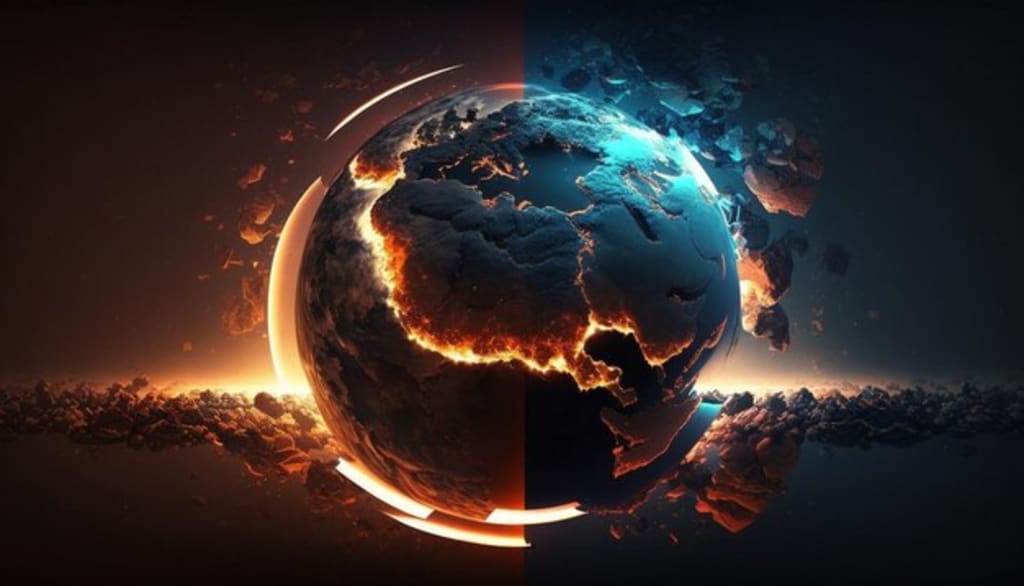
Imagine Earth with an even 50/50 split between continents and oceans, our planet covered half by land and half by water. How would this change the planet as we know it, and what new kinds of vacations could this make possible? Also, what does the color of your urine have to do with this? This is a "What If," and here's what would happen if the Earth was half land and half water.
When it comes to making life possible on a planet, water is an absolute necessity. That's why we look for alien life on worlds where liquid water could exist. On our own planet, 71% of its surface is currently covered by water, most of which is in our five oceans, collectively forming one global ocean. Now, if you were to replace nearly a quarter of our ocean water with land, how would Earth transform into just another lifeless rock in space?
Due to global warming, Earth's sea levels are already rising, but if you aimed to balance the planet's land-to-water ratio, you'd see sea levels drastically decrease, not just by a few meters, but by around three kilometers. This transformation would lead to some significant alterations on Earth.
The regions around both the North and South Poles would completely dry out, and every continent on the planet would expand significantly. All this newly emerged land around the world would be approximately equivalent to the current surface areas of Asia, Europe, Africa, and North America combined. This would result in an enormous amount of unused space. While the areas extending off the old coasts would be relatively flat, some regions that used to be deep ocean would reveal vast corridors and steep crevasses.
With this new land configuration, the one global ocean would be no more. All the oceans would be separated from each other, and all the continents would be one connected landmass. This change could be beneficial for the evolution of life. Early humans initially spread across the globe by walking, and with the 50/50 split in place, you'd be able to cover even more ground, making around-the-world trips on your own two feet possible.
However, this shift in the balance between water and land wouldn't be without its challenges. With so much less water covering the surface, ocean currents would be disrupted, seriously destabilizing the climate. These currents distribute the heat absorbed by the oceans around the globe, and disrupting them would result in even colder temperatures around the North and South Poles, while the equatorial regions would become even hotter. Climate change would accelerate as oceans wouldn't be able to absorb as much carbon dioxide from the air, causing excess carbon dioxide to blanket the planet and raise temperatures. Rainfall levels would also decrease, leading to dangerous droughts and the formation of new deserts in many inland areas.
While there might be an abundance of new land available, large stretches of Earth could become uninhabitable. Plants, animals, and humans would need to adapt to being less dependent on water or start using it more efficiently. Water scarcity could lead to animals evolving to be smaller with more species adopting a strictly carnivorous diet. Unfortunately, the abundance of life currently supported by Earth's oceans would struggle to survive.
Perhaps the most surprising consequence of this transformation is that your urine would likely change forever. Typically, urine is composed of more than 90% water, but with less water in your daily life, it would become much darker and start to smell like ammonia. While things could be worse, draining the oceans of every drop of water is a story for another "What If."
About the Creator
Info Wave
Your source for the latest insights, updates, and knowledge. 🌐 Stay informed with us!"
THE SPHERICAL SPACETIME - ALEXIS KARPOUZOS
I. The Question of a Spacetime without Centre From Aristotle to Kant, Western philosophy approached space and time primarily as conditions of the possibility of experience or as properties of reality. In the Aristotelian tradition, space is defined topologically — as the place of bodies — and time arithmetically — as 'the number of motions with respect to before and after'. In Kantian critical philosophy, space and time become a priori forms of intuition, transcendental conditions of all phenomenal experience. Yet in both traditions a common assumption is preserved: space and time are structures that organise phenomena from a — however implicit — centre of reference. Alexis Karpouzos radically challenges this assumption. The Spherical Spacetime he introduces is neither place nor intuition; it is a dynamic ontological structure that refuses every privileged point of reference, every external centre, every principle that precedes the very movement of the world. The question posed from the outset is this: what does it mean to think a spacetime that does not 'contain' beings but is the very manner in which beings are? And what ontological consequences does this displacement carry for the understanding of existence, consciousness, and truth?
By alexis karpouzos2 days ago in Education
Peter Ayolov’s Publications
Peter Ayolov is a media theorist and lecturer at Sofia University 'St. Kliment Ohridski', Faculty of Journalism and Mass Communication. His research focuses on the political economy of communication, propaganda models, digital media, narrative structures, and the transformation of language in contemporary technological environments. His work examines how digital communication systems organise dissent, amplify outrage, and reshape the relationship between media, public opinion, and political power.
By Peter Ayolov4 days ago in Education



Comments
There are no comments for this story
Be the first to respond and start the conversation.