
Welding Machine Parts Name and Their Key Functions
Welding Machine Parts Name and Their Key Functions

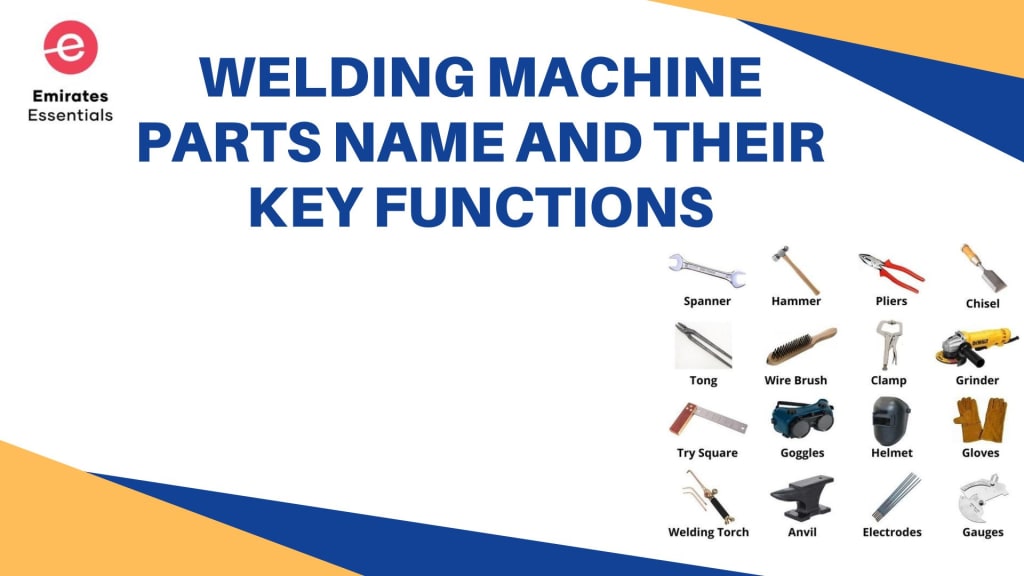
When you examine a welding setup, it can seem like a jumble of wires, clamps, and various gadgets. But every piece has a name and a job. Learning the names of welding machine parts helps you select the right parts, repair them when they break, or explain your setup to others.
A welding machine is an electrical device that joins metal parts by melting their edges with controlled heat. It uses electric current to create a strong, lasting bond between materials.
Every part of a welding machine plays a specific role in making that bond possible, from generating power to controlling heat and ensuring safety.
Looking for top-quality welding machines in the UAE? Emirates Essential is your trusted destination for durable, high-performance welding machines and accessories. Get the perfect tools for every welding job — reliable, efficient, and built to last. Shop now at the best hardware store in the UAE!
Welding Machine Parts Name and Their Functions
Core Machine Parts
1. Power Source
The power source is the heart of a welding machine. It converts electrical energy into the right voltage and current to form a stable arc. Depending on the process, it can supply AC or DC output. A reliable power source ensures consistent welds and steady heat control.
2. Electrode Holder
Also known as a stinger, the electrode holder grips the welding electrode and carries the current to it. It allows the welder to guide the electrode precisely. Good insulation and grip are essential for safety and control.
3. Ground Clamp
The ground clamp, or earth clamp, completes the electrical circuit. It connects the return cable to the workpiece or table, ensuring steady current flow. A firm, clean connection prevents power loss and unstable arcs.
4. Welding Cables
These heavy-duty cables transfer current between the power source, electrode holder, and ground clamp. They must handle high amperage safely. Flexible, durable cables help maintain steady current flow and allow easy movement during work.
5. Control Panel
The control panel is the main interface for adjusting welding settings. It lets you set voltage, amperage, and, in some machines, wire feed speed or gas flow. Digital displays and precise controls make it easier to maintain consistent results.
Welding Process–Specific Parts
6. Welding Torch or Gun
The torch or gun is the tool that delivers heat to the work area. In MIG welding, it supplies both the wire and shielding gas. In TIG welding, it holds a tungsten electrode is used. It gives the welder control over the arc and weld quality.
7. Wire Feeder
Used in MIG and flux-cored welding, the wire feeder automatically pushes the wire electrode from a spool to the gun. It maintains a steady wire feed rate, ensuring a continuous and uniform weld bead.
8. Shielding Gas and Regulator
Shielding gas protects the molten metal from oxygen and other contaminants in the air. Common gases include argon, CO₂, or their mixtures. The regulator maintains a consistent flow rate for smooth, clean welds.
9. Consumables
Consumables are the parts that wear out during welding. They include electrodes, filler wires, contact tips, and nozzles. Each affects arc stability, penetration, and weld finish. Regular replacement helps maintain performance.
10. Nozzle, Contact Tip, Diffuser, and Liner (MIG)
These smaller components inside a MIG gun ensure smooth operation.
Nozzle: Directs shielding gas toward the weld.
Contact Tip: Transfers current to the welding wire.
Diffuser: Spreads gas evenly for full coverage.
Liner: Guides the wire smoothly from the feeder to the gun.
Together, they control gas flow and ensure consistent wire feeding.
Safety and Accessory Parts
11. Personal Protective Equipment (PPE)
PPE is vital for every welder. It includes a welding helmet, gloves, flame-resistant clothing, boots, and safety glasses. These protect against sparks, heat, and ultraviolet radiation during welding.
12. Chipping Hammer
Used after welding, the chipping hammer removes slag from the weld bead, especially in stick welding. Cleaning the weld surface helps reveal any defects and improves the final appearance.
13. Wire Brush
A wire brush cleans rust, dirt, and slag from the metal before and after welding. A clean surface ensures proper fusion and a smooth weld.
14. Welding Table
A welding table provides a flat, stable, and fire-resistant surface for welding work. It also helps maintain good grounding when connected to the clamp. Proper setup prevents movement and improves accuracy.
15. Cooling System
Some high-performance welding machines use air or water cooling systems. They prevent overheating during continuous welding and extend the lifespan of torches and cables.
Conclusion
Understanding the welding machine parts names helps you use the machine more effectively and safely. Each component from the power source to the smallest nozzle plays a part in producing clean, strong welds. Whether you’re a beginner or a professional, knowing how each part works means better control, fewer mistakes, and longer tool life. Combine good technique with the right equipment, and welding becomes smoother, safer, and more efficient.
FAQs
Q1. What is a welding machine used for?
A. A welding machine joins two or more metal parts by melting them with electric heat and forming a strong bond as they cool.
Q2. How does a welding machine work?
A. It converts electrical energy into heat through an electric arc, melting metal surfaces so they fuse upon cooling.
Q3. How to operate a welding machine?
A. Connect the ground clamp, insert the electrode, set the right current, and start the arc to melt and join the metals.
Q4. What are the main parts of a welding machine?
A. The key parts include a power source, electrode holder, ground clamp, cables, and control panel.
Q5. What does a power source do in welding?
A. It converts input power into the correct voltage and current needed to maintain a stable welding arc.
Q6. What is the function of the electrode holder?
A. It grips the electrode securely and passes the current to it, allowing the welder to guide and control the weld.
Q7. Why is the ground clamp important?
A. It completes the electrical circuit, ensuring consistent current flow and a safe, stable welding process.
Q8. What are the three types of welding machines?
A. The main types are arc welding machines, MIG welding machines, and TIG welding machines, each used for specific applications.
Q9. What is VRD in a welding machine?
A. VRD stands for Voltage Reduction Device, which lowers open-circuit voltage to improve operator safety when the welder is idle.
Q10. Does a welding machine consume more electricity?
A. Yes, welding machines use high current for short durations, but power consumption depends on machine type and usage time.
Q11. How many amps does a welding machine use?
A. Most machines use between 40 to 400 amps, depending on the welding process, material thickness, and desired output.
Q12. How much does a welding machine cost?
A. Prices vary by type and capacity, ranging from $100 for small units to $2,000 or more for industrial welders.
Q13. How can I make my welding machine last longer?
A. Keep it clean, inspect cables regularly, and store it in a dry, dust-free place to prevent damage and corrosion.
About the Creator
Are Wormholes Real or Just Equations? Exploring the Reality of Spacetime Tunnels
What Is a Wormhole? A wormhole is a hypothetical tunnel connecting two separate regions of spacetime. Instead of traveling across the vast distances of space, a traveler could pass through a shortcut created by spacetime geometry itself.
By shahkar jalal7 days ago in Education


Comments
There are no comments for this story
Be the first to respond and start the conversation.