
Are Wormholes Real or Just Equations? Exploring the Reality of Spacetime Tunnels
Wormholes are among the most fascinating concepts in modern science. Often portrayed in science fiction as portals for instant travel across galaxies, wormholes also appear in the equations of Einstein’s theory of general relativity. But this raises a fundamental question: Are wormholes real physical objects, or are they merely mathematical solutions with no counterpart in the actual universe? This question sits at the heart of modern theoretical physics. Wormholes are not inventions of imagination—they emerge naturally from the mathematics describing spacetime. Yet no one has ever observed one. This leaves scientists wondering whether wormholes exist in nature or only on paper. In this article, we explore what wormholes are, why they appear in physics equations, whether the universe allows them, and what evidence might someday reveal their existence.

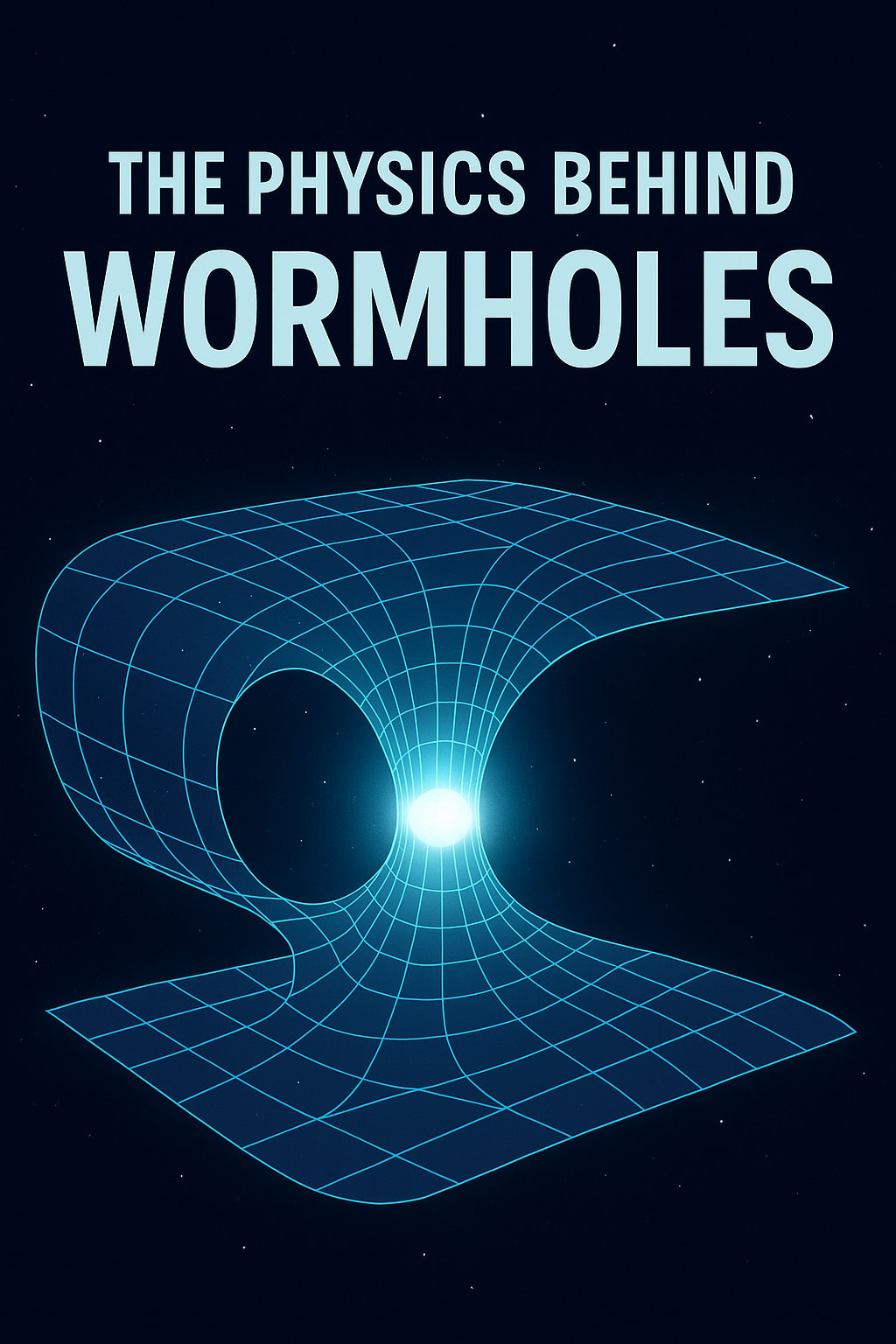
What Is a Wormhole?
A wormhole is a hypothetical tunnel connecting two separate regions of spacetime. Instead of traveling across the vast distances of space, a traveler could pass through a shortcut created by spacetime geometry itself.
In Einstein’s theory of general relativity, spacetime is curved by mass and energy. Wormholes arise when spacetime curves in a way that forms a tunnel rather than a pit.
________________________________________
Where Did Wormholes Come From?
Wormholes were not invented by science fiction writers. They first appeared in 1935 when Albert Einstein and Nathan Rosen studied solutions to Einstein’s field equations.
They discovered a mathematical structure now called an Einstein–Rosen bridge, which connects two black holes in different regions of spacetime. This was the first theoretical wormhole.
However:
• It collapses instantly
• Nothing can travel through it
• It is not a usable tunnel
Still, it showed that spacetime could, in theory, form wormhole-like connections.
________________________________________
Are Wormholes Required by Physics?
No. Wormholes are allowed by Einstein’s equations, but they are not required.
This is an important distinction:
• Black holes must exist because they are inevitable outcomes of gravity
• Wormholes are optional solutions that may or may not appear in nature
The equations permit them, but the universe is not obligated to create them.
________________________________________
The Problem of Stability
Most wormhole solutions collapse instantly.
Gravity pulls spacetime inward, pinching the tunnel shut. To prevent this, wormholes need exotic matter—a form of matter with negative energy density that pushes spacetime outward.
Exotic matter:
• Exists in quantum physics in tiny amounts
• Has never been found in large, stable quantities
• Is extremely difficult to produce
Without it, wormholes are short-lived and useless.
________________________________________
Do Quantum Laws Allow Wormholes?
Quantum mechanics complicates the picture.
Quantum fields allow:
• Negative energy
• Spacetime fluctuations
• Temporary wormhole-like structures
Some theories suggest that microscopic wormholes may exist in the quantum fabric of spacetime. However:
• They are incredibly small
• They exist briefly
• They cannot be used for travel or communication
This means wormholes might exist at a fundamental level—but not in a way we could ever see or use.
________________________________________
Could Wormholes Exist Inside Black Holes?
Some models propose that:
• Black hole interiors do not end in singularities
• Instead, spacetime continues through a wormhole
• The black hole connects to another universe or region
These ideas are mathematically consistent, but they remain untested. Since nothing escapes a black hole, we cannot observe what happens inside.
________________________________________
ER = EPR: A New View of Wormholes
A modern theory known as ER = EPR suggests:
• Quantum entanglement and wormholes are two sides of the same phenomenon
• Every pair of entangled particles may be connected by a tiny wormhole
These wormholes:
• Are real in a mathematical sense
• Are non-traversable
• Do not allow travel or signals
This implies wormholes might be woven into the fabric of reality itself—but not in a dramatic science-fiction way.
________________________________________
Why Haven’t We Seen One?
If large wormholes existed, they might:
• Bend light in unusual ways
• Produce gravitational lensing
• Distort cosmic radiation
So far:
• No such signatures have been detected
• All observed objects fit standard black hole models
The universe gives us no direct evidence for wormholes.
________________________________________
Are Wormholes Testable?
Future experiments may test wormhole ideas indirectly by:
• Studying quantum entanglement
• Measuring spacetime fluctuations
• Probing black hole interiors via gravitational waves
• Testing quantum gravity models
However, detecting a real wormhole remains extremely unlikely with current technology.
________________________________________
Why Physics Allows Wormholes
Wormholes are allowed because:
• Einstein’s equations describe geometry, not material objects
• Spacetime can curve in many ways
• Some geometries form tunnels
This means wormholes are geometrically valid, even if physically rare or impossible.
________________________________________
Are Wormholes Like Other Theoretical Objects?
Physics has predicted many things before they were observed:
• Black holes
• Gravitational waves
• Higgs bosons
• Neutrinos
Wormholes could join this list—or they could remain purely theoretical.
The difference:
• Black holes are unavoidable
• Wormholes are optional
________________________________________
What Most Physicists Believe
The current scientific consensus is:
• Wormholes are mathematically real
• They are not proven to exist physically
• Traversable wormholes require exotic matter
• Quantum effects likely prevent large stable wormholes
• Microscopic wormholes may exist
Thus:
Wormholes are probably real in equations—but not as usable cosmic tunnels.
________________________________________
Why Wormholes Still Matter
Even if wormholes never exist physically, they:
• Help test general relativity
• Reveal spacetime’s flexibility
• Link gravity with quantum mechanics
• Guide theories of quantum gravity
They are powerful tools for understanding reality.
________________________________________
Final Conclusion
So, are wormholes real or just equations?
They are both.
Wormholes are real solutions to the equations that govern spacetime. Physics allows them. But nature may not create them in large, stable forms. The universe seems to favor simpler, more stable geometries.
For now, wormholes remain one of science’s most beautiful ideas—suspended between mathematical truth and physical mystery.
Whether they exist as cosmic tunnels or only as equations on a page, wormholes continue to push the boundaries of what we know about space, time, and reality itself.
About the Creator
Keep reading
More stories from shahkar jalal and writers in Education and other communities.
Could future humans build artificial wormholes?
What Is a Wormhole? A wormhole is a hypothetical structure in spacetime that acts like a tunnel connecting two distant points. Instead of traveling through ordinary space, a traveler would pass through a shortcut created by spacetime geometry itself.
By shahkar jalal2 days ago in Education
Most Expensive Flowers in the World
The most expensive flowers in the world are admired not only for their beauty but also for their rarity, growing conditions, and the effort required to cultivate them. Some flowers are priceless because they bloom for only a short time, while others take years of research and care to grow. Their high value often comes from limited availability, special environments, and strong cultural importance. In this article, we explore what makes certain flowers so valuable and why people around the world are fascinated by them.
By Horizon Dwellers2 days ago in Education
The Neuroscience Behind Healing: Exploring the Mind–Body Connection in Therapy
Modern therapy has entered a new era, one deeply informed by neuroscience. For decades, the mind and body were viewed as separate entities, with mental illness treated apart from physical health. However, neuroscience has dismantled this outdated view, revealing the brain's essential role as the command center where thoughts, emotions, and bodily responses intersect. This understanding has reshaped mental health therapy by emphasizing the biological and physiological roots of psychological distress.
By Debra Bailey PHD3 days ago in Education
Bruce Lee and The God of War: Kuan Ti
It starts with love.. The Power to the God Of War and Wealth Walk into a Chinese restaurant (even in Oklahoma, USA), a Chinese police station, a kung fu martial arts studio or even a Chinese temple and you often see a red faced warrior holding a heavy quan-do (spear like weapon).
By WILD WAYNE : The Dragon King4 days ago in Chapters




Comments
There are no comments for this story
Be the first to respond and start the conversation.