

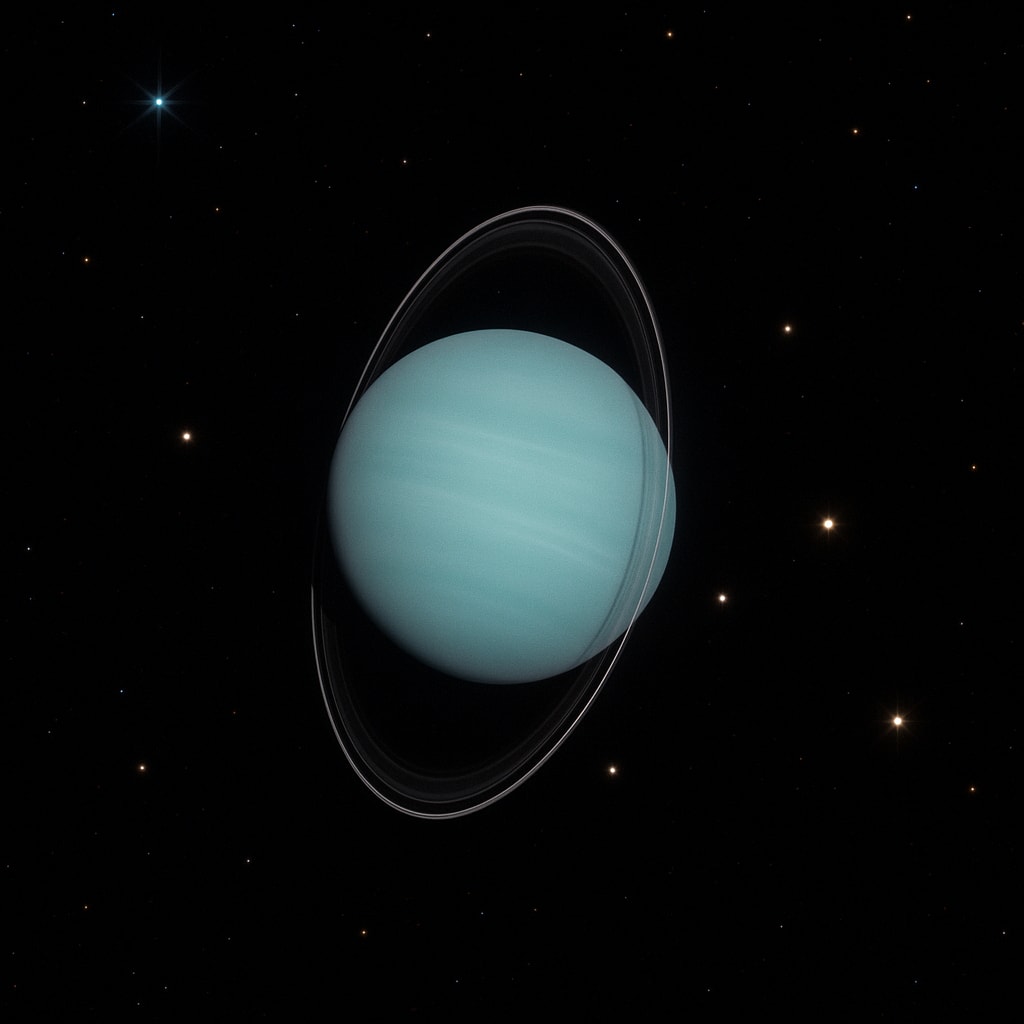
In early 2025, astronomers were once again reminded that even in our own Solar System, surprises still await discovery. Using the sharp eyes of the James Webb Space Telescope (JWST), researchers identified a tiny new moon orbiting Uranus. Temporarily designated S/2025 U 1, this object is only about 10 kilometers (6 miles) across, making it the smallest known moon of the distant ice giant.
At first glance, a chunk of rock and ice this small might seem insignificant, but its discovery is far more important than the numbers suggest. Each new moon adds a piece to the puzzle of Uranus’ history, its gravitational environment, and the evolution of its ring system.
The Challenge of Spotting a Moon So Small
Uranus orbits nearly three billion kilometers (about 1.9 billion miles) from Earth, making it one of the most difficult planets to study in detail. Its faint rings and large family of moons form a dynamic system that is easily overshadowed by the planet’s pale blue-green glow. Small satellites like S/2025 U 1 are particularly hard to find, because their weak light blends into the background noise of space.
That’s where JWST comes in. Unlike ground-based telescopes, which must look through Earth’s turbulent atmosphere, JWST observes from deep space, capturing faint traces of light across the infrared spectrum. In its data, scientists noticed a subtle, moving point of light between Uranus’ rings. Careful analysis confirmed it was a new moon.
This detection highlights the telescope’s extraordinary sensitivity. If JWST can spot an object as small as S/2025 U 1 nearly three billion kilometers away, what else might be hiding in the Uranian system, still waiting to be uncovered?
A Moon Between Moons
S/2025 U 1 doesn’t just orbit Uranus randomly — it has carved out a home between two already known moons: Ophelia and Bianca. This “narrow corridor” of space may look empty, but in reality, it’s a busy gravitational neighborhood. The newcomer must constantly balance the pull of Uranus with the tugs of its larger siblings.
Such an arrangement raises intriguing questions. How stable is this orbit? Could gravitational interactions eventually nudge the tiny moon inward or outward? Might it collide with another moon, or contribute debris to Uranus’ rings? Astronomers will be watching closely, as even subtle changes could reveal valuable insights into how the system works.
Why a Tiny Moon Matters
At just 10 kilometers across, S/2025 U 1 is dwarfed by Uranus’ larger moons. For comparison:
- Titania, the largest Uranian moon, is about 1,600 kilometers across.
- Cordelia, previously considered the smallest, measures around 40 kilometers.
In other words, the new moon is about four times smaller than the smallest one known before. That makes it an extreme outlier — a tiny survivor in a system dominated by giants.
But small moons play outsized roles in planetary systems.
Clues to Ancient Collisions – Uranus’ moons may have formed after massive impacts billions of years ago. Tiny remnants like S/2025 U 1 could be fragments from such events, preserved as time capsules of the Solar System’s past.
Shaping the Rings – Moons this small can act like “shepherds,” influencing the shape of planetary rings. Micrometeoroid impacts on their surfaces can also send dust into space, potentially replenishing ring material.
Testing Orbital Dynamics – Studying how such a small moon interacts with larger neighbors helps refine our models of gravitational stability, not just for Uranus but for planetary systems in general.
A Hidden Zoo of Moons
Before this discovery, Cordelia held the title of smallest Uranian moon. Now, with S/2025 U 1 taking the crown, astronomers are realizing that Uranus’ system may be even more crowded than expected.
If JWST can find a 10-kilometer moon, then dozens — perhaps even hundreds — of smaller objects could be circling the planet undetected. These “moonlets” would be invisible to older telescopes but could play a vital role in shaping Uranus’ complex ring structures.
It’s a reminder that our Solar System, though mapped and studied for centuries, still holds secrets in plain sight.
Looking Ahead
The discovery of S/2025 U 1 is more than a minor addition to a planetary catalog — it’s a glimpse into the unseen machinery of Uranus’ orbital ballet. Every moon, no matter how small, has a role to play. And with JWST’s continuing mission, we may soon discover an entire population of tiny moons lurking in the shadows.
Future spacecraft missions to Uranus, which NASA and other space agencies are now considering for the 2030s, could revolutionize our understanding of this enigmatic planet. A close-up view of S/2025 U 1 and its neighbors would tell us whether such moons are icy, rocky, or mixtures of both, and whether they are leftovers of Uranus’ formation or fragments from later collisions.
For now, the smallest moon of Uranus reminds us of a timeless truth in astronomy: the cosmos is full of surprises, and sometimes the most modest discoveries reveal the grandest stories.
About the Creator
Keep reading
More stories from Holianyk Ihor and writers in Education and other communities.
The Universe as a Quantum Process
When we gaze at the night sky, the cosmos feels infinite, majestic, and timeless. Stars shine steadily, galaxies stretch out across unimaginable distances, and everything appears stable. Yet modern science suggests a surprising truth: behind this apparent permanence lies a world ruled by uncertainty, probabilities, and fluctuations. More and more physicists are exploring the idea that the universe itself may be a quantum process — a vast system unfolding according to the laws of quantum mechanics.
By Holianyk Ihor4 months ago in Education
Sowing Strength: How Farmer Training Breaks the Cycle of Hunger
A single factor rarely causes hunger. It is the result of interconnected challenges, including poverty, weak agricultural systems, climate change, and limited access to education. Although global food production is sufficient to feed the world’s population, millions of people still struggle to secure enough nutritious food. In many cases, those most affected by hunger are farmers themselves—individuals who work the land daily but lack the training needed to farm efficiently and sustainably.
By Convoy of Hope6 days ago in Education
SEO Education: 5 Steps to Start a Career in SEO
Is SEO still worth learning? Where should you start? It’s a fair question. And it comes up almost daily. Google updates feel constant. AI shows up directly in search results. Advice from three years ago already looks shaky. For someone new, SEO can feel unstable, maybe even risky as a career bet.
By Iryna Podliesna3 days ago in Education


Comments
There are no comments for this story
Be the first to respond and start the conversation.