
SEO Education: 5 Steps to Start a Career in SEO
Is SEO still worth learning? Learn how beginners should start, which skills still matter, and how Google updates and AI are changing SEO.


Is SEO still worth learning? Where should you start?
It’s a fair question. And it comes up almost daily.
Google updates feel constant. AI shows up directly in search results. Advice from three years ago already looks shaky. For someone new, SEO can feel unstable, maybe even risky as a career bet.
A typical beginner concern sounds like this: algorithms keep changing, SEO rules seem to shift every year. Is SEO still a smart skill to invest time in? And if the answer is yes, where does a complete beginner even start?
One Reddit user summed it up bluntly:
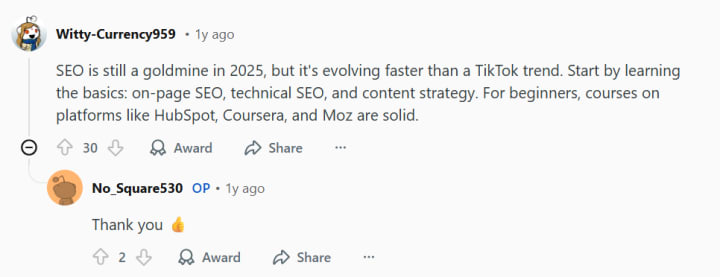
SEO hasn’t disappeared. It has sped up. The gap between surface-level knowledge and real skill has widened, and shortcuts stop working faster than they used to.
That’s why starting correctly matters.
And that’s what the rest of this guide focuses on.
Step 1: Understand How Search Engines Work
SEO rewards people who understand fundamentals. It punishes guesswork.
Before tools, courses, or checklists, you need to understand how search engines crawl, index, and rank pages. Without this foundation, tactics stop working the moment Google changes something.
Search engines follow a simple process:
- they crawl pages through links;
- they store pages in an index;
- they rank results based on relevance and trust.
If a page can’t be crawled or indexed, it won’t rank. No workaround fixes that.
It’s also important to separate: organic search, which builds long-term visibility, paid ads, which stop the moment budgets stop.
Search systems evaluate:
- how closely a page matches a query;
- how trustworthy the source looks;
- how users interact with the result.
Everything else in SEO depends on this foundation.
Step 2: Learn the SEO Basics (On-Page, Technical, Off-Page)
SEO work falls into three areas. Ignoring one breaks the system.
1. On-page SEO focuses on content and structure: keyword research, search intent, titles, meta descriptions, internal links.
2. Technical SEO, at a beginner level, focuses on access: indexability, site structure, page speed, mobile usability. You don’t need to code. You need to notice issues!
3. Off-page SEO deals with trust: backlinks, brand mentions, external signals.
Link quality matters more than volume. That rule still holds.
Step 3: Get Structured SEO Education
Most beginners don’t start with textbooks or formal certifications. They start on YouTube.
That’s not a weakness. It’s often the most practical entry point. Platforms like Ahrefs and Semrush publish training videos that walk through their tools step by step, showing how keyword research, site audits, and competitor analysis work in real situations.
As people go deeper, many add SEO podcasts to their learning routine. Podcasts help beginners understand how experienced practitioners think, make decisions, and respond to algorithm changes. They focus less on step-by-step instructions and more on context, strategy, and real tradeoffs from day-to-day SEO work.
At some point, most beginners start looking for structure. This is where curated learning paths help filter outdated advice and reduce noise. A practical way to do this is by comparing SEO courses designed for different skill levels, formats, and goals, instead of picking random tutorials.
Each format plays a different role. Together, they create a more realistic education path.
Helpful resources for structured SEO learning:
- Google Search Central — official documentation and best practices directly from Google https://developers.google.com/search
- LearningSEO.io by Aleyda Solis — a free, structured SEO roadmap with curated resources and tools for every experience level https://learningseo.io Aleyda is the author of one of the most popular newsletters SEOFOMO with +40,500 subscribers, where she shares the latest SEO news, resources and jobs.
- Nathan Gotch (YouTube) — practical insights on Search Everywhere Optimization, covering Google, ChatGPT, and YouTube ranking strategies https://www.youtube.com/@nathangotch
- Search Engine Roundtable (Barry Schwartz) — daily SEO news and Google algorithm updates from one of the most trusted industry voices https://www.seroundtable.com
- Free SEO courses worth taking https://collaborator.pro/blog/best-seo-courses
- SEO podcasts that should be on your playlist https://seranking.com/blog/best-seo-podcasts
- Career tips from industry insiders https://www.jellyfish.com/en-gb/training/blog/how-to-get-a-job-in-seo
Step 4: Practice SEO Using Real Tools
SEO becomes real only when you work with data.
Every beginner should know:
- Google Search Console for indexing and performance;
- Google Analytics for user behavior;
Early on, focus on: impressions and clicks, indexed pages, organic traffic trends.
Avoid chasing vanity metrics. They don’t teach much.
The fastest way to learn is by analyzing real websites. Your own or someone else’s. Ask why certain pages rank and others don’t.
Step 5: Build Experience and Start Your SEO Career
Experience rarely comes first. People create it.
A personal site works. Small projects work. Local businesses work.
Conclusion
Search changes. AI reshapes interfaces. Fundamentals still decide outcomes.
Start small. Learn in order. Practice consistently.
That’s how people actually build careers in SEO :)
About the Creator
Keep reading
More stories from Iryna Podliesna and writers in Education and other communities.
Top Website Monetization Platforms to Maximize Your Revenue in 2026
Website monetization platforms are tools that help website owners generate revenue from their traffic. These platforms support different monetization models, including programmatic advertising, affiliate marketing, sponsored content, and performance-based ads.
By Iryna Podliesna9 days ago in Education
Generosity Without Boundaries: Advancing Equity Through Philanthropy
Philanthropy has always played a meaningful role in shaping societies and improving the lives of individuals in need. From supporting educational programs to funding healthcare initiatives, acts of giving have helped communities overcome many challenges. In today’s diverse world, however, philanthropy is taking on a deeper purpose. It is increasingly focused on equity—ensuring that resources and opportunities are distributed fairly among people from different backgrounds and circumstances.
By John Olin Killgoreabout 16 hours ago in Education
Lycan Lore
As the students of my 10am mythology class take their seats, I decide to steer the day's curriculum away from Greek and dive into a Western European discourse on the misaligned beliefs of the Werewolf. A tale of truth or fiction. No one really knows.
By Lamar Wigginsabout 22 hours ago in Fiction


Comments
There are no comments for this story
Be the first to respond and start the conversation.