

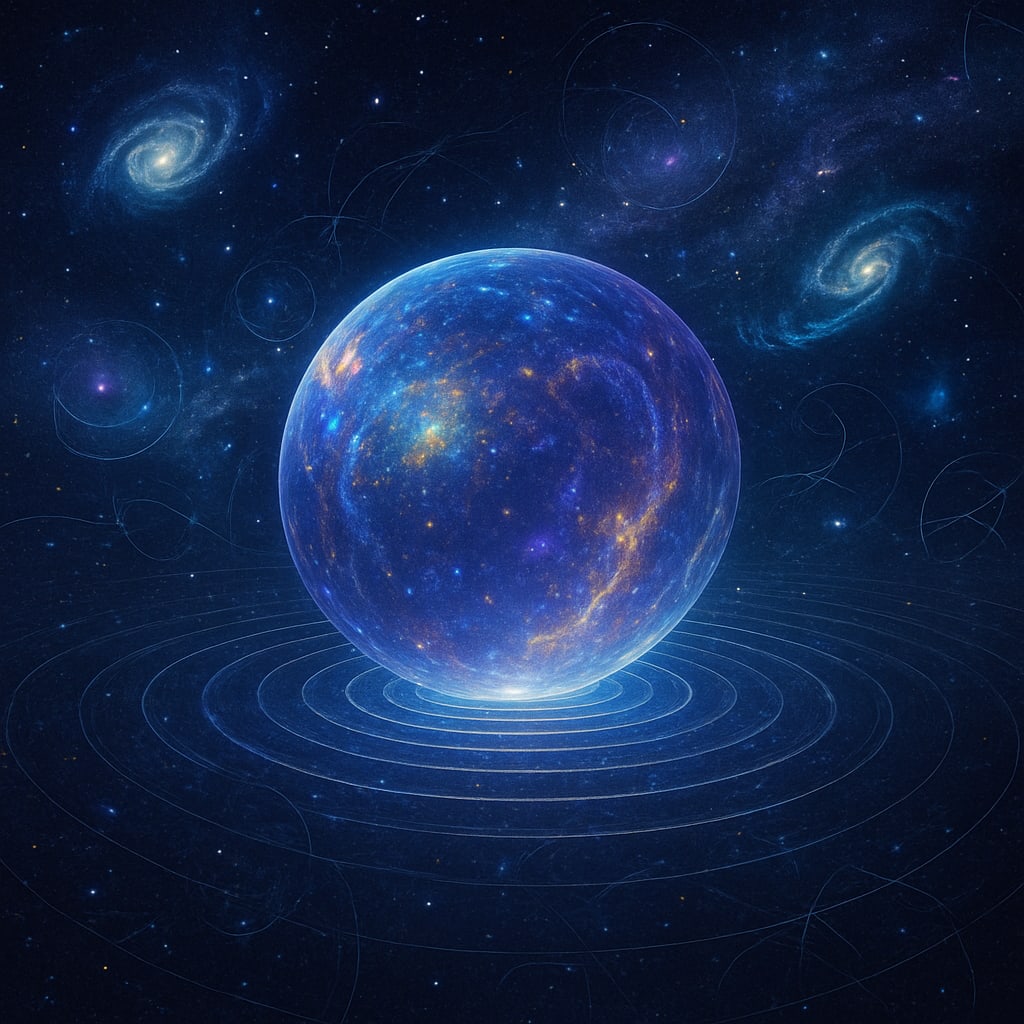
When we gaze at the night sky, the cosmos feels infinite, majestic, and timeless. Stars shine steadily, galaxies stretch out across unimaginable distances, and everything appears stable. Yet modern science suggests a surprising truth: behind this apparent permanence lies a world ruled by uncertainty, probabilities, and fluctuations. More and more physicists are exploring the idea that the universe itself may be a quantum process — a vast system unfolding according to the laws of quantum mechanics.
What Does “Quantum Process” Mean?
Quantum mechanics describes the behavior of matter and energy on the smallest scales — electrons, photons, atoms. In this strange domain, certainty disappears. Particles can exist in multiple states at once, a phenomenon called superposition. An electron may act like a particle or a wave depending on how we look at it. Even the simple act of observation changes the outcome of an experiment.
In other words, the quantum world is not deterministic but probabilistic. Instead of definite outcomes, it offers probabilities. Extending this idea to the cosmos leads to a bold vision: the universe itself may not be a fixed structure but the result of an ongoing quantum process.
The Universe Born from “Nothing”
One of the most fascinating ideas in cosmology is that the Big Bang might have originated from a quantum fluctuation. In classical physics, a vacuum means empty space. But in quantum physics, a vacuum is not empty at all — it teems with energy, with “virtual particles” constantly appearing and vanishing in fractions of a second.
Now imagine a fluctuation in this seething quantum vacuum that was powerful enough to give birth to an entire universe. According to some models, this is exactly how our universe began — as a tiny “bubble” of space-time that expanded and continues to expand today. In this sense, we are living inside a ripple of quantum uncertainty.
The Universe as a Wave Function
In quantum mechanics, a system is described by a wave function — a mathematical expression that contains all possible outcomes of the system. Physicist Hugh Everett proposed that the wave function could apply not just to particles but to the entire universe.
If this is true, then our universe is one branch of a much larger wave function, where other possibilities also exist. This leads to the concept of the multiverse: countless parallel universes where every possible version of history plays out. In one universe, Earth may never have formed; in another, humanity may have developed completely differently. What we experience is simply one realization of the vast quantum spectrum.
Quantum Mechanics at the Heart of Cosmic Evolution
Even within our universe, quantum mechanics is essential for its evolution. Take stars, for example. Without quantum tunneling — the ability of particles to “tunnel” through energy barriers — nuclear fusion in stars would not occur. The sun’s light, which makes life possible on Earth, is directly powered by quantum effects.
On a larger scale, quantum fluctuations in the very early universe are believed to have seeded the clumping of matter that later formed galaxies and stars. Without those fluctuations, the universe might have remained a smooth, featureless expanse. In short, everything we see — galaxies, planets, and even ourselves — can trace its origins back to quantum processes.
The Universe as Information
Another intriguing perspective is that the universe is not made of matter in the traditional sense but of information. From this viewpoint, quantum mechanics provides the “code” that governs reality. Some researchers even compare the cosmos to a gigantic quantum computer, where every interaction, from star formation to human thought, is part of a vast computation.
This approach connects physics with philosophy and even with questions of consciousness. If reality is information-driven, then observing, measuring, and participating in the universe means we are not passive spectators but active contributors to the unfolding process.
Philosophical Implications
Thinking of the universe as a quantum process changes how we view fundamental ideas like beginning, end, cause, and chance. If the universe emerged from a quantum fluctuation, then “nothingness” itself may not truly exist — it is always a backdrop for new possibilities.
It also suggests that uncertainty is not a flaw in our understanding but a built-in feature of reality. We are part of a cosmic game of probabilities, where every decision and every observation ripple outward, shaping what becomes real.
Conclusion
We usually imagine the universe as solid, immense, and unchanging. Yet quantum physics tells us the foundation of reality is fragile, dynamic, and uncertain. The universe may be less like a machine and more like a wave — a process, not a product.
Perhaps the greatest mystery is that this quantum process has given rise to stars, planets, life, and human beings capable of asking these very questions. In exploring the idea of the universe as a quantum process, we are not just studying the cosmos — we are trying to understand the deep logic of existence itself.
About the Creator
Keep reading
More stories from Holianyk Ihor and writers in Education and other communities.
Humanity as a Galactic Civilization
The idea of humanity becoming a galactic civilization sounds like something out of a science fiction novel. Yet if we take a step back and look at the history of our species, it feels less like fantasy and more like the natural continuation of a pattern. Humans have always been explorers. From the moment our ancestors ventured out of caves to sail oceans, climb mountains, and eventually reach the skies, we have expanded the boundaries of the known world. Our next frontier isn’t just another continent or even another planet — it’s the stars themselves.
By Holianyk Ihor4 months ago in Education
Before the Bell: Daily Pre-Market Steps That Drive Consistent Trading Wins
In daily trading, the difference between consistency and chaos often comes down to what happens before the session starts. The most reliable traders don’t wait for the bell to decide what to do—they use the early hours to map out a plan, filter distractions, and establish a tactical approach to the day.
By Agast Mishra7 days ago in Education
Image-to-text technology, also known as Optical Character
Image-to-text technology, also known as Optical Character Recognition (OCR), has transformed the way we interact with visual information. It allows machines to extract text from images, enabling various applications across multiple industries. From digitizing printed documents to reading text from scanned images, OCR plays a vital role in making printed content accessible, editable, and searchable. The need for such technology has grown exponentially with the increasing reliance on digital data and the rapid shift from physical to digital content in nearly all sectors of life. As the digital world continues to expand, image-to-text technology has paved the way for more seamless workflows, enabling businesses and individuals alike to save time, effort, and resources.
By Alexander Jackson4 days ago in Education
Getting Serious About Comedy (Part I)
If I were asked to remark on my life and the childhood that paved some road leading me to this point, I would have to say something about all the funny people who surrounded me for the last 26,872 days (and counting). Somewhere along that road, I became a big fan of laughter and the comedy that spawns it – and, I mean not only my own laughter, but the laughter of others, some of which I have actually been responsible for inducing.
By John Oliver Smith7 days ago in Humor



Comments
There are no comments for this story
Be the first to respond and start the conversation.