
The Night of Mi‘rāj: A Journey Beyond Time, Space, and Human Imagination
An in-depth exploration of the spiritual, historical, and scientific dimensions of the Prophet Muhammad’s ﷺ miraculous ascension
Mi‘rāj — A Night That Reshaped Human Understanding
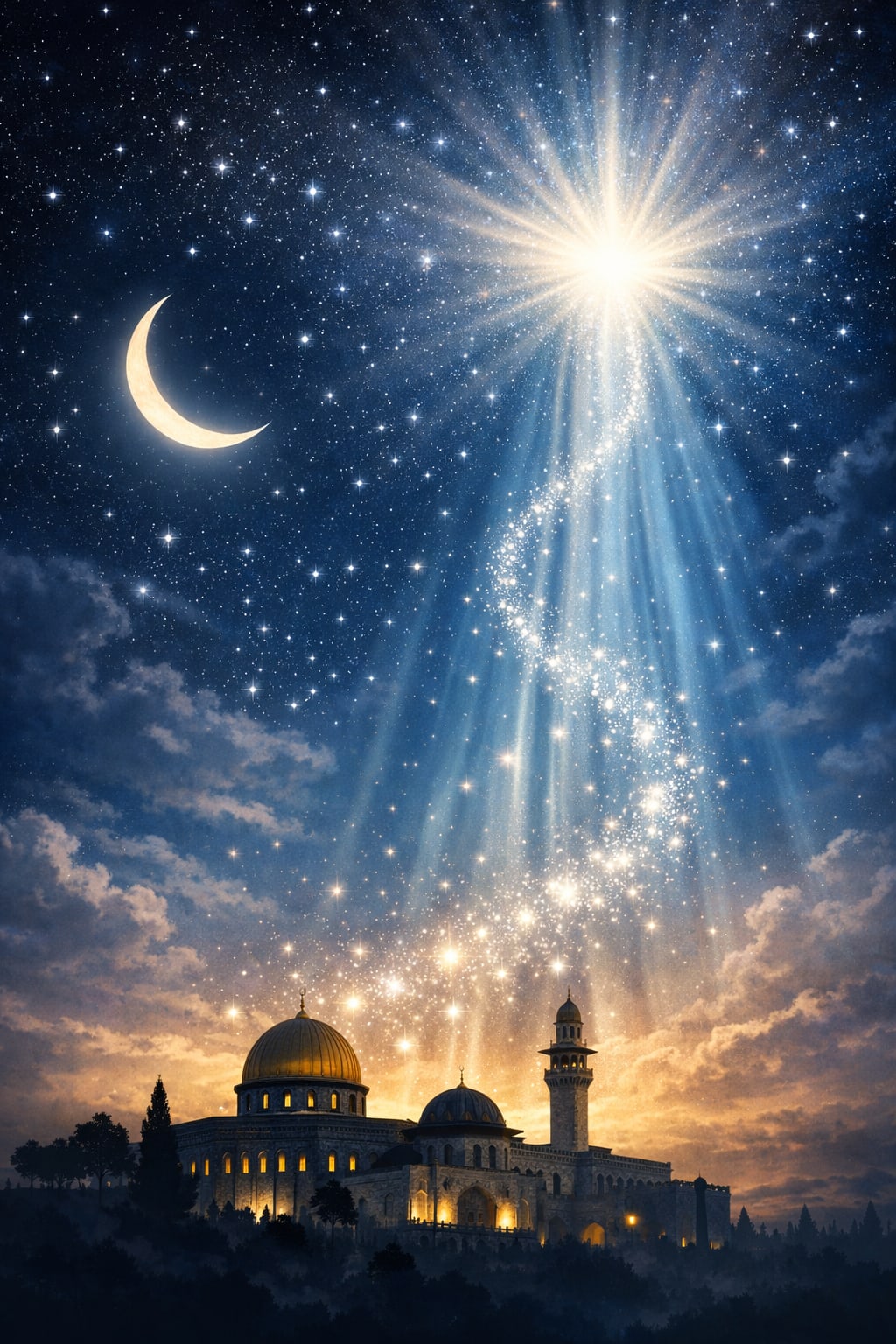
Among all the extraordinary events recorded in Islamic tradition, Mi‘rāj stands as one of the most profound. It is not merely a journey; it is a moment when the boundaries of time, space, and perception were transcended by the Prophet Muhammad ﷺ through the will of God.
On this blessed night, the Prophet ﷺ traveled from Makkah to Jerusalem in the journey known as Isrā, and from there ascended through the heavens in the Mi‘rāj. The experience brought together the spiritual and the cosmic, merging the earthly world with the unseen realms.
The Journey of Isrā — From Makkah to Jerusalem
The journey began when the Prophet ﷺ was taken from Masjid al-Haram to Masjid al-Aqsa on a heavenly steed called Buraq. Narrations describe Buraq as a luminous creature whose speed surpassed anything known to the human world.
Today, modern physics gives us a unique perspective on this description. According to Einstein’s theory of relativity, if an object were to travel faster than light, time would slow down for that traveler — a phenomenon known as time dilation. In this sense, the Mi‘rāj journey introduces ideas that align with scientific theories that emerged centuries later.
But beyond scientific analysis, Isrā carries deep symbolic meaning:
Jerusalem as the spiritual center of prophets
A reminder of continuity among divine messages
A transition between earthly and celestial realms
At Masjid al-Aqsa, the Prophet ﷺ led all previous prophets in prayer, symbolizing unity, continuity, and divine leadership.
Mi‘rāj — Ascending Through the Heavens
After the prayer in Jerusalem, the Prophet ﷺ began the miraculous ascent. At each level of the heavens, he met a notable prophet:
1st Heaven: Adam ﷺ
2nd: Jesus and John (Yahya) ﷺ
3rd: Joseph ﷺ
4th: Idris ﷺ
5th: Aaron ﷺ
6th: Moses ﷺ
7th: Abraham ﷺ
Each encounter carried blessings, wisdom, and recognition of the Prophet’s ﷺ unique mission.
Sidrat al-Muntahā — The Point Beyond Human Access
The journey continued until reaching Sidrat al-Muntahā, the Lote Tree of the Utmost Boundary. It is described as the furthest point where any created being can go. Even the Archangel Gabriel (Jibreel عليه السلام) stopped here and said:
“If I move a step beyond this point, I will be consumed.”
From here on, the journey belonged solely to the Prophet ﷺ — a moment that is beyond human understanding, veiled in divine mystery.
The Divine Meeting — The Gift of Prayer
During this sacred encounter, God gifted the Muslim community with Salah (the five daily prayers). Originally prescribed as fifty prayers, the number was reduced to five while retaining the reward of fifty — a powerful symbol of mercy.
Prayer became not just an obligation, but a daily spiritual ascension — a personal Mi‘rāj for every believer.
Scientific Interpretations — A Journey Through Dimensions?
While Mi‘rāj remains a miracle beyond the scope of physical laws, modern science offers frameworks that allow us to reflect deeper:
1. Time Dilation (Einstein’s Relativity Theory)
If one travels at extreme speeds, time behaves differently. The Prophet’s ﷺ experience — completed in a fraction of earthly time — resonates with this concept.
2. Wormholes and Space-Time Shortcuts
Physics suggests the possibility of tunnels through space-time. Mi‘rāj could reflect a spiritual or divine form of such movement.
3. Higher Dimensions
Islam speaks of seven heavens, which may correlate with the idea that the universe contains layers of reality beyond human perception.
While these interpretations are not explanations, they highlight that Mi‘rāj fits comfortably within frameworks that science is only beginning to explore.
Spiritual Meanings — A Journey of Divine Nearness
The most important aspect of Mi‘rāj is not its scientific possibilities, but its spiritual message. At its heart, Mi‘rāj represents:
God’s closeness
Human potential
Mercy and guidance
The honor of the Prophet Muhammad ﷺ
It teaches us that the boundaries we see in the physical world are not the limits of reality.
The Impact of Mi‘rāj on Muslim Civilization
The event of Mi‘rāj inspired generations of Muslims in fields such as:
Astronomy
Philosophy
Architecture
Literature
Mysticism (Sufism)
Islamic scholars, poets, and thinkers drew from Mi‘rāj to understand the structure of the cosmos, the nature of time, and the journey of the human soul.
Lessons of Mi‘rāj for the Modern World
Today, when the world is filled with noise, conflict, and distraction, Mi‘rāj provides timeless lessons:
1. Prayer is a direct link to God
Every sincere prayer becomes a personal Mi‘rāj.
2. Knowledge and faith are not opposites
Islam encourages reflection, study, and intellectual curiosity.
3. Honor and humility go hand in hand
Even during the greatest spiritual experience, the Prophet ﷺ returned to guide his community.
4. Human potential is greater than we imagine
Mi‘rāj reminds us that the soul is capable of reaching unimaginable heights.
Conclusion — The Mi‘rāj Continues in Every Prayer
Mi‘rāj is not only a historical event. It is a reminder that the human journey is not limited to the physical world. Five times a day, believers are given the opportunity to elevate themselves spiritually, just as the Prophet ﷺ was elevated on that blessed night.
It is an invitation to rise above limitations, to seek knowledge, to purify the heart, and to draw closer to God.
Mi‘rāj teaches us:
A believer’s true journey is upward — toward light, truth, and divine presence.
About the Creator
Keep reading
More stories from Muhammad Islam khan swati and writers in Education and other communities.
Greenland, the United States, and the New Arctic Power Game
For much of modern history, Greenland was viewed as a remote stretch of ice, distant from global decision-making and international power struggles. But that has changed. As the Arctic warms and world powers turn their attention northward, Greenland has become a central figure in a rapidly shifting geopolitical landscape.
By Muhammad Islam khan swati6 days ago in Education
Was Alexander the great really that great?
Order, order! Who do we have on the stand today? Alexander... the Great, eh? Well, what’s so great about him? Your honor, the better question is, what's not great about him? He was the King of Macedon and considered a living demigod by Egyptians and Greeks alike. He conquered Persia when it was one of Earth's largest empires. And he was a thoughtful student of Aristotle, creative enough to untie the impossibly tight Gordian knot by cutting it in half. The Gordian knot is a myth— just like the countless other stories invented to enhance Alexander’s legend!
By Munesh Yadav3 days ago in Education
The 1793 Chain Cent: America's First Large-Scale Copper Coin
Holding a 1793 Chain Cent is like holding the first argument of a new nation. More than just America’s first mass-produced penny, this coin is a piece of history that sparked public debate, fueled by a design many found utterly wrong. Its story—from a chaotic mint to a collector's dream—explains why it remains one of the most coveted pieces in all of American numismatics. This guide will walk you through its turbulent birth, teach you to spot the tiny detail that can mean a fortune, and explain what truly makes it valuable.
By Laura Bennett6 days ago in Education
Silver Screen Magic with Mae West
American actress and singer Mae West became a popular film actress during the Great Depression. She started entertaining in vaudeville, then performed on Broadway, and finally went to Hollywood. She signed up with Paramount Pictures and made her debut in the 1932 film “Night After Night.” She also starred in musicals, comedies, and crime dramas. The American Film Institute named her one of the best classic Hollywood actresses.
By Rasma Raisters5 days ago in Geeks


Comments
There are no comments for this story
Be the first to respond and start the conversation.