
Greenland, the United States, and the New Arctic Power Game
How climate change and global competition are reshaping the world’s largest island

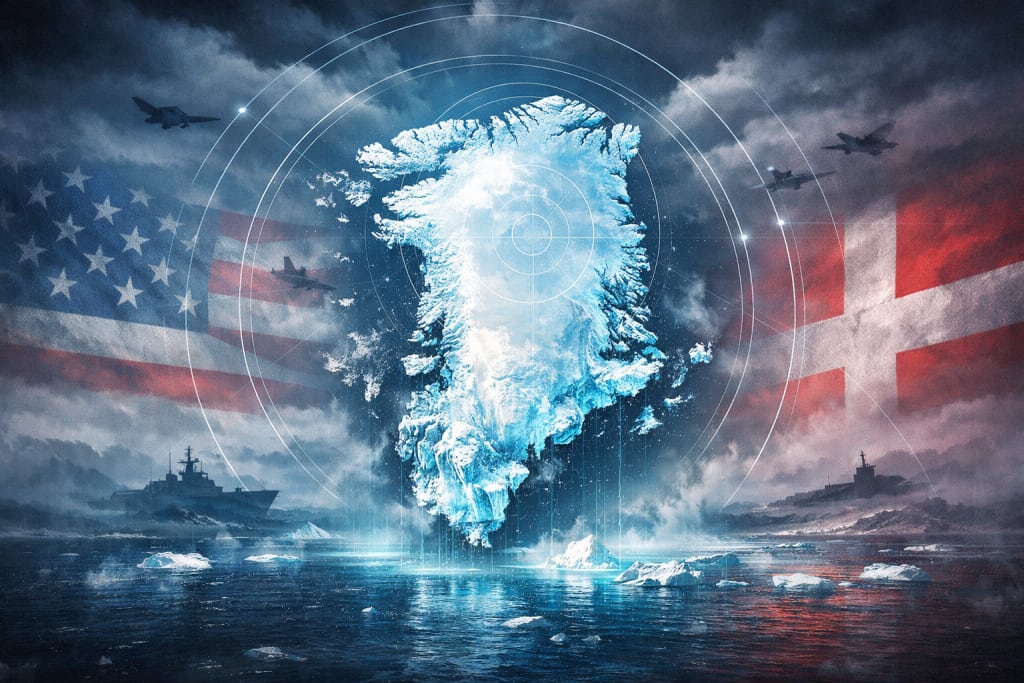
For much of modern history, Greenland was viewed as a remote stretch of ice, distant from global decision-making and international power struggles. But that has changed. As the Arctic warms and world powers turn their attention northward, Greenland has become a central figure in a rapidly shifting geopolitical landscape.
What was once a quiet territory is now a place where strategic interests, environmental pressures, and global competition intersect. The renewed focus on Greenland is driven by its unique location, vast mineral resources, and the impact of climate change—elements that together have reshaped the island’s global importance.
Why Greenland Matters Strategically
Greenland’s position between North America and Europe has always given it military value. During the Cold War, the United States relied on the Thule Air Base for early missile detection. Today, that strategic advantage remains critical as new security challenges emerge in the Arctic.
The U.S. sees Greenland as essential for monitoring activity across the North Atlantic and the polar regions. At the same time, Russia has expanded its presence along the Arctic coast, and China has shown growing interest in the region’s shipping routes and raw materials. This competition has intensified the United States’ desire to strengthen ties with Greenland’s government and maintain a stable foothold in the area.
Climate Change Opening New Doors—and New Risks
As the Arctic warms at record speed, melting ice has exposed new opportunities and raised urgent environmental concerns. With retreating ice sheets, shipping lanes that were once inaccessible for most of the year are now opening. These routes could eventually shorten global trade paths, positioning Greenland near future transportation corridors.
Beyond navigation, Greenland contains significant mineral deposits, including rare earth elements, zinc, iron ore, and other materials essential for modern technology and renewable energy systems. These resources have placed Greenland at the center of global interest, especially at a time when nations are looking for alternatives to traditional mineral suppliers.
The Controversial Talk of “Buying Greenland”
Global attention reached a peak in 2019 when former U.S. President Donald Trump publicly expressed interest in purchasing Greenland. While the idea was not new—territorial purchases have occurred in history—the proposal sparked strong reactions from both Denmark and Greenland’s officials.
Leaders from both sides made it clear that Greenland was not for sale. For many Greenlanders, the discussion highlighted a deeper issue: their determination to protect their autonomy and identity. While the proposal faded quickly, it underscored how strategically—and symbolically—important the island has become for the United States.
Greenland’s Path Toward Greater Control
Greenland is a self-governing territory within the Kingdom of Denmark, and over the years, it has gained more control over its internal affairs. Many citizens support the long-term goal of full independence, although the island’s economy—reliant largely on fishing and financial support from Denmark—creates challenges.
This means Greenland must navigate global interest carefully. U.S. partnerships offer economic and technological opportunities, but leaders remain cautious about relying too heavily on any one country. Maintaining balance is central to Greenland’s political vision.
A New Era of Arctic Competition
The broader picture involves more than just Greenland and the United States. Russia has invested heavily in Arctic infrastructure, reactivating military bases and expanding its fleet of icebreakers. China, meanwhile, has taken a long-term approach, positioning itself as a scientific and economic partner in the region.
These developments have transformed the Arctic into a competitive arena, where access, influence, and long-term stability are at stake. In this environment, Greenland’s role has grown significantly. Its geography, resources, and political future now carry global weight.
Where the Greenland–U.S. Relationship Goes Next
Looking ahead, the United States is likely to expand cooperation through:
infrastructure and development partnerships
scientific and climate-related research
mineral exploration efforts
continued security collaboration
For Greenland, the challenge will be to manage these relationships while protecting its environment, culture, and long-term goals. Independence remains a topic of discussion, but economic stability and environmental responsibility will shape how far and how fast the island moves toward it.
One thing is clear: Greenland is no longer a distant outpost. It has become a key player in the evolving Arctic narrative, where climate change, global interests, and local aspirations meet.
About the Creator
Keep reading
More stories from Muhammad Islam khan swati and writers in Education and other communities.
The Night of Mi‘rāj: A Journey Beyond Time, Space, and Human Imagination
Mi‘rāj — A Night That Reshaped Human Understanding Among all the extraordinary events recorded in Islamic tradition, Mi‘rāj stands as one of the most profound. It is not merely a journey; it is a moment when the boundaries of time, space, and perception were transcended by the Prophet Muhammad ﷺ through the will of God.
By Muhammad Islam khan swati5 days ago in Education
How Learning About Global Health Gives Early Impacts to Medical Students
Medical students begin forming their professional identities long before they enter residency, and early exposure to global health giving plays a decisive role in shaping those identities. While traditional training emphasizes diagnostics and clinical precision, global learning encourages students to understand the broader human context behind every medical decision.
By Dr. Seth Eidemiller6 days ago in Education
Why Do We Dream?
In the third millenium BCE, Mesopotamian kings recorded and interpreted their dreams on wax tablets. A thousand years later, Ancient Egyptians wrote a dream book listing over a hundred common dreams and their meanings. And in the years since, we haven't paused in our quest to understand why we dream. So, after a great deal of scientific research, technological advancement, and persistence, we still don't have any definite answers, but we have some interesting theories. We dream to fulfill our wishes.
By Munesh Yadav3 days ago in Education
So You Decided To Become a Nurse Practitioner:
So you decided to become an "Advanced Practice" nurse. Congratulations!... is what I would say if this was a good idea. Grad school? In this economy? What were you thinking? Likely it was something along the lines of either 1) “I've seen these other chucklefucks do it— Why can't I?” or even 2) “I've got a nice career, I should shake it up. I miss feeling like I have no clue what I'm doing.”
By Sandor Szabo2 days ago in Fiction


Comments
There are no comments for this story
Be the first to respond and start the conversation.