
The Irony of AI Detection in Writing
When AI Becomes the Judge: The Unfair Battle Between Writers and Machines
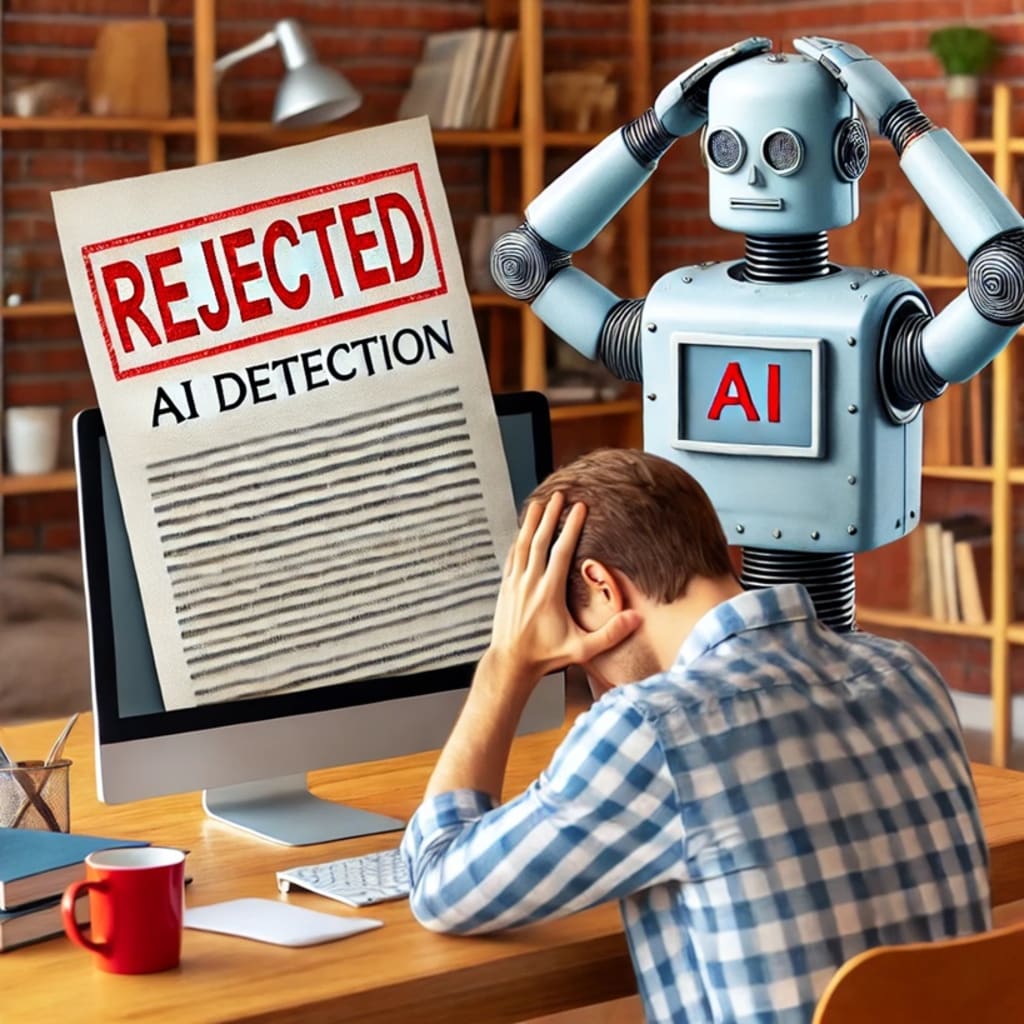
One day, while browsing YouTube, I came across a woman discussing how to earn money through writing on Vocal. She not only explained the process but also introduced tools to help improve writing. Curious, I followed her advice and rewrote the content of a video into an article—summarizing its key points and sharing my thoughts. Since I wasn’t copying word-for-word but simply discussing the video’s story, I assumed this was completely acceptable.
To my surprise, my article was rejected for being "amended by AI." This left me puzzled because my first article had been accepted without issue. Why was my second one flagged? Determined to test the system, I submitted another article—this time writing completely without any tools, ignoring grammar mistakes and making sure every word was purely my own.
Guess what? It got rejected again.
Now, this raises a serious question: If grammar tools and AI writing assistants are not allowed, why is an AI tool being used to judge my writing? Why is it acceptable for machines to decide whether my work is “human enough,” but not acceptable for me to use technology to improve my writing?
This contradiction is both absurd and discriminatory. It sends the message that only people with perfect, A+ English deserve to publish articles—even if those articles are meant to inform or entertain. It also unfairly punishes those who may not have flawless grammar but have valuable ideas to share.
If platforms are so obsessed with rejecting AI assistance, maybe I should just write my articles by hand and submit them in my own handwriting. But wait—the website doesn’t even allow handwritten submissions! It forces me to use a fixed, digital font, yet it wants to ban AI because it’s "not human enough"? What kind of logic is that?
What’s even more frustrating is that I wasn’t trying to cheat the system. I wasn’t copying from another source, nor was I submitting low-effort content. I simply used a tool to refine my thoughts, the same way someone might ask a friend to proofread their work. But instead of appreciating my effort to improve, Vocal’s system instantly disqualified my writing.
This entire situation proves a bigger point: AI isn’t the enemy. It’s a tool—just like spell check, grammar correction, and even the very keyboard we use to type. If AI can help improve clarity and readability, why should it be demonized while AI detection tools are blindly trusted?
The reality is, platforms like Vocal claim to support creativity and diversity, but their AI-driven rejection system tells a different story. Instead of encouraging writers to express themselves, they are enforcing an outdated, rigid standard that benefits only native English speakers or those who already excel in writing. This means talented individuals who have important ideas to share are being silenced—not because their content is bad, but because of arbitrary restrictions.
I believe encouraging competition among writers is a great idea, but let’s be honest—AI will always be better at ensuring flawless, high-quality writing. Instead of banning it, why not use it to help writers grow? Why not allow AI-assisted writing while still requiring originality and personal input?
I am submitting this article just to test Vocal’s platform again. But if you reject it, I won’t waste my time any further—there are plenty of other websites that will accept my opinion without ridiculous restrictions.
Your rejection isn’t a loss for me—it’s a loss for your business. While you push writers away, other platforms will gladly welcome this same article and benefit from it instead.
At the end of the day, rejection doesn’t mean my work lacks value—it just means I’ve used the wrong platform. After all, even Harry Potter was rejected multiple times before becoming a billion-dollar success.
So, the real question is: Are you truly encouraging creative expression, or are you just policing writers with an unfair, flawed system?
About the Creator
Keep reading
More stories from Rosemarie Chung and writers in Education and other communities.
The Hidden Dangers of Untreated Severe Mental Illness: A Call for Stricter Intervention and Accountability
It is deeply concerning that there is no effective mental health assessment to accurately identify individuals with severe mental health issues. If this issue continues to be neglected, those under the care of such individuals could face serious harm, including abuse or even death. The lack of proper regulations by mental health authorities to identify and provide necessary treatment to mentally challenged individuals is alarming. Determining whether they are capable of managing their condition and safely integrating into society is a complex challenge. Allowing such individuals to live freely without adequate support and supervision can lead to significant problems, as many may not recognize the importance of seeking or adhering to proper treatment.
By Rosemarie Chung11 months ago in Criminal
The One Lighting Move That Instantly Makes Your Photos Look Better
Photography advice often focuses on complex settings, advanced editing, or buying better equipment. While those things can help, they often distract from something far more powerful and immediate. One simple lighting habit can dramatically improve almost every photo you take, whether you’re shooting with a phone or a professional camera.
By Kelln Small4 days ago in Education
Managing Anxiety During Exams: A Student’s Guide
Exams are one of the most common sources of stress for students at every level. Even the most prepared individuals often feel nervous before or during a test. Exam anxiety is natural — it’s the body’s way of preparing for a challenge — but excessive stress can interfere with focus, memory recall, and overall performance. Understanding the causes of anxiety and learning effective coping strategies can make a significant difference. This guide provides practical, evidence-based techniques to manage stress before, during, and after exams.
By Games Mode On5 days ago in Education
Affection and Healing for Yourself
During the night of the last quarter moon, I gathered my ritual supplies. I carefully handled the chunk of black tourmaline that would protect me from your overall negative and narcissistic energy. I carefully walked the house with my stick of selenite in hand, asking the universe to cleanse our working space.
By Alisha Wilkins ✒️🦋🖋️4 days ago in Fiction



Comments