teacher
All about teachers and the world of teaching; teachers sharing their best and worst interactions with students, best teaching practices, the path to becoming a teacher, and more.
Unraveling the Fascinating World of Dogs: A Comprehensive Guide to Man's Best Friend
Introduction: Dogs have long held a special place in our hearts as loyal companions and beloved pets. They come in all shapes, sizes, and breeds, each with its unique characteristics and traits. In this comprehensive guide, we will delve into the fascinating world of dogs, exploring their history, breeds, behavior, care, and more. Whether you're a seasoned dog owner or considering getting a furry friend, this article aims to provide you with a wealth of information to deepen your understanding and appreciation for these incredible creatures.
By AHMED BUTT3 years ago in Education
Homer Lane: Experimental Educator
Experiments with children All childhood education is a form of experimentation. Teaching objectives, measurements and syllabi change change almost every year, but do we know what really works well, do we put enough effort into developing the ideal educational plan for each individual child?
By James Marinero3 years ago in Education
Apache helicopter
The Apache helicopter, also known as the AH-64 Apache, is a twin-engine attack helicopter that was developed by McDonnell Douglas, now owned by Boeing, for the United States Army. The helicopter is used for a variety of missions, including close air support, reconnaissance, and anti-tank warfare.
By Mahendrarajah Mithusharan3 years ago in Education
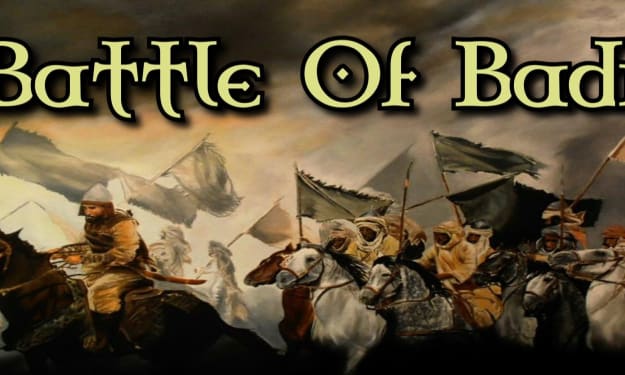
The Battle of Badr
When the Holy Prophet (SAW) was informed of the strong preparation of the disbelievers of Makkah against Muslims, he was left with no choice but to set up a powerful group of Muslims to fight against them. The moment, however, was a great testing time for the faith of the disciples of Islam. The Ansaar (Natives of Madina) also had to decide within themselves whether to participate in this combat or not, because the Pact of Brotherhood between them and Muhajireen (the natives of Makkah) did not include fighting enemies outside the boundaries of Madina. The Messenger of God asked his companions about it, Muhajireen approved their inclusion straight away, but as they were very less in number, Muhammad, who wanted to be sure, asked them 3 times until S’ad b. Mu’ad realized that He (PBUH) was wishing Ansaar to participate too. He stood up and said to the Holy Prophet ﷺ that Ansaar were always ready to fight in the way of Allah and His Apostle (PBUH) at any given situation (good or bad). Rasulullah (SAW) was delighted at this great sight of Muslim unity and standing firm against the enemies of Allah.
By Maruf Ademola Muslim3 years ago in Education
10 Oldest Animals That Ever Lived
Most of Earth's history is uncovered through in-depth research into fossils. Scientists have been able to dig into the present and past creatures, only to find that some species have lived for millions of years yet remain unshaken. The animal kingdom remains lively, thanks to these oldest living creatures.
By Jessica Kingsley3 years ago in Education
Middle East Tourism Industry Shows Promising Signs of Recovery Post-COVID
The Middle East has faced many challenges in recent years, including political unrest, economic struggles, and the COVID-19 pandemic. However, the tourism industry in the region has shown remarkable resilience and continues to grow despite these obstacles.
By Leeroy Gondo3 years ago in Education
The luminescent doorways
Title: "The Luminescent Doorway" Once in a realm beyond imagination, nestled between the boundaries of reality and dreams, there existed a hidden door. This door, known as the Luminescent Doorway, possessed the power to transport those who entered to extraordinary worlds untouched by mortal eyes. But it remained unseen and unheard of by all, save for a single individual who was destined to discover its secrets.
By AHMED BUTT3 years ago in Education
Medicine
There is a problem with medicine. I'm missing something. This means that not only is it more difficult to find the cause of some diseases and find effective ways to treat them, some diseases are overlooked entirely. You may be the one missing, but we'll get to that in a moment. Because it's a story first. 8 billion stories to be exact. Indeed, our DNA is our body's instruction manual. But it is also a history book that chronicles our own unique genetic history. Our story all begins about 300,000 years ago when humans emerged in Africa. Some genetic stories tell of leaving for Europe, East Asia, or the Americas after hundreds of thousands of years. Some hereditary stories tell of the expansion of empires. Other diseases are diseases that we have evolved to prevent, and other diseases are the simple act of settling down and raising cows and drinking their milk. Each of us has a different genetic history, but perhaps not as different as you might expect. We share 99.9% of each other's DNA. Our story is 99.9% identical to her, but that 0.1% difference in her is incredibly powerful. This small difference in our genetic history has the potential to develop better treatments for disease, treatments that work for everyone. But medicine is not currently reading all these stories. To illustrate this, I would like to describe how researchers study the causes of disease and develop and test the efficacy and safety of new treatments. To figure out what causes a particular disease, researchers look for large numbers of people suffering from that disease and comb through their genetic histories. They look for small variations they share, small parts of the DNA story written differently. If they find something they will try all sorts of ways to deal with the effects. And when we find something that looks promising, we run clinical trials to see if it's real. In Phase 1, a small group of volunteers will attempt treatment. Well, often only half of them work and the other half get a placebo that doesn't work at all. If there are no significant side effects at the target dose, the treatment is approved and can proceed to the next stage of clinical trials. The second phase, this time with more participants, all suffer from ailments the researchers hope the drug can treat. If the drug seems to work, move on to Phase 3, where more participants will try the drug longer. Only then will new treatments be reviewed and hopefully approved for use by our general public. However, there is a problem with that. Here is the ethnicity of so many people that these days are used to find the cause of various diseases. And it can be compared with the ethnic diversity of the world's population. See the difference? The genetic histories investigated by researchers skew heavily toward those of people of European descent. This is because reading stories of people of mostly European descent in search of the causative pieces of DNA to target diseases for new drugs misses key parts of the stories told by various other groups. It means that there is a possibility. For example, it can change the risk of a disease or even reveal how the disease develops. For example, if scientists had only studied the stories of people of European descent, they might not have discovered the mutation that causes sickle cell aneFrom the early stages of research, the drug development process, to clinical studies. The good news is that more and more people are thinking about it. For example, cancer researchers at University College London studying genetic markers for cancer analyzed tissue samples from a wide range of ethnicities to ensure that the cancer biomarkers they identified were relevant to people of as many ethnicities as possible. I want to Conclusion:
By finky perly3 years ago in Education
From Bartering to Bitcoin: The Evolution of Currency
From Bartering to Old Currencies Before the advent of paper money and cryptocurrencies, people used to rely on bartering as a means of exchange. This primitive system involved trading goods and services for other goods and services without the involvement of money. However, as societies grew more complex, people began to use old currencies such as shells, beads, and precious metals to facilitate trade.
By Hussain Arif Motivational3 years ago in Education
PROCRASTINATION AND YOU (THE DANGER SIDE)
Procrastination Is a common problem that many people struggle with. It refers to the tendency to delay or postpone tasks that need to be completed, often resulting in stress and anxiety as deadlines approach. While procrastination can affect anyone, it can be especially problematic for individuals who have difficulty with time management or who struggle with motivation.
By Olanrewaju IsaacJoseph3 years ago in Education