teacher
All about teachers and the world of teaching; teachers sharing their best and worst interactions with students, best teaching practices, the path to becoming a teacher, and more.
How Can Assignment Helper Malaysia Support You Through Exams?
In this article, we will explore how Assignment Helper Malaysia can support students during exams, what features to look for in a quality assignment service, and how to make the most of these services for academic success.
By Andersan Smith5 months ago in Education
Donald Trump: From Business to the White House
Introduction Donald John Trump is one of the most recognized figures in modern American history. Known as a businessman, television personality, and the 45th President of the United States, his career has combined business, media, and politics in unique ways. This article provides an educational overview of Trump’s early life, business career, political rise, presidency, and legacy, with the aim of understanding his impact on American society and global politics. Early Life and Education Donald Trump was born on June 14, 1946, in Queens, New York City. He was the fourth of five children of Fred Trump, a successful real estate developer, and Mary Anne MacLeod Trump. Trump attended the New York Military Academy during his teenage years, where he was noted for his leadership skills. Later, he studied economics at the Wharton School of the University of Pennsylvania, graduating in 1968. Business Career After completing his education, Trump joined his father’s real estate company. By the 1970s, he had taken over the business, renaming it the Trump Organization. He expanded its operations into large-scale projects, including hotels, casinos, and office towers. Some of his most famous developments include Trump Tower in New York City and various resorts in Atlantic City. Trump also became well-known as a media personality. In 2004, he began hosting the television show The Apprentice, which further increased his fame and gave him a reputation as a tough businessman. His business career, however, was not without controversy. Several of his ventures faced bankruptcies, but Trump maintained a strong personal brand. Entry into Politics Although Trump had spoken about politics for decades, he formally entered the political arena in 2015 when he announced his candidacy for president. Running as a Republican, he focused on issues like immigration, trade, and American jobs. His slogan, “Make America Great Again”, became widely known. 2016 Presidential Election In 2016, Trump ran against Democratic candidate Hillary Clinton. Despite many experts predicting his loss, Trump won the Electoral College and became the 45th President of the United States. His victory marked a major political shift, as he positioned himself as an outsider to traditional politics. Presidency (2017–2021) During his presidency, Trump implemented several key policies. His administration focused on tax cuts, deregulation, and reshaping the U.S. Supreme Court with conservative judges. He also emphasized a strong stance on border security, introduced trade policies favoring American industries, and pursued changes in healthcare and immigration laws. In foreign policy, Trump’s administration made historic moves, such as engaging directly with North Korea, renegotiating trade agreements like NAFTA (replaced by USMCA), and recognizing Jerusalem as the capital of Israel. His presidency was also marked by tensions with China and efforts to reduce U.S. involvement in long-term overseas conflicts. Impeachments and Challenges Trump’s presidency faced two impeachments by the House of Representatives. The first, in 2019, was related to his dealings with Ukraine. The second, in 2021, followed the events at the U.S. Capitol. In both cases, he was acquitted by the Senate. These events made him the first U.S. president to be impeached twice. Post-Presidency Role After leaving office in January 2021, Trump remained active in American politics. He continued to influence the Republican Party and announced his intention to run again for president in the 2024 election. His supporters see him as a leader who challenges political traditions, while his critics remain opposed to his style of leadership. Legacy and Impact Donald Trump’s impact on American politics is undeniable. He reshaped the Republican Party, inspired new political debates, and left a lasting mark on domestic and international policies. Whether praised or criticized, his influence continues to be a central topic in political discussions. Conclusion Donald Trump’s journey from a businessman to the presidency highlights the complex relationship between media, business, and politics in the United States. His career demonstrates how personal branding, public communication, and determination can shape a political path. For students, researchers, and anyone interested in modern history, studying Trump offers valuable insights into leadership, controversy, and the evolving nature of democracy.
By Javed Khan 5 months ago in Education
The Bicycle Repairman
In the middle of a busy neighborhood, tucked between a corner grocery shop and a tiny tea stall, stood a shed barely wide enough to fit a bicycle. Its faded sign read: “Repairs Done Here.” Most people hardly noticed it anymore. They walked past it on their way to bigger shops, louder markets, or shinier workshops that promised “quick service” for the right price.
By arsalan ahmad5 months ago in Education
Why Salamanders Can Regrow Limbs, but Humans Can’t
Introduction Salamanders, especially the axolotl, have an amazing power that has puzzled scientists for hundreds of years they can regrow lost body parts. If an axolotl loses a leg, it doesn’t stay gone forever. Within just a few weeks, the animal can grow it back, complete with bones, muscles, nerves, and skin. What’s even more surprising is that this ability isn’t limited to legs; axolotls can also repair parts of their heart, lungs, and even brain.
By Muzamil khan5 months ago in Education
Cloud Seeding: Engineering Rainfall in a Thirsty World
Introduction In today’s world, where climate change worsens droughts and billions face water shortages, people are searching for new ways to secure fresh water. One solution that sounds almost like science fiction is cloud seeding a process where scientists try to “help” clouds produce more rain or snow. This method has been around for decades and is used to increase rainfall, reduce hail damage, and even clear fog. As water demand keeps rising, it’s important to understand what cloud seeding really is, how it works, and what challenges it brings.
By Muzamil khan5 months ago in Education
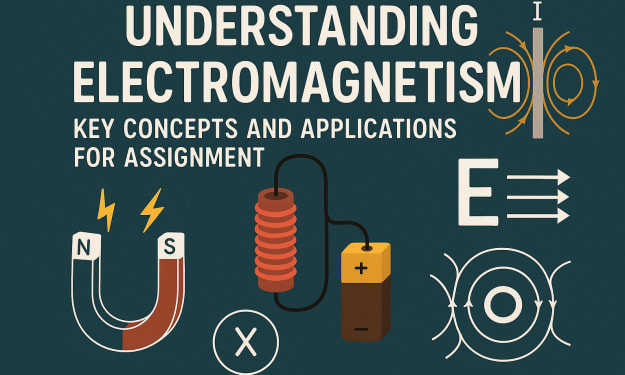
Understanding Electromagnetism: Key Concepts and Applications for Assignment
Electromagnetism is a funny-sounding name, but it is a really useful branch of physics. It lights your house, drives electric motors, and even makes your cell phone possible. When you learn about circuits, wireless transmissions, or MRI machines, you are relying on concepts in electromagnetic theory. Although the name is heavy, it relates to the common technology you use daily.
By Emma Green5 months ago in Education
MAA 204 – Accounting Information Systems and Data Analytics: Notes & Solutions
Studying MAA 204 – Accounting Information Systems and Data Analytics can feel overwhelming at first. The subject combines accounting principles with information systems and modern data analytics, requiring students to manage both technical and theoretical concepts. From learning how Enterprise Resource Planning (ERP) systems streamline business processes to mastering data visualization tools, this unit is packed with practical knowledge.
By Shani Pandey5 months ago in Education
Top 12 Common Study Mistakes and How to Avoid Them. AI-Generated.
Top 12 Common Study Mistakes and How to Avoid Them Learn the top 12 common study mistakes students make and how you can practically avoid them. It is easier than you think to increase your focus, memory and results with these simple study tips.
By Daily Blend5 months ago in Education
How Reliable Is Assignment Helper Malaysia for Long-Term Support?
With growing demand, platforms offering assignment help have multiplied. Yet, not all services can provide consistent, high-quality, and long-term academic support. This post dives into what makes Assignment Helper Malaysia stand out, its essential features, and why students rely on it for extended academic assistance.
By Andersan Smith5 months ago in Education
Artificial Intelligence: Unlocking the Future of Human Innovation
Artificial Intelligence (AI) is one of the most transformative innovations of the modern era. From voice assistants in smartphones to advanced medical systems, AI is rapidly becoming part of our daily lives. But what exactly is AI, and why is it considered such a powerful force in shaping the future? This article explores the concept of AI, its applications, benefits, challenges, and what lies ahead. What is Artificial Intelligence? Artificial Intelligence refers to the ability of machines to perform tasks that normally require human intelligence. These tasks include problem-solving, decision-making, understanding language, recognizing patterns, and even learning from experience. Unlike traditional computer programs that follow fixed instructions, AI systems are designed to adapt and improve over time. There are two main types of AI: 1. Narrow AI – designed for specific tasks, such as search engines, translation tools, or chatbots. 2. General AI – a theoretical form of AI that could perform any intellectual task like a human. This type is still in research and does not exist yet. How AI Works AI systems rely on a combination of algorithms, data, and computing power. Machine Learning (ML), a subset of AI, allows machines to learn patterns from large datasets without being explicitly programmed. Deep Learning, which uses artificial neural networks, has made remarkable progress in areas like image recognition and speech processing. For example, when you type a message on your phone and predictive text suggests the next word, that’s AI at work. Similarly, when streaming platforms recommend movies or shows, they are using AI to analyze your preferences. Applications of AI AI is already being used in countless industries: Healthcare – AI assists in diagnosing diseases, analyzing medical scans, and even predicting patient risks. Education – Personalized learning platforms help students learn at their own pace. Business – Companies use AI for customer service chatbots, fraud detection, and data analysis. Transportation – Self-driving cars are being developed using AI technologies to improve road safety. Agriculture – AI-driven machines help farmers monitor crops, detect pests, and improve yield. Daily Life – From smart home devices to digital assistants like Siri or Alexa, AI is everywhere. Benefits of AI The benefits of AI are vast and undeniable. It improves efficiency, reduces human error, and saves time. In healthcare, AI can help doctors detect diseases early, potentially saving lives. In business, AI helps organizations make smarter decisions by analyzing huge amounts of data. For individuals, AI makes daily tasks more convenient and accessible. AI also has the potential to create new job opportunities in fields like data science, AI development, and robotics engineering. Just as previous technologies created new industries, AI is expected to do the same. Challenges and Concerns Despite its advantages, AI also presents challenges: Job Displacement – Some worry that automation could replace human workers in certain industries. Bias in AI – If AI is trained on biased data, it can produce unfair results. Privacy Issues – AI systems that process personal data raise concerns about how that information is used. Dependence on Technology – Relying too much on AI may reduce critical thinking and problem-solving skills in humans. Addressing these challenges requires careful regulation, ethical guidelines, and transparency in AI development. The Future of AI The future of AI is both exciting and uncertain. Researchers are working on making AI systems more reliable, ethical, and beneficial for society. We can expect AI to play a larger role in healthcare, education, business, and even space exploration. While some fear that AI could one day surpass human intelligence, most experts believe that with proper rules and safeguards, AI can be a powerful partner in building a better future. Conclusion Artificial Intelligence is more than just a technological trend; it is a revolution shaping how we live, work, and think. While it brings incredible opportunities, it also raises important questions about ethics, privacy, and human responsibility. The key is to use AI wisely—to enhance human potential, not replace it. If developed responsibly, AI has the power to make the world smarter, safer, and more connected.
By Javed Khan 5 months ago in Education