
The Bicycle Repairman
How one man’s quiet kindness kept a community moving

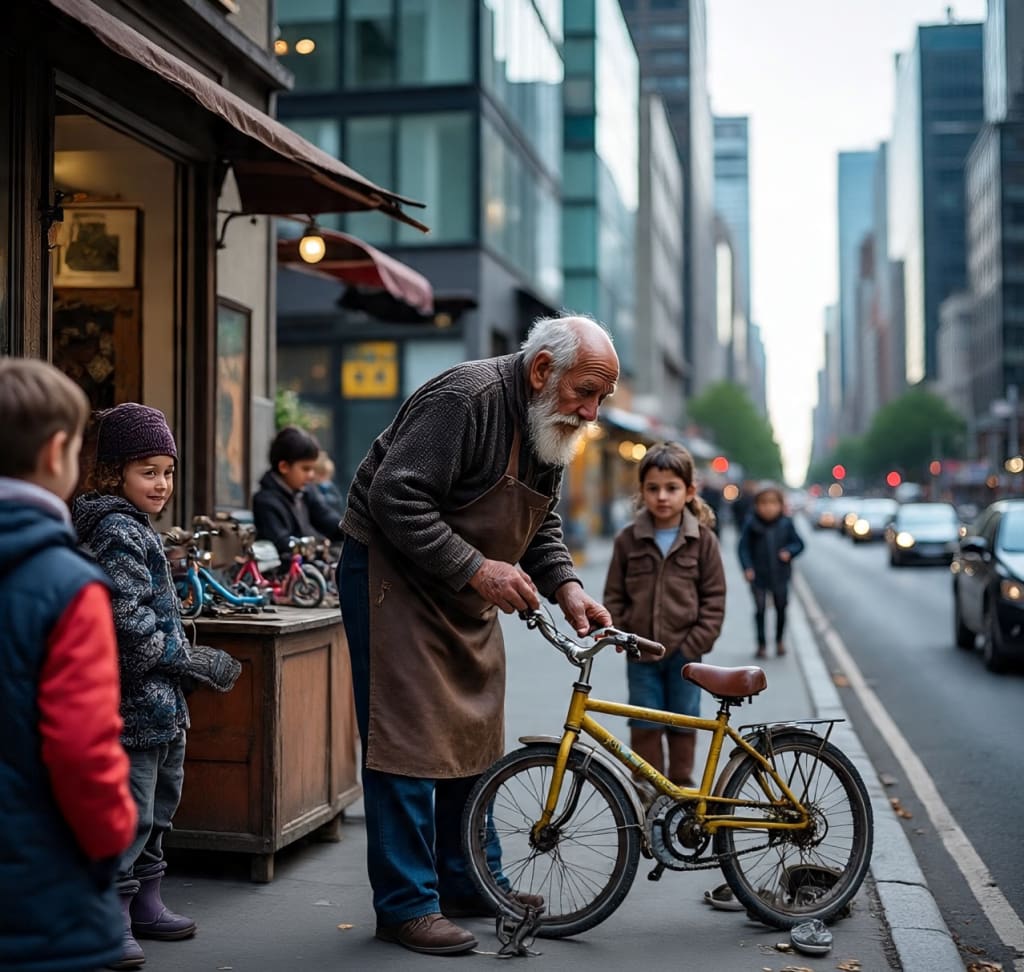
In the middle of a busy neighborhood, tucked between a corner grocery shop and a tiny tea stall, stood a shed barely wide enough to fit a bicycle. Its faded sign read: “Repairs Done Here.” Most people hardly noticed it anymore. They walked past it on their way to bigger shops, louder markets, or shinier workshops that promised “quick service” for the right price.
But the children noticed.
Every afternoon, as school ended and the streets filled with the chatter of students heading home, the shed came alive. Kids would roll in with rusty chains, bent pedals, and squeaky wheels. And there, always waiting, was Mr. Rahman—the old man with gentle eyes, oil-stained hands, and the warmest smile in the whole block.
Mr. Rahman had been repairing bicycles for decades. At first, it was his profession; later, it became his way of giving back. He refused payment from children. “Your laughter is enough,” he would say, patting their shoulders. For adults, he charged only what they could afford, often less than the cost of tea.
People often asked him why he never raised his prices. After all, the city had changed, prices of everything had doubled, but his rates stayed the same. Mr. Rahman would just shrug. “Bicycles carried me through my life,” he’d say. “Helping others ride freely is my thanks.”
The Overlooked Helper
For most adults, he was simply the bicycle repairman—someone they nodded at politely but rarely thought about. Some considered his little shed outdated in a world rushing toward cars and motorcycles. But for the children, he was a magician.
When little Ayaan’s tire burst the day before the school cycling race, Mr. Rahman worked long after sunset to patch it up. When Sara’s chain broke halfway to school, he cycled her the rest of the way on his own bike and fixed hers by evening. To the kids, his kindness wasn’t just service—it was love.
The Festival Crisis
One year, just before the spring festival, the neighborhood buzzed with excitement. Shops decorated their windows, families planned meals, and children polished their bicycles, eager to ride in the annual parade. The parade had always been led by children on bikes, a tradition symbolizing freedom and joy.
But that year, disaster struck.
Two days before the festival, the delivery service that transported decorations, food, and supplies around the neighborhood suddenly broke down. The small trucks and vans couldn’t make it through the narrow streets blocked by construction. Panic spread. How would the festival happen without supplies?
That evening, a group of worried organizers sat by the tea stall, discussing alternatives. Mr. Rahman listened quietly from his shed. Finally, he stood, wiping grease from his hands.
“Why not use bicycles?” he suggested.
The men laughed at first. “Carry festival supplies on bicycles? Impossible.”
But Mr. Rahman only smiled. “Not impossible. Strong bicycles can carry a lot with the right baskets. And you have dozens of children eager to ride.”
The idea seemed absurd, yet when word spread to the children, their eyes lit up. They rushed to Mr. Rahman’s shed, begging him to prepare their bikes. “We can do it, Uncle Rahman!” they shouted.
And so, through the night and the next day, Mr. Rahman worked tirelessly. He fixed broken brakes, oiled rusty chains, tightened loose screws, and even attached makeshift baskets to handlebars and racks. His shed became the beating heart of the neighborhood. Parents watched in awe as the old man, hunched but determined, transformed every bike into a small delivery vehicle.
The Parade of Wheels
On the morning of the festival, instead of vans, dozens of children pedaled proudly through the streets, carrying colorful boxes, flowers, and decorations on their bicycles. Adults cheered from doorways, amazed at the sight. What had seemed like a crisis became the most memorable parade in years.
People no longer overlooked the bicycle repairman. They saw how his quiet devotion had saved their tradition. For once, Mr. Rahman wasn’t just the man in the shed—he was the heart of the festival.
More Than Repairs
In the weeks that followed, neighbors began to stop by his shed not only for repairs but to offer thanks, tea, or simply conversation. Some parents brought extra tools, some donated paint to freshen the sign, and one local artist even painted a mural of children riding bicycles with Mr. Rahman at the center.
But Mr. Rahman remained as humble as ever. When praised, he would chuckle softly. “I didn’t save the festival,” he said. “The children did. I only fixed their wheels.”
Yet everyone knew it wasn’t just wheels he had fixed. He had repaired something much greater: the community’s sense of unity.
Legacy on Two Wheels
As years passed, children grew up, traded bicycles for motorbikes or cars, and moved on to different lives. But whenever they returned to the neighborhood, they always stopped at the little shed. Some brought their own children, introducing them to the man who once patched their tires and lifted their spirits.
One evening, long after the festival had become a cherished memory, a now-grown Ayaan visited Mr. Rahman. “Uncle,” he said, “I still remember the night before that race, when you fixed my bike even though you were tired. I won because of you. And I learned something too—that helping others, no matter how small, can change everything.”
Mr. Rahman’s eyes glistened, and his smile deepened. “That’s all I ever wanted to teach,” he whispered.
The shed remained small, the sign still faded, and the world outside still rushed forward. But inside that tiny corner of the neighborhood, the Bicycle Repairman’s quiet kindness continued to echo—proof that sometimes, the simplest acts leave the deepest marks
About the Creator
Keep reading
More stories from arsalan ahmad and writers in Education and other communities.
The Stranger’s Smile
The train was unusually crowded that Monday morning. Commuters packed into every carriage, holding on to metal poles, reading newspapers, or scrolling through their phones with blank, tired expressions. The air felt heavy, not just from the heat of so many bodies squeezed together, but from the invisible weight of people dragging themselves toward another long week.
By arsalan ahmad7 months ago in Education
Financially Ready for Retirement: Smart Planning Tips for a Stress-Free Future
Retirement is often viewed as a time to relax, pursue personal passions, and spend more time with family and friends. However, achieving a comfortable retirement requires careful financial planning long before your working years end. Without preparation, many individuals may struggle to maintain their lifestyle or cover essential expenses after leaving the workforce.
By Michael Petruskaa day ago in Education
Understanding Scaling with Quality Control
Business growth is often seen as a positive milestone that reflects increasing demand, improved market presence, and stronger financial performance. However, growth also introduces operational complexity. When companies expand production, services, or geographic reach, maintaining consistent standards becomes more challenging. For this reason, organizations must focus on effective scaling with quality control measures to ensure that expansion does not reduce reliability or customer satisfaction.
By Devin Doyle of Newport Beachabout an hour ago in Education
Thief In The Night
To the thief in the night that took and replicated what once was mine: Honestly, I feel kind of bad for you. It’s funny, because we hardly know each other. I only know of you through the magazines you’ve written and the broadcasts you have televised in the past — as well as through the public mentions of you from your show business connections there.
By Snarky Lisa6 days ago in Humans




Comments
There are no comments for this story
Be the first to respond and start the conversation.