student
From balancing your course load to forging relationships with classmates to extracurricular involvement, these are the tried and true methods to nail your career as a student.
Determining the Age of the Universe: A Cosmic Journey
The Big Bang Theory At the core of our understanding of the universe's age is the Big Bang theory, which posits that the universe originated from an extremely hot and dense state around 13.8 billion years ago. This theory provides a framework for interpreting various astronomical observations. By studying the evolution of the universe since that initial event, scientists can estimate its age.
By shahkar jalal2 months ago in Education
Homework is Weighing Down Children
Homework is like a see-saw. The more a student has on their to-do list, the more it is going to weigh on their stress levels. The less they balance, less stress will increase. Katelyn Patterson, journalist, when providing basic information on homework, finds that “Homework, in practice, is a chance for students to work through lessons and make sure that they comprehend what is being taught in class. However, in most situations, all it tends to do is add stress and result in resentment for learning” (Homework Isn't Helpful...).
By Katherine Roteman3 months ago in Education
The Future of Learning: How AI is Changing Education
Introduction: The Rise of AI in Education Artificial intelligence (AI) is already a huge disruptor in so many sectors, from healthcare to finance to entertainment. But perhaps the most dramatic place where AI is just beginning to leave its mark is in education. What was once science fiction is now a normal part of the classroom experience, shaping how students learn and how teachers teach.
By The Chaos Cabinet3 months ago in Education
Journey Beyond the Classroom
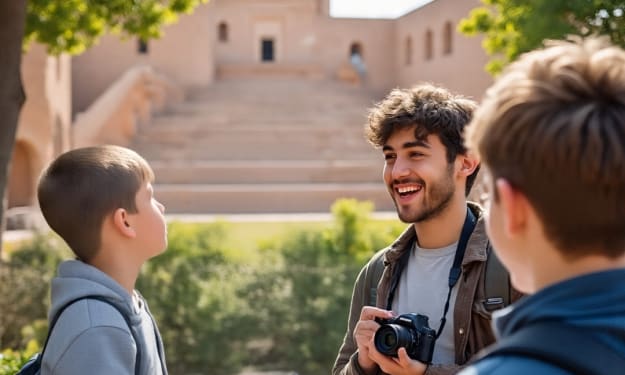
It was a bright morning filled with excitement and anticipation. The air buzzed with chatter as students gathered near the school gate, ready to begin their long-awaited study tour. Bags were packed, cameras were charged, and hearts were full of curiosity. For many, it was their first journey away from the familiar walls of the classroom — a chance to learn through experience rather than from books. Our destination was the ancient city of Lahore, a place rich with history, architecture, and culture. The bus ride began with laughter and songs echoing through the air. Teachers smiled as students shared snacks, took pictures, and admired the passing scenery. Slowly, the concrete city faded away, replaced by green fields and distant mountains. It felt as if we were traveling not just through space, but through time itself — leaving behind the routine of school to explore the world beyond. Our first stop was the Lahore Museum, often called the “treasure house of history.” As we stepped inside, we were greeted by rows of artifacts, each telling its own story. The ancient coins, sculptures, and paintings revealed the artistic beauty and cultural depth of our ancestors. Our history teacher guided us through each section, explaining how these relics connected to what we had studied in our textbooks. But this time, the learning was different — it was alive. We could see, touch, and feel the things that once existed only in our imagination. Next, we visited the Badshahi Mosque, one of the grandest architectural wonders of Mughal times. Standing beneath its massive domes, we felt both small and inspired. The fine carvings on the red sandstone walls glowed warmly under the sun, reflecting centuries of craftsmanship. Our teacher spoke softly about the Mughal emperors, their vision, and their love for art and architecture. As the call to prayer echoed through the courtyard, a deep sense of peace and respect filled our hearts. After lunch, we went to the Shalimar Gardens, a masterpiece of symmetry and beauty. The sound of flowing water, the fragrance of blooming flowers, and the sight of ancient fountains created an atmosphere of calm and wonder. Students sketched, took photos, and noted down their observations for later reports. Some of us even sat under the shade of old trees, discussing how nature and history blend together to form such timeless beauty. The next day, our study tour continued with a visit to a science museum. The experience was completely different but equally fascinating. We interacted with models of planets, human anatomy, and machines. There were hands-on exhibits that allowed us to experiment and understand how things worked. For the first time, many of us realized that science is not just about formulas — it’s about discovery. Learning through experience made even the most complex ideas seem simple and exciting. Throughout the trip, our teachers encouraged us to observe, ask questions, and connect what we saw to what we had learned. Every evening, we gathered together for short reflection sessions. Students shared what inspired them most during the day — some spoke about the history, others about the science, and a few about the bonds of friendship that had grown stronger during the journey. On the final day, before returning home, we visited the Wagah Border. The flag-lowering ceremony filled us with pride and emotion. The discipline, energy, and unity of the soldiers reminded us of the strength and spirit of our nation. It was a powerful lesson in patriotism that no classroom could ever teach. As the bus drove back toward our school, silence filled the air. Everyone seemed lost in thought, replaying memories of the trip. We had seen, learned, and felt so much in just a few days. The study tour had not only enriched our knowledge but also transformed the way we looked at learning. We realized that education is not confined to four walls or limited to exams. It’s a lifelong journey — one that involves seeing, questioning, and understanding the world around us. The laughter we shared, the lessons we learned, and the experiences we gained became treasures we would carry forever. When we finally reached our school, the same gates that once symbolized our starting point now felt like a return from a meaningful adventure. The study tour had ended, but its impact would continue for years to come — inspiring us to keep exploring, keep learning, and keep growing beyond the classroom.
By Muhammad Saad 3 months ago in Education
Must-Have Kali Linux Tools for Cybersecurity Specialists in 2026
Kali Linux is a popular platform among professionals working in ethical hacking and cybersecurity. With the global cybersecurity tools market estimated to rise to USD 208.05 billion in 2025 and potentially surpassing USD 450 billion by 2033 at a CAGR of 9.5%, the demand for efficient security tools has never been greater, as per Business Research Insights.
By Pradip Mohapatra3 months ago in Education
What Is the Edge of the Universe
The Observable Universe First, it’s essential to differentiate between the entire universe and the observable universe. The observable universe refers to the portion of the universe that we can see and study, limited by the finite speed of light and the age of the universe, approximately 13.8 billion years. This means that the farthest we can observe is about 46 billion light-years away, forming a sphere around us.As we look further into space, we see light that has traveled for billions of years, giving us a glimpse into the universe's history. However, this does not mean that we can see the "edge" of the universe; rather, it indicates a limit to our observations. Beyond this limit, the universe continues, potentially infinitely.
By shahkar jalal3 months ago in Education
AI is secretly changing your life faster than you realize
You might not notice it, but artificial intelligence is already part of your life. It works quietly in the background, learning from your habits, predicting your next move, and shaping the world around you. From the moment you wake up and check your phone, to the time you fall asleep scrolling through social media, AI is constantly at work.
By Wahdat Rauf3 months ago in Education
Was There Time Before the Big Bang?
Understanding the Big Bang The Big Bang theory is the leading explanation for the origin of the universe. It posits that approximately 13.8 billion years ago, the universe began as an incredibly hot, dense point and has been
By shahkar jalal3 months ago in Education
A Post-Viva Outcome – a Space in the Wilderness, a Scene of Destruction
The viva report for my PhD in Creative Writing, containing nine pages of suggested amendments, was an unanticipated and shocking outcome for both my Director of Studies and my Supervisor of historical content.
By Shelley Dootson-Greenland3 months ago in Education