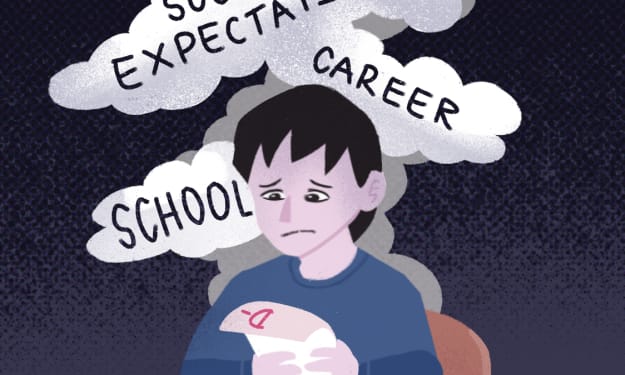
high school
High school made less stressful; a roundup of high school horror stories and tips on asking your date to prom, preparing for college and much more.
Unveiling the Complexity of Humans: Exploring the Wonders of Humanity
Introduction: Humans, the remarkable species that dominate the planet, are a complex and fascinating subject of study. From our intricate biology to our intricate emotions, our history, achievements, and potential, humans embody a vast range of characteristics that set us apart. In this comprehensive article, we will delve into the multifaceted nature of humans, exploring our biology, psychology, society, and the incredible capacity for growth and change that defines us.
By AHMED BUTT3 years ago in Education
Homer Lane: Experimental Educator
Experiments with children All childhood education is a form of experimentation. Teaching objectives, measurements and syllabi change change almost every year, but do we know what really works well, do we put enough effort into developing the ideal educational plan for each individual child?
By James Marinero3 years ago in Education
Apache helicopter
The Apache helicopter, also known as the AH-64 Apache, is a twin-engine attack helicopter that was developed by McDonnell Douglas, now owned by Boeing, for the United States Army. The helicopter is used for a variety of missions, including close air support, reconnaissance, and anti-tank warfare.
By Mahendrarajah Mithusharan3 years ago in Education
Exploring Alice in Wonderland Syndrome: A Curious Twist of Perception
Introduction: In the realm of literature, Lewis Carroll's enchanting tale, "Alice's Adventures in Wonderland," has captivated readers for generations. Within the whimsical world of Wonderland, Alice encounters various peculiarities, one of which is Alice in Wonderland Syndrome (AIWS). This intriguing neurological condition distorts perception and challenges our understanding of reality. In this article, we will embark on a journey to understand AIWS, its symptoms, potential causes, and the impact it has on those who experience it.
By AHMED BUTT3 years ago in Education
Importance of Education
Over the years, man had lived lifestyles that are controversial. While some get themselves educated about a thing or the other, some lived to wallow in abject ignorance and allow themselves to be ruled and controlled by the educated. Living an educated life is essential to human beings, and that in recent years, going to colleges has been a thing of joy for the populace. A college is a beautiful place for students to experience.
By Maruf Ademola Muslim3 years ago in Education
How Asian American Students Can Stand Out in the Competitive College Application Process
As an Asian American student, you may feel the pressure to excel academically, participate in extracurricular activities, and demonstrate leadership skills in order to stand out during the college application process. With so many applicants vying for limited spots at top universities, it's important to showcase your unique qualities and experiences in order to distinguish yourself from the competition. Here are some expert tips to help you stand out during the college application process:
By Robbie Shanky3 years ago in Education
Medicine
There is a problem with medicine. I'm missing something. This means that not only is it more difficult to find the cause of some diseases and find effective ways to treat them, some diseases are overlooked entirely. You may be the one missing, but we'll get to that in a moment. Because it's a story first. 8 billion stories to be exact. Indeed, our DNA is our body's instruction manual. But it is also a history book that chronicles our own unique genetic history. Our story all begins about 300,000 years ago when humans emerged in Africa. Some genetic stories tell of leaving for Europe, East Asia, or the Americas after hundreds of thousands of years. Some hereditary stories tell of the expansion of empires. Other diseases are diseases that we have evolved to prevent, and other diseases are the simple act of settling down and raising cows and drinking their milk. Each of us has a different genetic history, but perhaps not as different as you might expect. We share 99.9% of each other's DNA. Our story is 99.9% identical to her, but that 0.1% difference in her is incredibly powerful. This small difference in our genetic history has the potential to develop better treatments for disease, treatments that work for everyone. But medicine is not currently reading all these stories. To illustrate this, I would like to describe how researchers study the causes of disease and develop and test the efficacy and safety of new treatments. To figure out what causes a particular disease, researchers look for large numbers of people suffering from that disease and comb through their genetic histories. They look for small variations they share, small parts of the DNA story written differently. If they find something they will try all sorts of ways to deal with the effects. And when we find something that looks promising, we run clinical trials to see if it's real. In Phase 1, a small group of volunteers will attempt treatment. Well, often only half of them work and the other half get a placebo that doesn't work at all. If there are no significant side effects at the target dose, the treatment is approved and can proceed to the next stage of clinical trials. The second phase, this time with more participants, all suffer from ailments the researchers hope the drug can treat. If the drug seems to work, move on to Phase 3, where more participants will try the drug longer. Only then will new treatments be reviewed and hopefully approved for use by our general public. However, there is a problem with that. Here is the ethnicity of so many people that these days are used to find the cause of various diseases. And it can be compared with the ethnic diversity of the world's population. See the difference? The genetic histories investigated by researchers skew heavily toward those of people of European descent. This is because reading stories of people of mostly European descent in search of the causative pieces of DNA to target diseases for new drugs misses key parts of the stories told by various other groups. It means that there is a possibility. For example, it can change the risk of a disease or even reveal how the disease develops. For example, if scientists had only studied the stories of people of European descent, they might not have discovered the mutation that causes sickle cell aneFrom the early stages of research, the drug development process, to clinical studies. The good news is that more and more people are thinking about it. For example, cancer researchers at University College London studying genetic markers for cancer analyzed tissue samples from a wide range of ethnicities to ensure that the cancer biomarkers they identified were relevant to people of as many ethnicities as possible. I want to Conclusion:
By finky perly3 years ago in Education
Cultivating Life Skills in Students
Introduction Life skills are essential competencies that help students navigate the challenges of daily life and prepare them for future success. These skills encompass a wide range of abilities, including communication, problem-solving, decision-making, and emotional intelligence. In this article, we will explore practical tips and techniques for developing life skills in students, equipping them with the tools they need to thrive both in and out of the classroom.
By Mashhud Usman3 years ago in Education
The Key Ingredients of Holistic Child Development
Introduction Holistic child development focuses on nurturing the whole child, encompassing their physical, emotional, social, cognitive, and spiritual growth. This approach aims to create well-rounded individuals who are equipped to thrive in all aspects of life. In this article, we will explore the key ingredients of holistic child development, providing a comprehensive framework for parents, educators, and caregivers to support the growth and well-being of children.
By Mashhud Usman3 years ago in Education
Enhancing Memory Domains in Children
Introduction A strong memory is essential for children's academic success and overall cognitive development. By sharpening their memory domains, kids can better retain information, improve problem-solving skills, and excel in various aspects of life. In this article, we will explore effective techniques and tips for enhancing memory domains in children, providing them with the tools they need to succeed both in and out of the classroom.
By Mashhud Usman3 years ago in Education