
Ranking in 2025: What SEO Looks Like in the Age of AI
From keywords to context: How to make traditional SEO work in the new search experience


Search has changed—again.
But this time, it’s not just another algorithm update. The rise of artificial intelligence (AI) in search engines is creating a completely different experience for users—and a new challenge for businesses.
AI-generated summaries, like Google’s AI Overviews, are now showing answers directly at the top of search results, often before any website link is even visible. Add to that the use of Featured Snippets, voice search, and personalized results, and it’s clear: the way people find and interact with content is evolving fast.
So, what does this mean for SEO? Is it still relevant? Does it still work? And if so—what actually matters now?
Let’s break it down.
The Evolution of SEO in the Age of AI
SEO isn’t dead—but it’s definitely different.
While traditional tactics like keyword stuffing and chasing exact-match domains have faded, the core of SEO is still very much alive. What’s changed is how search engines process and deliver content.
Instead of relying only on keywords and backlinks, search engines now use AI models to interpret meaning, context, and intent. Tools like AI Overviews and Generative Summaries analyze data across the web to give users instant answers—often without them needing to click a single result.
At the same time, search engines like Google are drawing more heavily from structured content that can be featured in rich results or Featured Snippets. This means your content has to be not just optimized, but also well-organized, useful, and structured in a way AI can easily understand.
It’s no longer just about ranking #1. It’s about earning visibility inside the answer boxes, summaries, and other dynamic elements AI-powered search now relies on.
Understanding the AI-Driven Search Landscape
The way people search online is no longer just about typing keywords and clicking on links. AI-powered search has brought a deeper layer of interpretation and personalization to the search process. Instead of scrolling through multiple links, users are now presented with AI-generated answers right at the top of the page. Answers are summarized, contextual, and often requiring zero clicks.
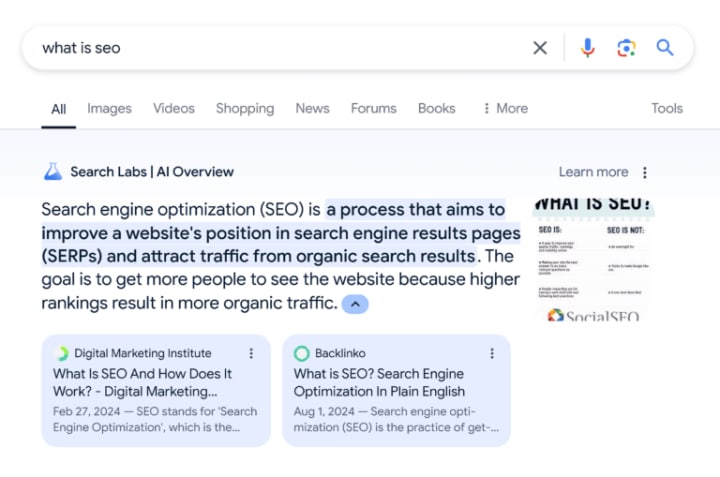
At the center of this shift are large language models (LLMs) — AI systems trained on huge amounts of data to understand how people speak, what they mean, and the context behind their questions. They don’t just look for keywords. They figure out what the user is really asking, even if it’s not said directly. For example, if someone searches “best no-code tools for SEO,” AI might pull insights from many articles, highlight the most mentioned tools, compare features, and suggest the best options.
Generative AI like Google’s Gemini or OpenAI’s GPT models are built on SOTA (state-of-the-art) transformer technology. This helps them understand how words connect, what users like, and how they search. Older systems like RankBrain and BERT started this process, helping Google handle more complex searches. But today’s AI goes even further — supporting multimodal search, which includes voice, images, and video, not just text.
Personalization plays a big role too. AI looks at things like your past searches, clicks, location, and device to show results that fit your habits. Most people don’t even notice this, but it shapes nearly every search result.
And it’s not just Google anymore. People are searching directly on tools like ChatGPT, YouTube, and Amazon. They ask for answers, advice, or product picks — straight from AI. That means your content needs to be well-written, clear, and structured in a way that both search engines and AI tools can understand and use.
Core SEO Principles That Still Matter
Even with all the changes AI brings to search, the core of SEO hasn’t gone away. In fact, it matters just as much—if not more—than before. Here are the key pillars that still drive results:
High-Quality Content
You’ve probably heard the phrase “Content is king.” That still holds true. Google—and AI systems—prefer content that’s informative, relevant, and up-to-date. Your pages should actually answer what people are searching for, in a clear, engaging way. Well-structured, helpful content that matches user intent is what gets picked up by both search engines and AI tools.
Authoritative Backlinks
High-quality backlinks from trusted, high-authority websites are still one of the strongest ranking signals. Think of them as endorsements: if credible sites link to your content, it tells Google that your page is valuable. A strong backlink profile helps boost domain authority and puts your content in a better position to rank higher.
Technical SEO
Good content won’t go far if your site’s a mess under the hood. Technical SEO means your site loads quickly, works well on mobile, and is easy for search engines to crawl. Google now indexes mobile versions first, so mobile-friendliness and speed aren’t optional—they’re critical.
Keyword Optimization
Using the right keywords helps search engines connect your content with what users are actually looking for. But it’s not just about stuffing words in. It’s about placing relevant terms naturally in your titles, headings, and throughout your content so that it aligns with the user’s search intent. That’s what helps Google understand what your page is about and when to show it.
Adapting Your SEO for the AI-Powered Search World
If you want your content to stay visible in this new AI-driven world, your SEO strategy needs a bit of an upgrade. Here's how to keep up:
Show real expertise and trust (E-E-A-T). Google and AI tools pay attention to who's writing the content. Build trust by sharing real experience, useful insights, and making sure your site looks reliable. People—and search engines—prefer sources they can trust.
Write with user intent in mind. Figure out what people actually want when they type a search. Are they comparing tools? Looking for a quick answer? Trying to buy something? Your content should answer the question behind the question.
Use a natural tone that sounds human. AI is good at understanding conversational language. So write the way people speak. Keep it clear, helpful, and natural—not robotic or overloaded with keywords.
Use structured data to help AI find your best stuff. Adding things like schema markup helps Google understand your content better. This is what powers featured snippets and AI summaries that show up at the top of search results.
Be thorough—go deep, not just wide. AI tools are looking for comprehensive answers, not surface-level fluff. So when you create content, cover related questions, add examples, and aim to be the go-to resource.
Think beyond just text. Search is no longer just typed queries. People search with images, voice, and video. Make sure your content includes visuals or media where it makes sense—and optimize it so search engines can find it.
Build a recognizable brand. Authority matters. When your brand is mentioned and linked from trusted sources, it boosts your credibility. Consistent, high-quality content helps people remember—and trust—you.
Stay flexible and keep learning. AI is evolving fast. The best thing you can do? Watch what's changing, test new ideas, and adjust your strategy as needed.
Final Thoughts
Search isn’t what it used to be—and that’s a good thing.
AI has made search faster, smarter, and more useful for users. But for businesses, it also means there’s more competition for visibility—and fewer clicks to go around.
That’s why now is the time to double down on what truly works: content that answers real questions, links that show trust, and a site that’s built right from the ground up.
The tools may have changed, but the goal hasn’t. Help people find what they need, and search engines—AI or not—will reward you for it.
About the Creator
Jelena Smiljkovic
SEO strategist and content writer, combining over 13 years of web development experience with a focus on content strategy, SEO growth, and digital marketing.
Keep reading
More stories from Jelena Smiljkovic and writers in Education and other communities.
Why the Next Generation Will Learn With AI Coaches
Ten years ago, if you wanted to improve at something - public speaking, writing, interviews - you needed a person. A teacher, a mentor, a friend who’d sit through your awkward practice run and give feedback. Today, your laptop or phone can do most of that. It listens, watches, analyzes, and tells you exactly what to fix.
By Jelena Smiljkovic3 months ago in Education
Most Sales Deals Fail Because Sellers Talk to the Wrong People
There is a quiet reason many sales conversations feel productive but go nowhere. Everyone leaves the call optimistic. Emails move back and forth. Documents get shared. Then momentum fades. Weeks pass. The deal stalls without a clear explanation.
By Armi Ponsica6 days ago in Education



Comments
There are no comments for this story
Be the first to respond and start the conversation.