
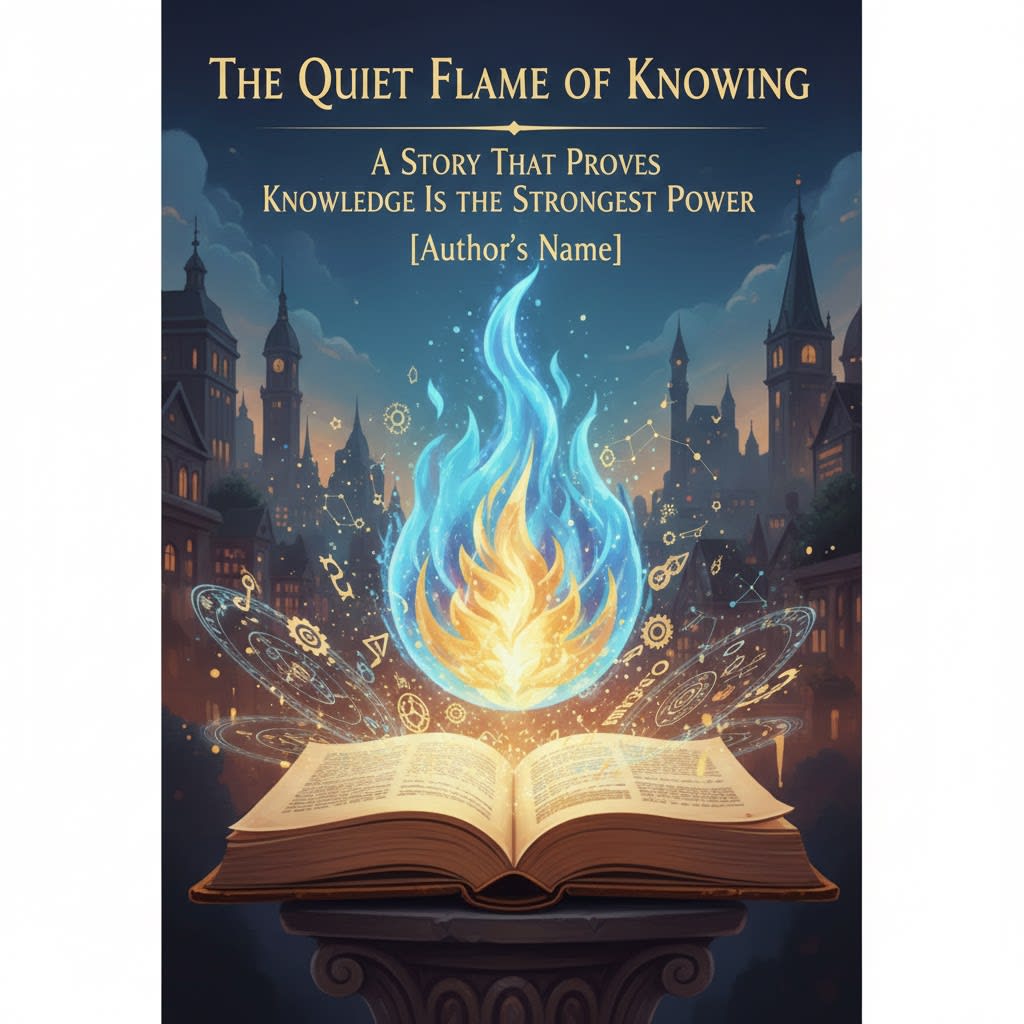
The Quiet Flame of Knowing
A Story That Proves Knowledge Is the Strongest Power

In a small town tucked between dusty hills and a narrow river, there lived a boy named Aarin. The town was not poor in land or people, but it was poor in questions. Life there moved like an old wheel—turning every day in the same direction, creaking but familiar. Children grew into adults, adults grew into elders, and most people believed that this was all life could ever be.
Aarin was different.
From the time he could speak, he asked questions that made people pause. Why does the river never run dry? Why do stars not fall? Why do some people rule while others obey? His mother smiled at his curiosity, though she often worried. “Too many questions can make life harder,” she would say gently, stroking his hair. His father, a carpenter, would simply laugh. “Let the boy ask,” he said. “Wood breaks if you force it, but it becomes strong if you understand it.”
There was only one small school in the town, with cracked walls and a roof that leaked during the rains. The teacher, an old man named Master Eron, had tired eyes but a sharp mind. He noticed Aarin immediately—not because the boy spoke the loudest, but because he listened the deepest. When others waited for lessons to end, Aarin waited for ideas to begin.
One evening, after class, Master Eron handed Aarin a thin, worn book. Its pages smelled of dust and time.
“Read this,” the teacher said. “Not to pass exams, not to impress anyone—but to understand.”
Aarin opened the book that night by the dim light of an oil lamp. Words unfolded like doors. He learned about numbers that could measure the sky, about history that warned the future, about science that explained the invisible, and about stories that carried wisdom across generations. Each page lit a small flame inside him.
As years passed, the town remained unchanged, but Aarin did not. Knowledge sharpened his thinking and softened his arrogance. He learned that power was not shouting louder, nor raising fists, nor commanding fear. Power was knowing why things were the way they were—and how they could be different.
One summer, a severe drought struck the town. The river that had always flowed obediently shrank into a thin, struggling line. Crops failed. Tempers rose. The town leader, a strong man named Borun, ordered people to ration water unfairly, keeping more for those loyal to him. Fear spread faster than hunger.
The people grumbled but obeyed. They had always obeyed.
Aarin did not.
He studied old records in the school, maps forgotten in dusty chests, and books Master Eron had hidden away for years. He discovered something important: beneath the hills lay underground water channels—ancient, natural paths that could be accessed with the right knowledge and effort.
Aarin went to Borun and spoke calmly. “There is another way,” he said. “We can bring water back if we work together.”
Borun laughed. “You are young and weak,” he said. “Power belongs to those who command, not those who read.”
Aarin did not argue. He went to the people instead. He explained patiently, using simple words, showing maps, answering questions. At first, they doubted him. No one had ever explained things to them before. But knowledge has a quiet strength—it convinces without force.
Slowly, people listened.
They worked together, digging where Aarin guided them, trusting what they could finally understand. Days later, water burst from the earth. Not a miracle, but something better—proof.
The town changed that day.
Borun’s power faded, not because he was defeated by violence, but because he was defeated by understanding. The people no longer feared him. They had learned.
Master Eron watched silently as the town rebuilt itself—not just its fields, but its thinking. Schools expanded. Books were shared. Children were encouraged to ask questions. Knowledge spread like light at dawn, touching everything.
Aarin never called himself a leader. He became a teacher.
Years later, when children asked him what power truly was, he smiled and said, “Power is not what you hold over others. Power is what you unlock within yourself. Knowledge does not rule—it frees.”
And the town that once lived in silence became a place where questions were welcomed, minds were sharpened, and strength was measured not by fists, but by understanding.
Because knowledge, once ignited, is a flame no darkness can defeat.
About the Creator
VFX in Education Market to Reach USD 6.9 Bn by 2034, Driven by Immersive Learning Demand
Introduction The VFX in education market refers to the integration of visual effects technologies into formal and informal learning environments. It encompasses tools, software, and course content that use visual effects to create realistic simulations, animated visualizations, and interactive learning aids. These elements are designed to help students grasp complex concepts more easily and support educators in delivering engaging lessons.
By Roberto Crum6 days ago in Education
Winning the Deal: Sports-Inspired Strategies That Can Transform Lending Negotiations
Strategy is a powerful element in both sports and business. Baseball and football, two of the most strategy-driven sports in the world, demonstrate how preparation, teamwork, and smart decision-making can determine the outcome of a competition. Coaches carefully analyze opponents, players study patterns, and teams constantly adjust their tactics during a game. These same principles can be applied to financial negotiations, particularly in the lending industry.
By James Cretella2 days ago in Education
Unofficial Challenge: Black History Celebration
Forward: February 28th, 10:53 PM, EST... The final hour of Black History Month, 2026. Hello fellow writers. I've had this challenge waiting in my drafts for most of the month. But I held off on publishing it, until now.
By Sam Spinelli7 days ago in Writers


Comments
There are no comments for this story
Be the first to respond and start the conversation.