
Hunting for Alien Life: The Search for Atmospheric Biosignatures on Distant Worlds
Space

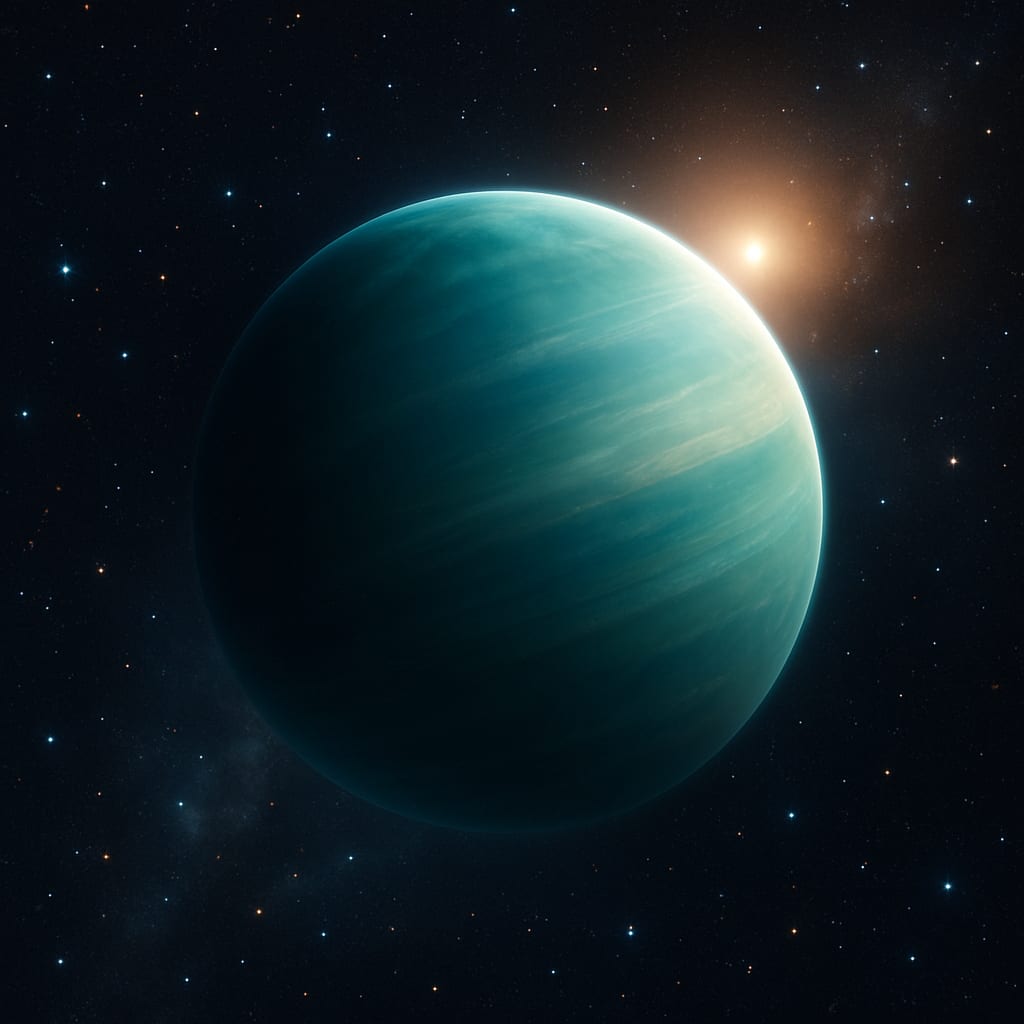
Just a few decades ago, the idea of planets orbiting other stars lived mostly in science fiction. Today, astronomers have confirmed more than five thousand exoplanets—burning-hot gas giants, frozen mini-Neptunes, super-Earths cloaked in clouds, and even rocky worlds that remind us of home. Yet the true holy grail remains undiscovered: evidence of life beyond Earth.
The most promising path to that discovery is not landing on distant surfaces or capturing breathtaking alien landscapes. Instead, it is far more subtle and elegant: reading the chemistry of a planet’s atmosphere. Certain gases, called biosignatures, can reveal whether a world hosts ongoing biological activity. Among the most important of these are oxygen (O₂), methane (CH₄), and ozone (O₃)—a trio that may one day let us answer humanity’s oldest question: Are we alone?
Why Atmospheres Hold the Key
When we observe a distant planet, we cannot simply zoom in and take a direct look at oceans, forests, or bacteria. Even the most advanced telescopes see only tiny points of light. However, as a planet passes in front of its star, starlight filters through its atmosphere. Molecules in that atmosphere absorb specific wavelengths of light, leaving distinct patterns—spectral fingerprints—that astronomers can analyze.
This technique, called transit spectroscopy, allows scientists to decode atmospheric chemistry from light alone. It was through spectral fingerprints that we first identified methane on Mars and ozone in Earth’s own atmosphere. Now, we are applying the same method to worlds dozens or hundreds of light-years away.
The Three Major Biosignatures
1. Oxygen (O₂): The Breath of Photosynthesis
On Earth, molecular oxygen is almost entirely biological. It is continuously produced by photosynthetic organisms—plants, algae, and bacteria. Without life, free oxygen would quickly react with minerals or volcanic gases and disappear.
So, if we detect abundant O₂ in an exoplanet’s atmosphere, it raises an eyebrow. However, nature has tricks: oxygen can also form through non-biological processes such as the breakdown of water (photolysis) on extremely dry planets. That means oxygen alone is suggestive, but not conclusive.
2. Methane (CH₄): A Short-Lived Signature
Methane is another gas with strong biological connections. On modern Earth, much of it comes from microbes, wetlands, and yes—cows. But unlike oxygen, methane is short-lived. It is easily destroyed by ultraviolet radiation. For a planet to maintain detectable methane, something must be constantly replenishing it. This is why CH₄ is a tantalizing clue. It could point to volcanism, but it could also point to life.
3. Ozone (O₃): A Loyal Companion
Ozone forms when ultraviolet light interacts with oxygen molecules. On Earth, the ozone layer protects life from harmful radiation. Detecting ozone on another planet would indirectly imply the presence of O₂, even if oxygen itself is harder to observe. O₃ acts like a loud, clear marker of an oxygen-rich environment.
The Ultimate Signal: Chemical Disequilibrium
The most convincing sign of life is not the presence of one gas, but the combination of certain gases that should not coexist for long periods without continuous replenishment. The most famous pair is:
O₂ + CH₄
On Earth, oxygen and methane are opposites in chemical terms. They react and cancel one another. If we ever discover a planet where these gases exist together in abundance, it would be extremely difficult to explain without biology. It would be the atmospheric equivalent of finding both a burning candle and a pile of fresh matchsticks—something must be actively sustaining the process.
How We Search Today
Today, astronomers have several methods at their disposal to search for biosignatures in exoplanet atmospheres.
- Transit spectroscopy analyzes starlight that passes through a planet’s atmosphere during a transit and is currently the most productive technique, used by telescopes like JWST and Hubble, with more advanced instruments planned for the future.
- Emission spectroscopy measures the planet’s own thermal glow and is particularly effective for studying hot, close-orbiting exoplanets.
- Finally, reflected-light spectroscopy examines starlight bouncing off a planet’s surface or clouds, a method that will be crucial for detecting Earth-like planets in the years to come.
The James Webb Space Telescope (JWST) is currently leading the effort, analyzing atmospheric chemistry in unprecedented detail. In the coming decades, next-generation observatories—such as the Habitable Worlds Observatory, LUVOIR, and massive 30–40-meter ground telescopes—will sharpen this vision further, potentially allowing direct detection of Earth-like atmospheres.
What Happens If We Find Biosignatures?
Imagine the announcement: “We have detected oxygen and methane in the atmosphere of an Earth-sized planet in the habitable zone.”
It would not prove intelligent life. It would not even prove complex life. But it would prove something monumental: life is not unique to Earth. The philosophical impact alone would be seismic, reshaping science, religion, art, and our place in the universe. Instead of wondering whether life exists elsewhere, we would begin asking how many worlds are alive? and what forms has life taken?
A New Age of Discovery
Every spectrum we capture is a message from another world. Most will be barren, hostile, or silent. But one day—perhaps soon—one spectrum will stand out, filled with the unmistakable signatures of a living planet.
The search for O₂, CH₄, and O₃ is more than chemistry. It is a search for cosmic company, for neighbors in the vast dark. And when we finally find them, it will mark a turning point in human history—on par with the discovery of fire, the invention of the telescope, or the first step on the Moon.
About the Creator
Keep reading
More stories from Holianyk Ihor and writers in Education and other communities.
Cataloging NEOs Down to 140 Meters: NASA and ESA’s New Planetary Defense Mission
Not long ago, the idea of defending Earth from an asteroid sounded like pure science fiction. It was something you’d expect from a Hollywood disaster movie, not a space agency budget proposal. But today, protecting our planet from near-Earth objects (NEOs) has become a serious, well-funded scientific priority. NASA and the European Space Agency (ESA) have now set a bold shared goal: to detect and catalog at least 90% of all NEOs that are 140 meters or larger. Simply put, they want to find nearly every space rock big enough to erase a major city from the map.
By Holianyk Ihor3 months ago in Education
Avoiding Common Counterfeit U.S. Coins: Expert Tips from Laura Bennett
Expert Guide to Spotting Fake U.S. Coins I’ve handled tens of thousands of coins in my career, and that moment of doubt—the gut feeling something isn’t right—is something every collector experiences. That feeling isn't a weakness; it's your best line of defense. This guide is your toolkit to turn that doubt into decisive action. I’ll share the same systematic approach I use to separate the real treasures from the clever fakes, so you can build your collection with confidence.
By Laura Bennett5 days ago in Education


Comments
There are no comments for this story
Be the first to respond and start the conversation.