
Avoiding Common Counterfeit U.S. Coins: Expert Tips from Laura Bennett
Don't get scammed. Learn from expert Laura Bennett how to identify counterfeit Morgan Dollars, Gold Eagles & more with our 5-step checklist. Essential reading for collectors & investors.

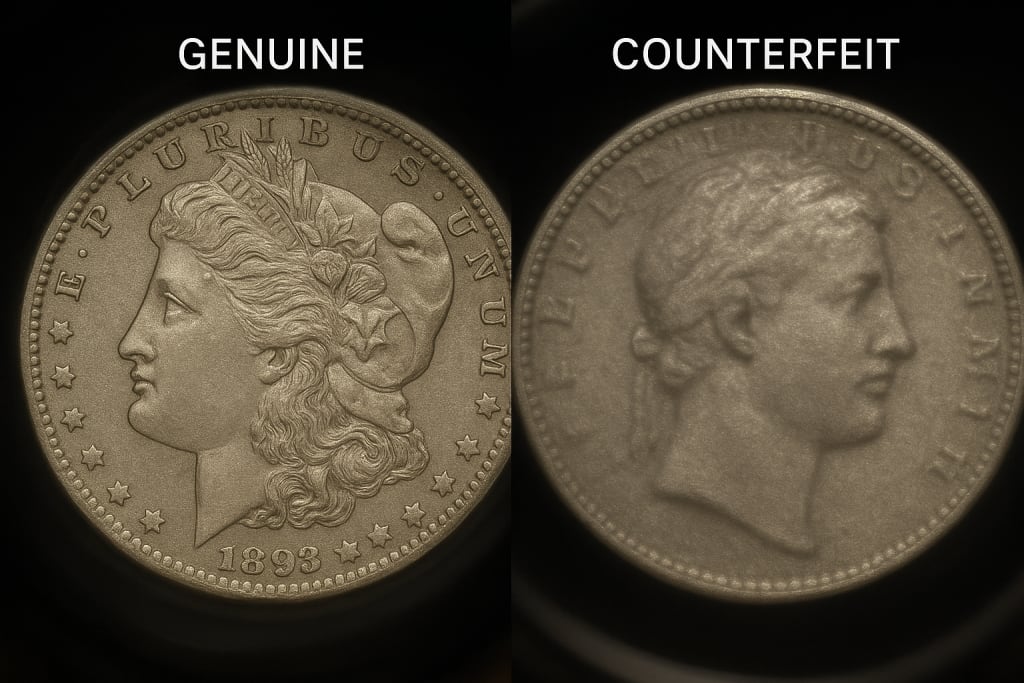
Expert Guide to Spotting Fake U.S. Coins
I’ve handled tens of thousands of coins in my career, and that moment of doubt—the gut feeling something isn’t right—is something every collector experiences. That feeling isn't a weakness; it's your best line of defense. This guide is your toolkit to turn that doubt into decisive action. I’ll share the same systematic approach I use to separate the real treasures from the clever fakes, so you can build your collection with confidence.
Know Your Enemy: The 4 Most Faked U.S. Coins
Fraudsters go where the money is. They target coins that are popular, valuable, or have a specific, rare date that collectors desperately want. Knowing what's on their hit list is your first strategic move.
Morgan & Peace Silver Dollars: Their size, silver content, and iconic status make them a permanent target. You’ll find everything from crude cast copies to scarily good struck fakes. Pay extra attention to the fine lines in Liberty’s hair and the eagle’s feathers.
American Gold & Silver Eagles: These modern bullion coins are faked for their raw metal value. Counterfeits often get the weight right but fail on the metallic composition or surface texture.
Key Date Mercury Dimes (Like the 1916-D): That tiny "D" mint mark is one of the most altered details in all of U.S. coinage. Scammers often add it to a common 1916 Philadelphia coin. Under magnification, you’ll see tooling marks or a font that just looks wrong.
Buffalo Nickels: The intricate design, especially the buffalo’s horn and leg, is hard to copy perfectly. On a worn genuine coin, the wear is smooth. On a fake, the high points often look oddly blurred or flat.
The 5-Step Authenticity Checklist: Your Action Plan
Forget about memorizing a million facts. Use this step-by-step framework. Start with the simple, non-invasive checks and only move on if the coin passes each stage.
Step 1: The Magnifying Glass Test
Grab a decent 5x to 10x loupe—it’s your most important tool. Look closely at:
The Lettering: Words like "E PLURIBUS UNUM" should have sharp, clean edges, not look rounded or fuzzy.
The Fine Details: On a Morgan dollar, check the individual strands of hair and the separate feathers. They should be distinct, not melted together.
The Fields and Edges: Look for tiny pits, bubbles, or seams. These are telltale signs of casting, a common method for lower-end fakes. The reeded edge should be clean and even.
Step 2: The Weight & Measure Check
This is where objectivity wins. You’ll need a cheap digital scale (accurate to 0.01g) and a caliper.
Weigh It: A real 1921 Morgan Dollar must weigh 26.73 grams. If your scale reads 25.5g or 28.0g, it’s a major red flag.
Measure It: Compare the diameter and thickness to the official Mint specs. Even a millimeter off is a problem.
Step 3: The Magnet Trick (The Quick Sift)
With a rare exception for the 1943 steel cent, genuine U.S. coinage isn’t magnetic. A strong neodymium magnet will slide slowly down a pure silver or gold coin but won’t stick. If your "silver" dollar jumps to the magnet, it’s definitively fake—likely a base metal core.
Step 4: The Sound Test (The Ring of Truth)
This takes a little practice but is powerful for silver and gold. Balance the coin on a fingertip and gently tap its edge with another coin. Genuine silver produces a clear, high-pitched ring that lasts for seconds. A fake made of lead or pewter will give a dull "thud."
Step 5: Reading the Surface Story
The Luster: Original mint luster has a beautiful "cartwheel" effect—a rotating band of light as you tilt the coin. This is brutally hard to fake. Many counterfeits look flat, dull, or have an artificial, greasy shine.
The Color: Natural toning develops logically. Artificial toning, applied with heat or chemicals, often looks splotchy, rainbow-hued in odd patterns, or too perfect.
The Sneaky Stuff: Altered & Doctored Coins
Sometimes the threat isn't a total fake, but a real coin that's been tampered with to boost its price.
Added Mint Marks: A common "P" coin might get a "D" or "S" soldered on. Look for differences in color, tiny scratches around it, or a mint mark that's in the wrong place.
Changed Dates: A digit might be re-engraved to create a rare date (like turning a '44' into a '14'). Under high magnification, the altered numbers show micro-scratches and wear differently than the rest.
Whizzing: Coins are sometimes mechanically polished to hide scratches and mimic a higher grade. This leaves hundreds of tiny, uniform scratches, killing the original luster and giving it a weird, glossy look.

When your own expertise hits its limit, it’s smart to bring in the pros. This is where grading services like PCGS or NGC come in. They seal the coin in a tamper-proof holder ("slab") with a guaranteed grade and authenticity. For any serious purchase, this isn’t an extra cost—it’s essential insurance. It turns a raw coin into a liquid asset everyone trusts. If you're ever unsure after your own checks, running it through a coin value checker is a prudent final step before money changes hands.
Wrapping It Up: Collect with Confidence
The goal here isn’t to make you paranoid, but to make you powerful. Start by knowing which coins are targeted, run through the basic visual and weight checks, and always trust that initial gut feeling. Remember, every expert uses tools and references. Collecting is a journey of lifelong learning. By using this structured approach, you move from hoping a coin is real to knowing how to prove it.
About the Creator
Laura Bennett
Numismatist and data science expert passionate about uncovering the stories behind historical coins through analytics. Bachelor’s degree in Archaeology and a Master’s in Data Science from Harvard University. https://coin-identifier.com/
Keep reading
More stories from Laura Bennett and writers in Education and other communities.
The 1793 Chain Cent: America's First Large-Scale Copper Coin
Holding a 1793 Chain Cent is like holding the first argument of a new nation. More than just America’s first mass-produced penny, this coin is a piece of history that sparked public debate, fueled by a design many found utterly wrong. Its story—from a chaotic mint to a collector's dream—explains why it remains one of the most coveted pieces in all of American numismatics. This guide will walk you through its turbulent birth, teach you to spot the tiny detail that can mean a fortune, and explain what truly makes it valuable.
By Laura Bennett2 months ago in Education
Graduated… But Still Broke. Why
Graduation day feels like victory. The hall is full. Names are called one by one. Parents sit proudly in the audience, holding their phones high to record the moment. Friends clap loudly. Teachers smile with approval. For years, this was the goal. Study hard. Get good grades. Earn the degree. And when that certificate finally rests in your hands, it feels like a passport to success. But sometimes, the applause is louder than the opportunity that follows.
By Shahid Zamanabout 12 hours ago in Education



Comments
There are no comments for this story
Be the first to respond and start the conversation.